Top 6 Chatbots For Enterprises Now (Compiled By AI Experts)

Finding the right chatbot for enterprises can be hard. With so many enterprise chatbots currently available, you need to make sure that the one you end up choosing is the best fit for your specific needs.
To help you guide that decision, our team of AI experts have researched and compiled a list of enterprise AI chatbots with pros, cons, and business use cases.
Let’s get into it.
Table of Contents:
What Are Enterprise Chatbots
A chatbot for enterprises is an AI-powered conversational system that is built to work inside large organizations. They’re connected to your company’s CRM, knowledge base, and internal documentation with built-in access controls, audit trails, and compliance certifications.
These chatbots typically handle customer service, helpdesks, internal queries, and Ops workflows, but are also capable of much more depending on your company’s needs.
What Makes An Enterprise Chatbot “The Best”: Our Evaluation Criteria
All chatbots for enterprise on our list were evaluated against four criteria. You can use it as a reference point in your own evaluation:
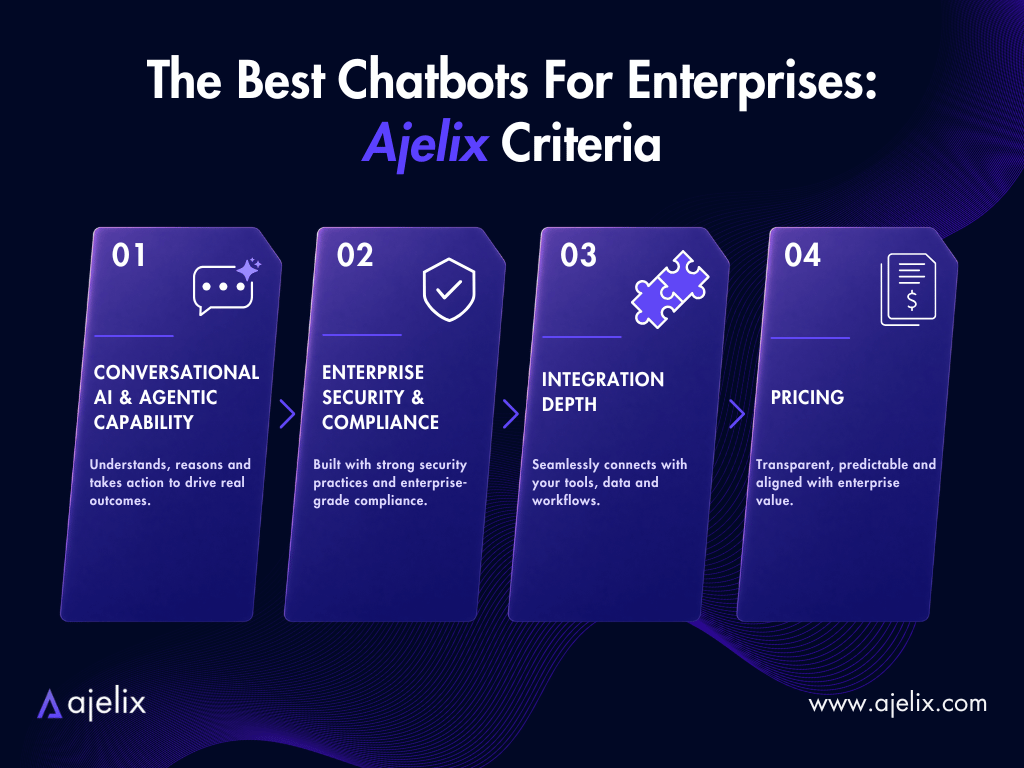
- Conversational AI & Agentic Capability: Can the chatbot handle long sessions and complete multi-step tasks? Is it autonomous enough to work through a task without involving a human at every step?
- Enterprise Security & Compliance: Does the chatbot offer role-based access and full audit trails? Does it hold all the necessary certifications, so that teams in regulated industries can use it? Can it be deployed on a private server or your own cloud?
- Integration Depth: Does it connect to other enterprise systems, either natively or through a custom API key? Can it reach CRMs, internal systems, data sources, and MCP servers?
- Pricing: Does the pricing stay predictable even if usage grows over time? Can you connect the platform to self-hosted LLMs for more control and customization?
Our core question throughout choosing the platforms was: would we implement this chatbot in our own company?
The 6 Best Chatbots For Enterprises Now
Here are the top 6 enterprise chatbot solutions, compared in a table overview:
| Platform | Best For | Key Features | Pricing Model |
| Ajelix Enterprise | Internal operations & company-specific workflows | RAG knowledge base trained on your own documentation Full audit trail, reasoning logs, granular RBAC Agentic chat with custom autonomous agents Flexible API provider | Custom enterprise contract |
| Microsoft Copilot Studio | Microsoft 365-native organizations | Generative answers grounded in SharePoint & Dynamics data 1,400+ connectors + MCP support AI-assisted topic authoring for non-technical users | From $200/mo (25K messages); $0.01/credit pay-as-you-go |
| IBM watsonx Assistant | Regulated industries requiring AI governance | Strong NLP (Natural Language Processing) accuracy RAG-grounded responses Audit trails, encryption, SOC 2 compliant | From $140/mo (1,000 users); custom enterprise pricing |
| Kore.ai | Multi-department, multi-agent orchestration | Master bot routes to department-specific sub-bots 300+ enterprise integrations (Salesforce, SAP, ServiceNow) SOC 2, GDPR, enterprise SSO; cloud and on-premise | Free tier (5K req/mo); custom enterprise pricing |
| Intercom Fin AI | High-volume customer support | Resolves up to 76% of tickets Performs actions: order lookups, account updates, cancellations RAG-grounded; 45+ languages; 300+ CRM connectors | $29-$132/seat/mo + $0.99 per resolved conversation |
| Zendesk AI | Teams already operating on Zendesk | Native integration with all Zendesk tools AI-powered ticket routing and intelligent triage SOC 2, GDPR, HIPAA compliant; 1,800+ integrations | From $55/agent/mo; Advanced AI add-on +$50/agent/mo |
Some immediate insights from the table:
- Intercom and Zendesk are specifically meant for customer service teams, while watsonx is designed for regulated industries. Other platforms are more generalist.
- The pricing for platforms is divided between fixed custom enterprise contracts depending on team size and usage, and per-resolution fees for seats. The latter can increase depending on consumption.
- The agentic and generative chatbots are the core of the AI product, and on them, the rest of the AI system is built.
Below, I cover what the enterprise chatbot platforms do well, what not so much, and who they’re built for.
1. Ajelix Enterprise
Who is it for? Business teams and enterprises that need a fully compliant AI platform with an agentic chat, custom agents, workflows and an API provider that connects to any external tool, platform and LLM.
- Pros: Their Enterprise plan is fully enterprise-compliant with granular RBAC, full audit trail and reasoning logs, usage monitoring and quota management. The custom agents and connectors are built around your company’s processes. Offers an option to self-host LLM or connect to any third-party API.
- Cons: Run by a smaller team than giants like Microsoft.
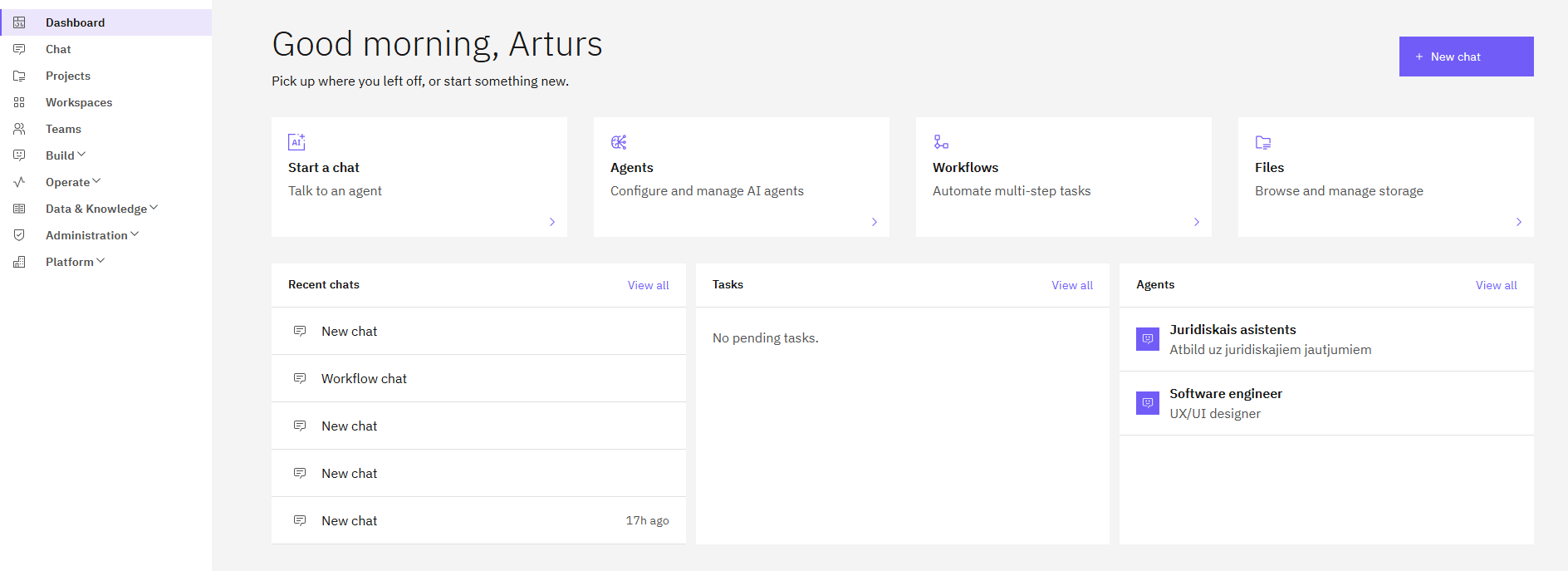
Ajelix has specialized in agentic AI and autonomous agents even before introducing their Enterprise plan. An agentic chatbot is included in all Ajelix tiers, with the Enterprise opportunity to also build custom agents depending on your organization’s needs.
Ajelix Enterprise is a transparent custom-priced contract depending on team size and usage – it offers a space to oversee the exact costs of your usage. Ajelix works with clients independently to customize workflows and make the company AI-native, regardless of industry.
Ajelix offers the options to self-host your own LLM and connect to any third-party source through an API key. A RAG system trained on your company’s documentation guides the AI to carry out processes that match your company’s standards and knowledge.
If you’re wondering what is the best chatbot for enterprises, Ajelix is likely your fit due to its versatility, enterprise-compliance, agentic and autonomous capabilities, and customization opportunities.

2. Microsoft Copilot Studio
Who is it for? Teams that are already deeply ingrained in Microsoft 365.
- Pros: 1,400+ business app connectors within a platform your employees are already familiar with.
- Cons: Locked to the Microsoft ecosystem. Consumption-based credit pricing makes enterprise costs difficult to forecast.
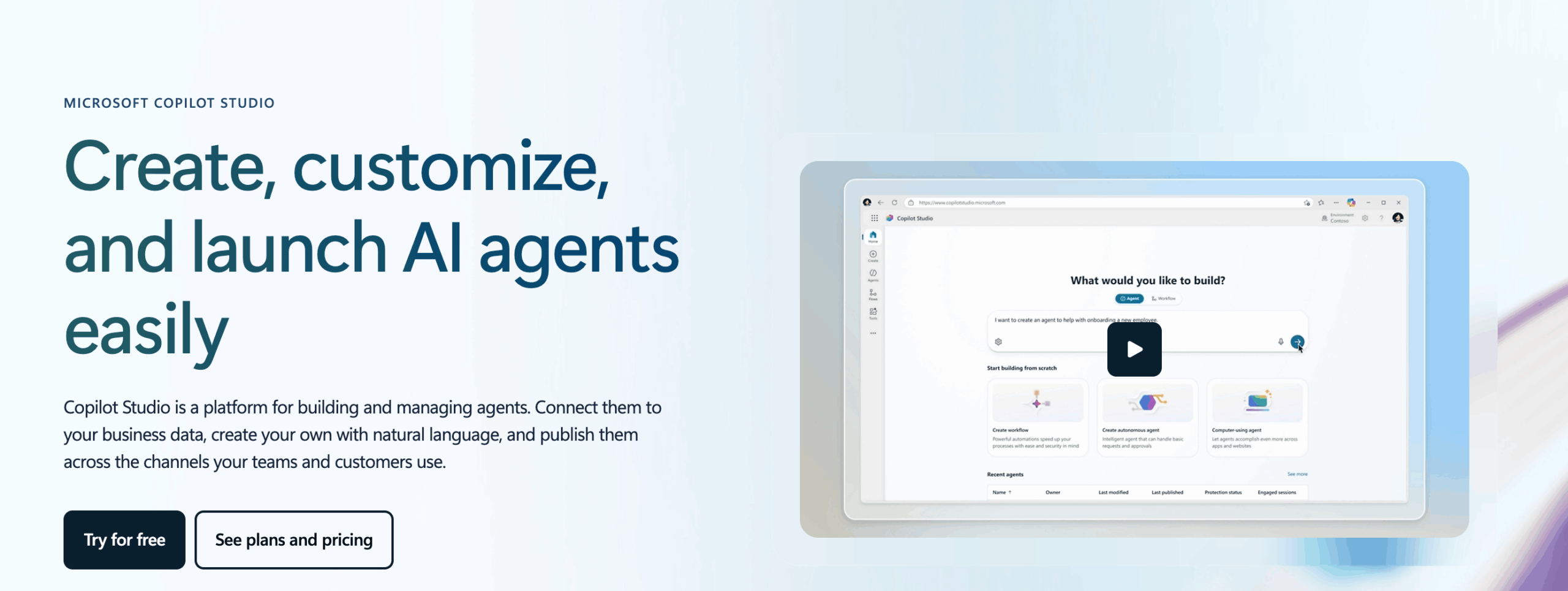
Copilot Studio scores high on enterprise compliance: SOC 2, ISO, HIPAA, audit logging, and DLP are built in as part of the Microsoft system.
Copilot’s agentic chatbot uses “Generative Actions” architecture where you give the agent a goal, instructions, and access to tools, and the agent autonomously determines the sequence of steps to complete the task. They also offer “Computer Use” to navigate legacy software interfaces that don’t have APIs.
The cost of Copilot can get high since you’re paying for both the Microsoft Office and the AI capabilities. This enterprise AI chatbot makes perfect sense if your team is already using Microsoft, but is a bigger commitment if you’re not.
3. IBM watsonx Assistant
Who is it for? Enterprises in regulated industries that need strong NLP accuracy, responses grounded in RAG, and IBM’s enterprise security infrastructure.
- Pros: Hallucination is low due to RAG and accurate NLP. IBM’s built-in security and compliance makes it a good fit for regulated industries. Hybrid deployment.
- Cons: Autonomous multi-step workflows require watsonx Orchestrate. Pricing is a custom enterprise contract with a high total cost of ownership.
IBM watsonx Assistant is the conversational AI component inside IBM’s watsonx Orchestrate platform. The chatbot interprets incoming messages and directs the conversation down the appropriate resolution path. It handles complex queries from large knowledge or data sets accurately, with a strong intent recognition.
watsonx Assistant connects natively to Salesforce, Genesys, Zendesk, WhatsApp, and Slack, and can deploy in any cloud or on-premise environment.
For teams in regulated industries who need compliance certifications and conversational accuracy above everything else, it’s the strongest fit on this list. It is truly an AI chatbot for enterprises, and not the best fit for smaller teams.
4. Kore.ai
Who is it for? Large enterprises with complex, multi-department chatbot needs.
- Pros: Multi-agent orchestration. Hybrid deployment options with enterprise-grade security, access control, and audit logging. Native integration with Microsoft environments.
- Cons: Requires developer expertise. High learning curve due to the multi-turn dialogue and orchestration logic.
Kore.ai’s chatbot handles conversations across WhatsApp, Teams, Slack, and web, with 250+ pre-built agents for banking, healthcare, retail, and IT that arrive with pre-trained intents and compliance-ready configurations.
Kore.ai’s chatbots capabilities are part of its Agent Platform for building, testing and hosting speech-enabled bots. It supports multi-agent orchestrations, with a master bot which routes specific tasks to sub-bots of the task’s purpose.
Kore.ai has a built-in sentiment analysis feature, which recognizes user emotions. It integrates natively with Microsoft environments including Azure AI Foundry, Teams, Microsoft 365 Copilot, and Copilot Studio.
Similarly to IBM’s watsonx Assistant, Kore.ai is a true enterprise bot, not the best fit for small teams.
5. Intercom Fin AI
Who is it for? High-volume customer support teams that want an AI agent focused entirely on resolving conversations autonomously.
- Pros: Up to 76% autonomous resolution rate (as reported by the vendor). Offers 45+ languages. RAG-grounded responses keep hallucinations low.
- Cons: Per-resolution pricing, which can be unpredictable. Knowledge sourcing is limited to your connected Intercom content.
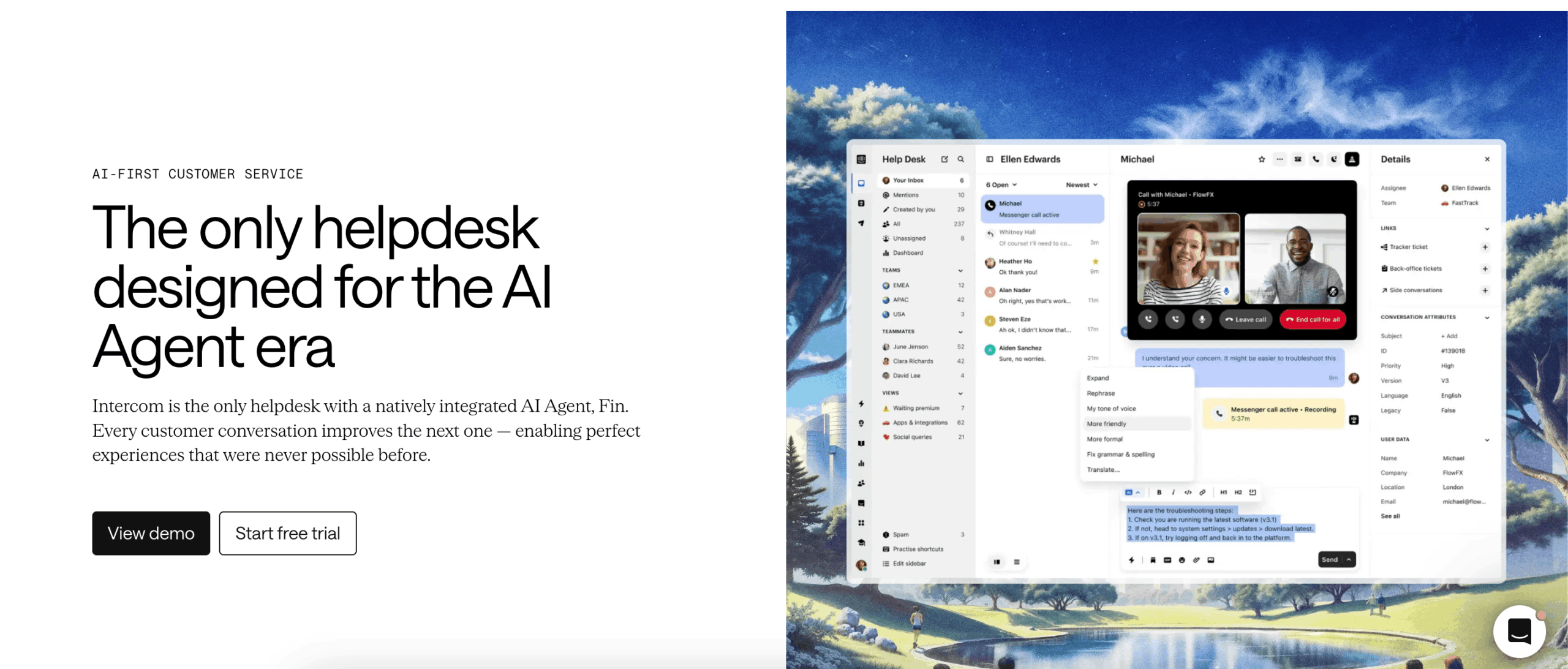
Fin’s chatbot gets its answers exclusively from your knowledge base rather than the open internet, which keeps it accurate and on-brand, even during times of high volume.
Fin 2 completes actions in connected systems and hands off to humans with full context when it can’t resolve. Coverage spans web chat, WhatsApp, Instagram, Facebook, email, phone, and SMS.
Worth noting: Salesforce recently reached an agreement to acquire Intercom, which may affect the product going forward.
6. Zendesk AI
Who is it for? Support teams already operating on Zendesk that want autonomous AI agents added directly into their existing ticketing and workflow infrastructure.
- Pros: Achieves up to 80% automation across voice, email, chat, and messaging. No-code Agent Builder lets teams build and deploy custom agents. 1,800+ integrations.
- Cons: Outcome-based pricing, which can be unpredictable. Only a good fit if you’re in the industry that already uses Zendesk.
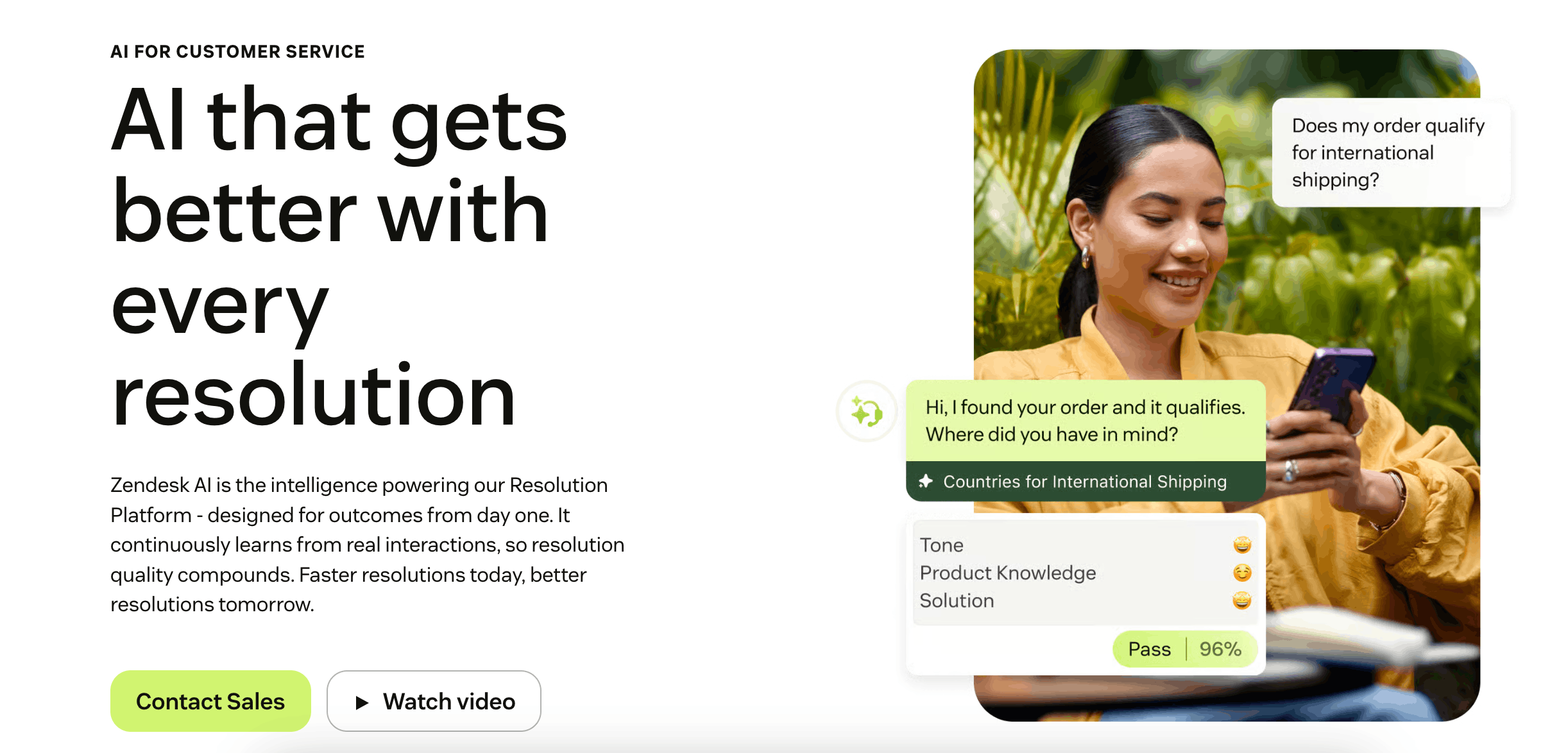
Zendesk AI’s chatbot is delivered through AI Agents, which are autonomous systems that resolve customer problems across all channels, including messaging, email, and voice. AI agents manage multi-step resolutions and perform actions across connected systems.
Their Resolution Learning Loop™ self-improves from every interaction, trained on approximately 20 billion ticket interactions. Voice AI Agents support 60+ languages, even with mid-conversation language switching.
For teams already on Zendesk, using Zendesk’s AI abilities makes perfect sense. For support operations not yet on Zendesk, the commitment required to unlock the best capabilities is much bigger.
Choose The Right Enterprise Chatbot For Your Needs
Now that we’ve looked at the top AI chatbot examples for enterprises, you should have a clearer idea about which one is the right fit for your company. But to help guide your decision further, we compiled a list of use cases.
| “I need a fully compliant AI platform with agentic chat, custom agents and workflows, a RAG system trained on my company’s documentation, granular RBAC, full audit trail, and the option to connect any LLM or external tool.”→ Ajelix Enterprise. Custom agents and connectors built around your company’s processes, with granular RBAC, full audit trail and reasoning logs, usage monitoring and quota management, and self-hosted LLMs plus any third-party API. Customized pricing with transparent usage oversight. Works regardless of industry. |
| “My organization is already deep in Microsoft 365 and I want an enterprise chatbot that lives inside the tools my team already uses.”→ Microsoft Copilot Studio. 1,400+ business app connectors, Generative Actions architecture where the agent autonomously determines steps to complete a task, and enterprise compliance built into the Microsoft trust layer. Keep in mind: consumption-based credit pricing makes costs harder to forecast. |
| “We operate in a regulated industry – banking, healthcare, or government – and need a chatbot with proven NLP accuracy, RAG-grounded responses, and IBM’s security certifications.”→ IBM watsonx Assistant. Strong intent recognition that holds up with fewer training examples, RAG that keeps responses grounded in your documentation, and a compliance stack covering SOC 2, HIPAA, encryption, and full audit logging. Deploys in any cloud or on-premise environment. Custom enterprise pricing with high total cost of ownership. |
| “We have multiple departments – customer service, IT helpdesk, HR – and need specialized AI agents coordinating with each other.”→ Kore.ai. Multi-agent orchestration routes tasks to department-specific sub-bots that execute in parallel, with 300+ enterprise integrations. Hybrid deployment with SOC 2, GDPR, and enterprise SSO. Native integration with Microsoft Azure AI Foundry and Teams. |
| “We have a high-volume customer support operation and want an AI agent that resolves conversations autonomously, and only charges us when it works.”→ Intercom Fin AI. Up to 76% autonomous resolution rate, RAG-grounded responses limited to your knowledge base to keep hallucinations low. Covers web chat, WhatsApp, Instagram, Facebook, email, phone, and SMS. Per-resolution pricing. |
| “Our support team already runs on Zendesk and we want autonomous AI agents layered directly into our existing ticketing and workflow infrastructure.”→ Zendesk AI. AI Agents trained on approximately 20 billion ticket interactions, with a Resolution Learning Loop™ that self-improves from every interaction. Achieves up to 80% automation across voice, email, chat, and messaging. No-code Agent Builder, 1,800+ integrations, and SOC 2, GDPR, HIPAA compliance. Only makes sense if Zendesk is already your support infrastructure. |
If Ajelix sounds like the right fit for your company, contact us.
FAQ
An enterprise chatbot is an AI-powered conversational system built for large organizations. It connects to your internal systems, such as CRM, knowledge base, documentation, and includes access controls, audit trails, and compliance certifications.
Regular chatbots handle simple, scripted interactions. Enterprise chatbots handle multi-step workflows, operate across departments, comply with regulations like SOC 2 and HIPAA, and integrate deeply with external tools.
RAG (Retrieval-Augmented Generation) means the chatbot answers by retrieving information from your own documentation rather than generating responses from general training data. It keeps answers accurate, on-brand, and less likely to hallucinate.
It depends on the platform and pricing model. Platforms like Ajelix Enterprise use custom contracts based on team size and usage. Per-resolution models like Intercom charge $0.99 per resolved conversation.
IBM watsonx Assistant is the strongest fit for banking, healthcare, and government. It offers RAG-grounded responses, strong NLP accuracy, and a compliance stack covering SOC 2, HIPAA, encryption, and full audit logging. It also deploys in any cloud or on-premise environment.
It varies. Copilot Studio and Zendesk AI offer no-code builders accessible to non-technical users. Kore.ai and IBM watsonx typically require developer expertise to configure correctly. Platforms with more complex orchestration logic naturally have a steeper learning curve.
An agentic chatbot autonomously executes multi-step tasks without requiring human input at every stage. For enterprises, this means the chatbot can complete processes like order lookups, account updates, or internal approvals from start to finish.
Yes, most platforms on this list offer deep integration libraries. Copilot Studio has 1,400+ connectors, Zendesk has 1,800+, and Kore.ai connects natively to Salesforce, SAP, and ServiceNow. Platforms like Ajelix also support custom API connections to any external tool or LLM.
Agentic AI chat that helps you complete projects
AI for work that ingests, transforms, and delivers the exact deliverables your team needs, while you stay focused on strategy. No more chatting, agents can get the job done.