The 5 Best Enterprise AI Agents of 2026 (Reviewed By Our Team)

These days, it’s hard to imagine how a company would function without the help of AI. But implementing it from scratch is a huge financial and strategic move. How do you pick the best enterprise AI agents?
The best AI should fit the needs of your specific business. You will likely need to browse several options and talk to multiple AI providers until you find what works for you.
Use this guide to start the process.
AI Agents For Enterprises: What Are They
AI agents execute workflows on their own – planning, deciding, using tools, checking results and more. This autonomy is how you go from a prompt to a finished project, for example, a PowerPoint presentation.
AI agents in enterprise plans tend to:
- Reach and navigate the systems your company uses;
- Use predefined rules – including your company’s policies and knowledge base, to control what they can access and work with;
- Are capable of working across your whole company;
- Understand both structured and messy data.
An enterprise AI agent is more powerful than a regular AI agent, while the core capabilities, such as planning, deciding, using tools and delivering work, remain the same. Enterprise agents:
- Connect to your company’s internal systems through secured APIs, not just use public web tools;
- Operate inside role-based access controls, in order for each employee to only see and do what their permissions allow.
Privacy controls are much stronger to protect the company data and processes, and actions the agent takes are logged for audit.
What Makes The Best Enterprise AI Agent: My Criteria
I reviewed over 10 best-rated Enterprise AI agents. Some had to leave my list, until I landed on the top 5 worth knowing about.
My most important question in the evaluation process was: “Would I use this for my own company?” But to make the decision more foolproof, I based my analysis on these six criteria:
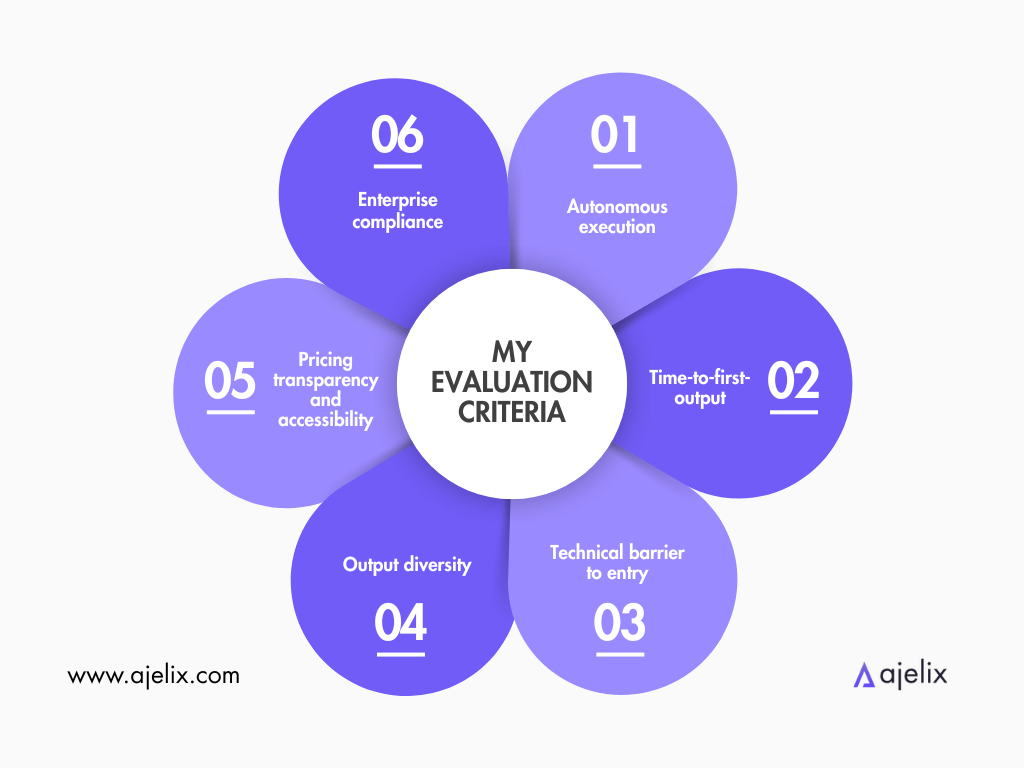
Autonomous Execution. Do the AI agents produce finished work and projects? The agents should give you something you can already use and only review to make sure the information is correct.
Time-to-first-input. How long does the implementation of enterprise AI take? It’s only appropriate that IT teams will need to work on connecting the agents with your company’s platforms, but this timeframe should be reasonable.
Technical barrier to entry. Can any employee of your company use the AI? If the learning curve is too high, rather than something you can learn with a day’s training session, it’s too inaccessible.
Output diversity. Can the AI agents execute workflows that your employees use? Presentations, spreadsheets, web pages, visual material, analysis – whatever deliverables are needed.
Pricing transparency and accessibility. The latest technology will always have a price, but is the price reasonable for your company’s budget? How deep into your communication with the AI platform will you find out the costs?
Enterprise compliance. Especially for regulated industries, with sensitive data, it’s crucial that the AI is safe to use. What privacy and safety controls does the enterprise AI platform have?
The Top 5 Enterprise AI Agents Now
Here are my Top Enterprise AI Agents at a Glance:
| AI Agent | Best For | Key Features | Pricing Model |
|---|---|---|---|
| Ajelix | Pricing transparency and accessibility | Custom agents and connectors for enterprise work Knowledge base with company documents Custom workflow designer The ability to monitor usage and manage quotas Granular Role-Based Access Control Human in the loop and built-in guardrails Full audit trail and reasoning | Custom: Enterprise Contract |
| Microsoft Copilot Studio | Enterprise compliance | Plugs into 1,400+ business apps Autonomous and multi-agent orchestration Built-in security and compliance for regulated industries | Platform add-on |
| Salesforce Agentforce | Enterprise compliance | Built-in guardrails: masks sensitive data, blocks manipulation, and lets a human review before risky actions Works directly on your live data in Salesforce, Snowflake, and BigQuery | Outcome-based + seat |
| Gemini Enterprise Agent Platform | Output diversity | Build agents visually (no code) or programmatically Access 200+ AI models, including Gemini, Claude, Llama, and Gemma Agents can talk to each other, follow governance rules, and share reusable skills | Consumption-based |
| Amazon Bedrock AgentCore | Pricing transparency and accessibility | Works with any major agent framework Agents remember context across sessions and stay within safety rules you set Every session runs in isolation, with full visibility into what happened for auditing | Engineering cost |
No single enterprise AI agent platform excels at all six criteria. Each platform here represents their own area of expertise, though their main solution is the implementation of agentic AI in a company’s processes.
Some immediate insights from the table overview:
- Copilot and Salesforce’s strengths are in compliance, but they both get there through their own established platforms.
- Ajelix is the most generalist tool, with key features that others don’t specialize in.
The rankings reflect full-workflow performance, not a single standout feature.
Below, I cover what each one does well, what not so much, and who it’s built for.
1. Ajelix
What teams is it for? Business teams that need finished projects and custom workflows.
- Pros: Any employee can use it with minimal training. Produces finished work.
- Cons: Run by a significantly smaller team than giants like Microsoft, Amazon and Google.
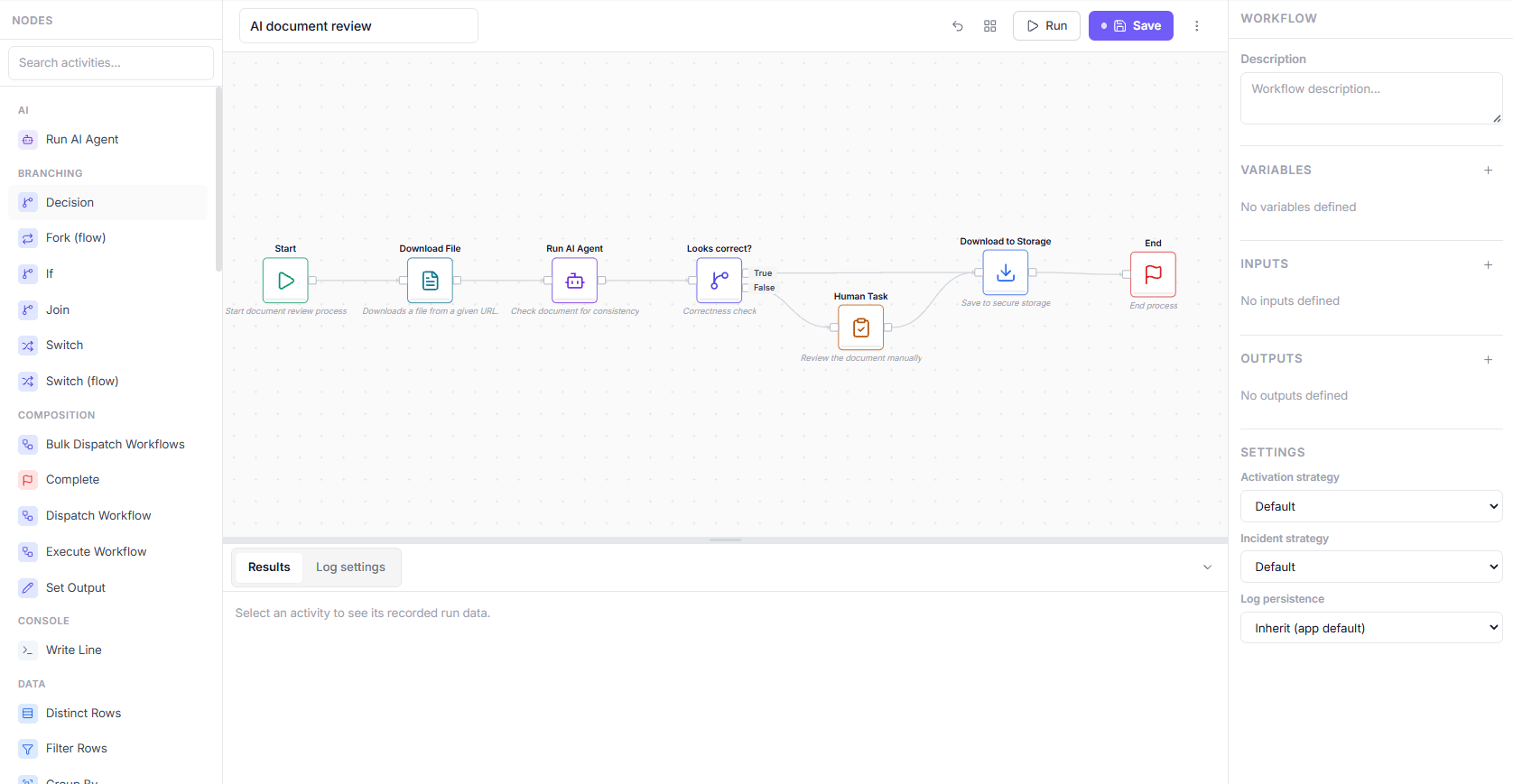
Ajelix ranks highest in the list of enterprise AI agents due to its versatility. Ajelix is an operational layer for enterprise AI needs. It has high security guardrails – both for user privacy and company data privacy. The ability to perform audits and reason them, monitor usage, and manage quotas makes the work transparent and under your control. Role-based access controls ensure that each employee can only use what is relevant to their work.
Ajelix works with clients independently to help companies become AI native, so each workflow can be customized to meet your needs. Additionally, you have the ability to create custom agents and connectors. The knowledge base featuring your company’s documentation guides the AI agents in the creation of deliverables that fit your company’s processes.
Ajelix offers self-hosted LLMs, and also the flexibility to use any API from any provider that the enterprise prefers. This makes it a convenient platform that allows flexibility and doesn’t tie clients to one LLM provider only. It’s also an option to place the full Ajelix platform (or, if preferred, only certain components) inside the enterprise’s servers. This makes Ajelix have the best AI agents for enterprise task automation.

2. Microsoft Copilot Studio
What teams is it for? Teams already using Microsoft 365.
- Pros: 1,400+ business app connectors within a platform your employees are already familiar with.
- Cons: Locked to the Microsoft ecosystem. Pricing rises fast across seats and credits.
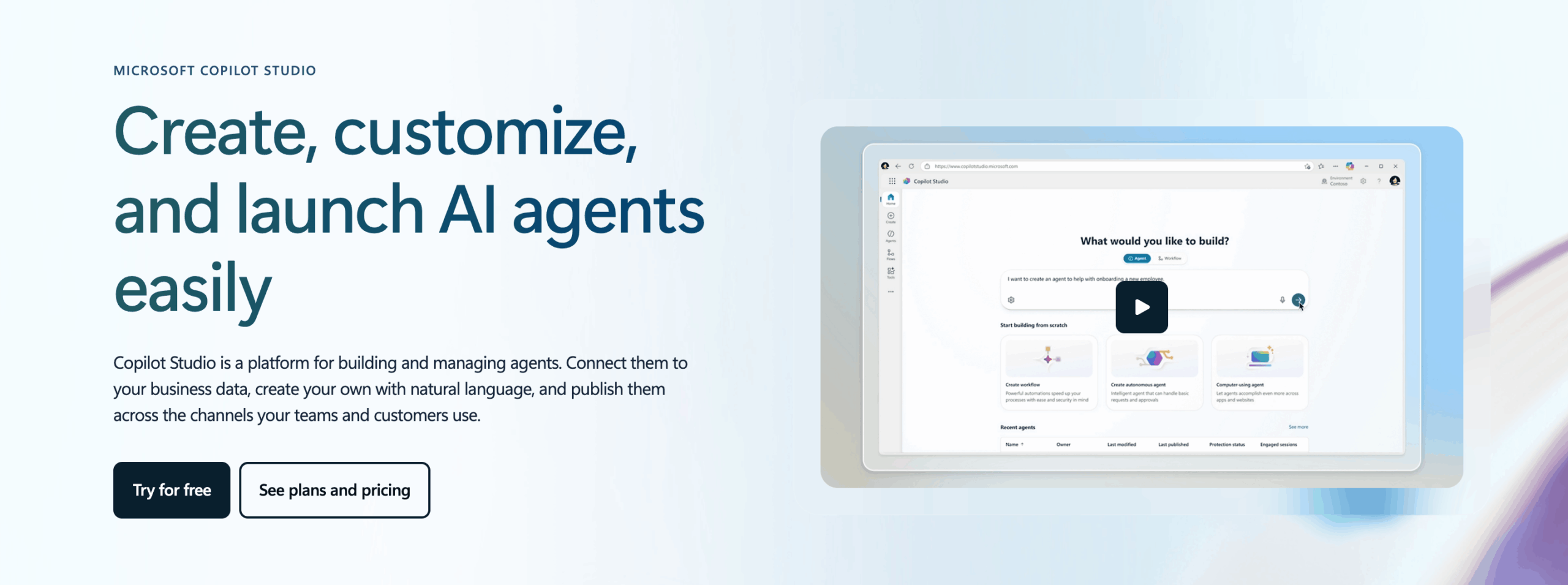
Copilot Studio scores high on enterprise compliance: SOC 2, ISO, HIPAA, audit logging, and DLP are built in as part of the Microsoft system. Simple bots can be built in hours, but capable agents can take several weeks, with the governance review. Overall, the time-to-first-output is reasonable for a platform with as much scope as Microsoft. This scope is what makes Copilot the best enterprise AI agent for large businesses already within the Microsoft workspace.
No-code agent building is available and can be learned by regular business users, but anything more complex becomes your IT team’s responsibility.
The cost of Copilot can get high since you’re paying for both the Microsoft Office and the AI capabilities.
3. Salesforce Agentforce
What teams is it for? Customer-service and sales teams whose data is already established inside Salesforce.
- Pros: Sophisticated reasoning engine with full decision logging. Cost aligns with the work done.
- Cons: Locked to Salesforce. Requires significant Salesforce investment first.
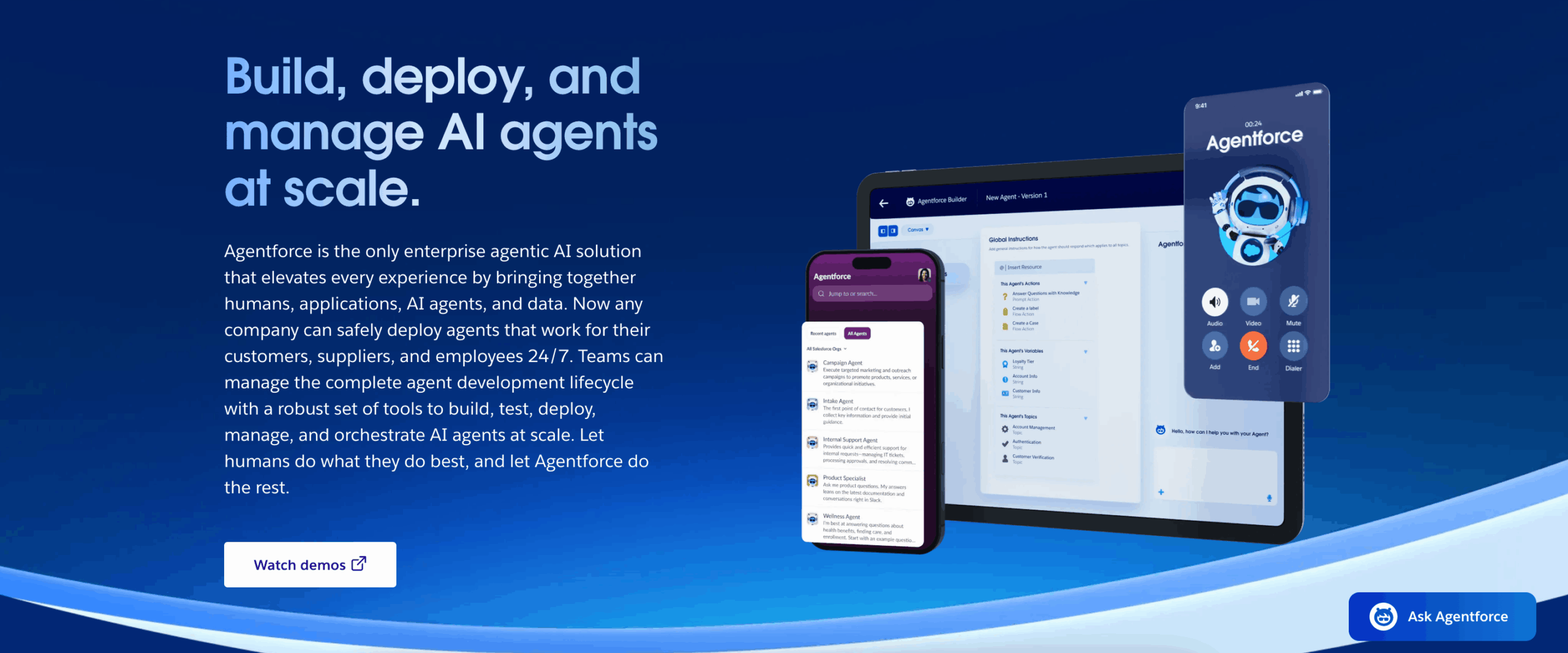
Agentforce combines autonomous execution with strong enterprise compliance: every agent decision is logged in a full audit trail and humans review risky actions. LLM data masking is currently disabled for Agentforce agents (Salesforce states agent performance and accuracy as the reason), but traffic remains encrypted in transit and covered by zero-data-retention agreements with model providers.
Time-to-first-input depends on your existing Salesforce setup – pre-built agents from AgentExchange can launch in days to weeks for organizations already on Sales Cloud or Service Cloud with clean data. Admin or IT-level knowledge becomes necessary for anything beyond pre-built agents. Data Cloud is required for more advanced building.
Salesforce’s per-action pricing ($0.10 each) is easy to understand on its own. But you have to choose between two billing models – pay per action or user – and you can’t mix them in the same account. Extra costs like Data Cloud credits come in separately, so the number you budgeted might not match the invoice.
4. Gemini Enterprise Agent Platform
What teams is it for? Google Cloud-established engineering teams that want the most model choices available.
- Pros: 200+ models available. Agents can communicate with each other natively.
- Cons: The no-code Agent Designer handles simpler workflows, but anything involving multi-step reasoning, custom data pipelines, or external API orchestration pushes you to the code-first kit.
Gemini’s agents can synthesize data from BigQuery, Salesforce, and Drive into coherent documents, presentations, and reports. You can use pre-built agents, such as NotebookLM Enterprise and Deep Research, from day one, in addition to custom agents that fit your company’s workflows. The Agent Development Kit is code-first, meant for engineering teams.
On output diversity, Gemini covers text, images, video, emails, and reports across marketing, sales, engineering, HR, and finance. Your tasks are rooted to the appropriate model.
Enterprise compliance is strong: you own your data, and you don’t need to worry about Google using it for model training. Every agent gets a cryptographic identity, and the Agent Gateway enforces security policies across the platform.
5. Amazon Bedrock AgentCore
What teams is it for? AWS-native engineering teams willing to own the full stack of agents.
- Pros: Works with any major framework – has no vendor lock-in.
- Cons: Hardest platform on this list to deploy and operate.
Autonomous execution is a core process with Bedrock – the built-in Code Interpreter can generate files, charts, and visualizations, and agents can fill web forms and extract data via the Browser tool. But as with Gemini, devs need to work on it first.
Time-to-first-output is faster than expected, but only once the engineering work is done. Someone has to design, build, and test the agent logic first, and hardening the production (observability dashboards, cost controls, policy enforcement) adds further effort.
Enterprise compliance is strong, with session isolation, VPC support, Bedrock Guardrails, and full audit logging via CloudWatch. It is the best company for building enterprise AI agents on this list.
How To Choose The Right Enterprise AI For Your Business Needs
As we’ve established in this article, the right enterprise platform depends mostly on what it is your company needs, as well as your existing IT and technical manpower. For the first reason, I compiled all the platforms on my list based on their use cases.
| “I need to turn raw company data into finished deliverables – reports, dashboards, spreadsheets, apps, websites – without an IT project.”→ Ajelix. The only platform on this list that takes your data and returns ready-to-use files without a developer required. Built for business teams who need output, not advice, with custom integrations and agents based on your needs. |
| “My company runs on Microsoft 365 and I need AI that fits inside our existing stack, with deep integrations and full compliance.”→ Microsoft Copilot Studio. Native integration across Word, Excel, Teams, Outlook, and Dynamics 365. SOC 2, ISO, GDPR, and HIPAA built in. The safest pick if you’re already in the Microsoft ecosystem and can’t compromise on security review. |
| “I need AI agents that handle customer service, sales outreach, and CRM workflows automatically.”→ Salesforce Agentforce. The Atlas Reasoning Engine runs a plan-act-reflect loop on your live CRM data. The strongest pick when customer experience is the core of your business. |
| “I want the widest model choice for custom agents – and I have engineers for the complex parts.”→ Gemini Enterprise Agent Platform. 200+ models available, including Gemini, Claude, Llama, and Gemma. The right pick when model variety and multi-agent architecture matter most. |
| “I want full control over agent infrastructure on AWS, with frameworks and models of my choice.”→ Amazon Bedrock AgentCore. Framework-agnostic, with infrastructure-level security that agents can’t bypass. The right pick for AWS-native engineering teams who want to own the entire stack. |
| “I’m not sure where to start and want something my whole team can use on day one of implementation.”→ Ajelix. Any employee can describe what they need and get a finished deliverable back. Start there. The enterprise features – custom connectors, audit trails, workflow designer – are built in. |
If Ajelix sounds like the right fit for your company, contact us.
FAQ
An enterprise AI agent is a system that autonomously plans, decides, uses tools, and delivers finished work – all integrated into your company’s existing platforms, data, and security policies. Unlike a chatbot that answers questions, an enterprise agent acts on your business systems, follows role-based access rules, and produces deliverables your employees can use.
It depends on your needs. Ajelix ranks first for autonomous execution and output diversity – it hands business users finished files. Microsoft Copilot Studio leads on compliance if you’re already on Microsoft 365. Salesforce Agentforce is strongest for CRM-driven customer workflows. There is no single best agent; there is only the best agent for your workflows.
Pricing varies widely by model. Ajelix uses a custom enterprise contract based on team size. Microsoft Copilot Studio is a platform add-on, plus credit packs. Salesforce Agentforce charges per action or seat. Gemini and Bedrock are consumption-based, meaning you pay for what you use, but costs can be hard to predict without a pilot.
It depends on the platform. Microsoft Copilot Studio typically takes several weeks for initial results. Salesforce Agentforce’s timeline depends on your existing Salesforce setup. Gemini and Bedrock require an engineering team to design and deploy agents before anyone sees output.
Microsoft Copilot Studio and Salesforce Agentforce both carry SOC 2, ISO, HIPAA, audit logging, and data loss prevention. Ajelix is GDPR-compliant with strict data privacy policies, and an enterprise-ready encryption. Gemini and Bedrock offer infrastructure-level security, session isolation, and governance controls. Always check with your compliance team before deployment.
It depends on the platform. Ajelix is built for business users – describe what you need and get a finished file back. Copilot Studio offers a no-code canvas for basic agents but needs IT for complex workflows. Agentforce works quickly if your Salesforce data is set-up and clean, but custom workflows need admin knowledge. Gemini offers pre-built agents and a no-code Agent Designer for simple use cases, but custom workflows push you to the code-first Agent Development Kit. Bedrock has no no-code option – an engineering team must build and deploy every agent first.
Start with your primary use case. If you need finished deliverables fast, start with Ajelix. If you’re already using Microsoft 365, Copilot Studio is the natural fit. If customer service and CRM are your core, choose Agentforce. If you have an engineering team and want model flexibility, look at Gemini. If you want full infrastructure control on AWS, Bedrock is your pick.
Agentic AI chat that helps you complete projects
AI for work that ingests, transforms, and delivers the exact deliverables your team needs, while you stay focused on strategy. No more chatting, agents can get the job done.


