What Is AI Orchestration? A Complete Guide

Agentic AI is supposed to make your mundane, repetitive tasks easier. When multiple AI models, agents and workflows become involved, it can end up feeling hectic.
This is where AI orchestration comes in. It’s the layer that connects models, tools, data sources, and agents into coherent, goal-driven workflows, so that your tasks get done soundly.
Table of Contents
What Is AI Orchestration?
AI orchestration is the system that connects AI models, data processes, tools, and human inputs into unified workflows. Rather than running each AI system in isolation, orchestration makes them work together – routing tasks, managing dependencies, enforcing governance, and tracking outcomes end to end.
Think of it as the conductor of an orchestra. Individual AI models are capable instruments on their own, but without a conductor directing timing and sequence, the results are messy. The orchestrator ensures every component plays its part at the right moment.
Basic workflow automation follows fixed, predefined rules. Meanwhile, AI orchestration adapts to context, handles failures gracefully, and can make routing decisions based on appropriate conditions.
If you’re already familiar with AI agents or agentic AI, see how these concepts connect in the sections below.
If not, I suggest reading this article first → Agentic AI VS AI Agents.
How It Works: Architecture & Components
AI orchestration works by routing a user input or trigger through a central orchestrator. This:
- breaks the goal into tasks,
- assigns them to the right models/tools,
- manages the flow of information between them,
- monitors the outcome.
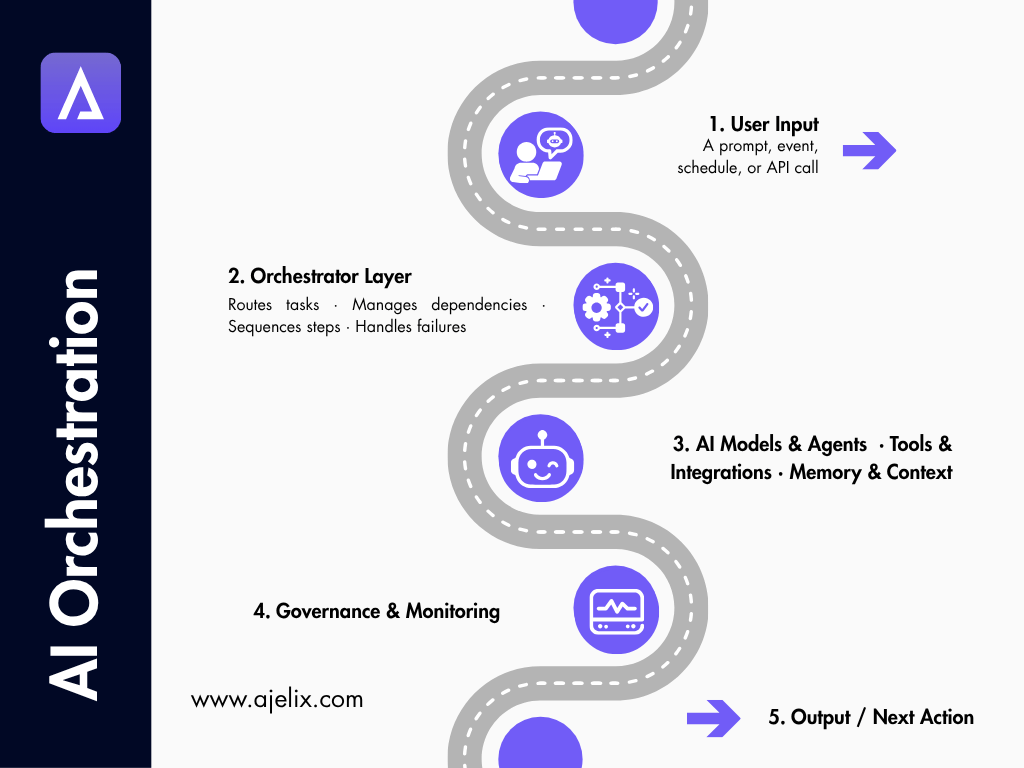
The Orchestrator is the decision-making core. It receives an input, determines what needs to happen, and coordinates every subsequent step. It doesn’t execute tasks itself, but delegates, sequences, and manages dependencies between components.
AI Models & Agents are the workers. Each model or AI agent handles a specific task – generating text, analyzing data, calling an API, or making a decision. In advanced setups, agentic AI systems reason and act autonomously across multiple steps.
Tools & Integrations: Orchestration systems connect to external services – databases, APIs, search tools, code executors – giving agents the ability to act beyond just generating output.
Memory & Context: Short-term memory keeps track of what’s happening within a single run. Long-term memory allows the system to retain information across sessions. Without this layer, multi-step tasks fall apart quickly.
Governance & Monitoring keeps everything in check. It controls access, logs every action, prevents runaway processes, and flags steps that need human review.
AI Workflow vs. Agent Orchestration
The core difference is that workflow orchestration tells the system what to do and when. Agent orchestration tells it what to achieve and lets it decide how.
AI Workflow Orchestration is structured and predictable. You define the steps upfront: task A triggers task B, task B passes output to task C. It suits repeatable, rules-based processes, such as data pipelines, scheduled reporting, and automated approvals.
Agent Orchestration decides as it goes. The orchestrator delegates goals to AI agents that reason, use tools, and adapt mid-task. The path isn’t predefined, rather the agent determines it based on context.
| AI Workflow Orchestration | Agent Orchestration | |
|---|---|---|
| Approach | Predefined, step-by-step execution | Goal-driven, adaptive reasoning |
| Control Flow | Path fixed at design time | Path determined at runtime |
| Decision Making | Rule-based logic and conditional branching | LLM-powered judgment and planning |
| Flexibility | Low – structured and rigid | High – adapts to context |
| Predictability | High – same input = same output | Medium – varies by reasoning |
| Best For | Repeatable tasks: pipelines, reporting, approvals | Complex tasks: research, analysis, multi-step decisions |
| Tool Use | Tools called in a fixed sequence | Agents select and chain tools autonomously |
| Multi-Agent | Not typical – single orchestrator model | Native – specialists coordinated by an orchestrator |
| Failure Handling | Explicit fallback rules and retries | Agents self-correct or re-plan on failure |
| Examples | Zapier, n8n | Ajelix, CrewAI |
Multi-agent orchestration takes this further. When a task is too complex for one agent, the orchestrator splits work across specialists. One handles retrieval, another analysis, another output. Each owns a role; the orchestrator keeps them in sync.
In practice, most enterprise systems use both. Workflow handles the structured parts. Agents handle what requires judgment.
At Ajelix, we apply this same principle. Structured workflows handle the repeatable layer – saved prompt templates that re-generate a monthly report with one click. The agent decides how to process the data, which steps to take, and how to produce the output. The workflow defines when, the agent decides how.
What Is Orchestration in Agentic AI?
Orchestration, in the context of agentic AI, is what manages how multiple AI agents work together toward a shared goal. It’s not an agent itself, but rather the structure that decides which agent does what, when, and in what order.
A single AI agent can handle a task without depending on other systems. But once a process requires judgment at multiple points – different sources, mid-task adaptation – a single agent isn’t enough.
When multiple agents need to work one after another, something has to connect them. Without that, each agent finishes its job and passes the result forward, but there’s no system keeping track of the full picture. If one agent fails or produces a bad output, the next one has no way of knowing. The error just carries through, and nothing flags it or explains what went wrong.
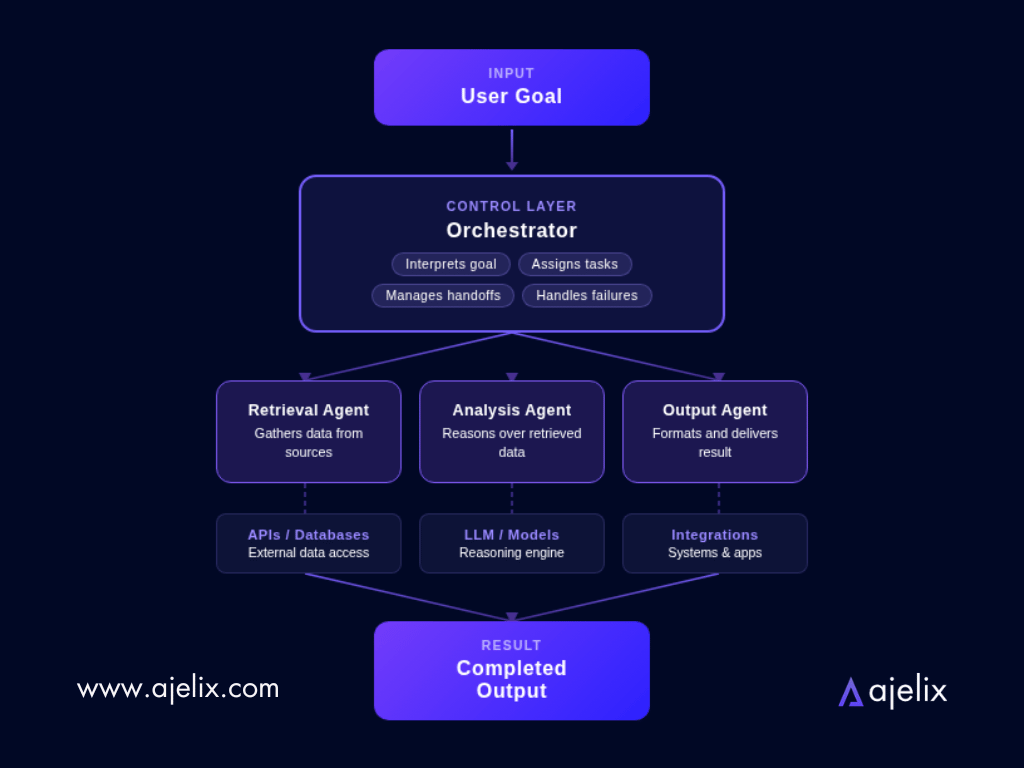
The orchestrator receives a goal, breaks it into tasks, assigns each task to the right agent, and oversees the transitions between them. It also tracks progress, controls resource usage, monitors data flow, and handles failure events.
The entire process runs end to end – meaning, when something goes wrong, the agents adjust without needing to be told.
Three components make this work:
- The Orchestrator coordinates sequencing and keeps every agent on track.
- Specialized Agents: Autonomous units each responsible for a distinct task (retrieval, analysis, output, etc.).
- Tools & Integrations: The APIs, databases, and systems agents interact with to do their work.

AI Orchestration Frameworks & Tools: Open-Source and Cloud-Managed
Open-Source Frameworks are codebases you download, run, and maintain yourself. You own the infrastructure, the data, and the configuration.
Cloud-Managed Platforms are services you subscribe to. The provider handles infrastructure, hosting, scaling, and maintenance.
Open-Source Frameworks
| Dimension | LangGraph | CrewAI | n8n |
|---|---|---|---|
| Deployment | Self-hosted | Self-hosted / Cloud | Self-hosted |
| Setup Complexity | High | Medium | High |
| Data Ownership | Full | Full | Full |
| Multi-Agent Support | Yes | Yes | Partial |
| No-Code Option | No | Partial | Partial |
| Customisability | Full | Full | Full |
| Cost Model | Free + infrastructure | Free / $99+/mo | Free + infrastructure |
| Developer Required | Yes | Yes | Yes |
| Best For | Complex branching workflows | Role-based agent teams | Full data control, developer teams |
LangGraph structures workflows as directed graphs where each node* is an agent or processing step. Built for non-linear workflows: agents can loop, branch, pause for human review, and resume.
Author’s Note. A node is just a single step in the workflow – one agent, one function, or one action.
CrewAI organises agents by role – researcher, writer, analyst – then sequences their tasks. It’s the fastest entry point for teams without dedicated AI engineering.
n8n handles complex, code-level workflow logic across hundreds of integrations. It’s meant to be used by developers and requires self-hosted infrastructure.
Cloud-Managed Platforms
| Dimension | Zapier | Microsoft Copilot | Manus AI |
|---|---|---|---|
| Deployment | SaaS | SaaS / Microsoft 365 | SaaS |
| Setup Complexity | Low | Low | Low |
| Data Ownership | Provider holds data | Partial (M365 compliance) | Provider holds data |
| Multi-Agent Support | No | Partial | Yes |
| No-Code Option | Yes | Yes | Yes |
| Customisability | Limited | Limited | Limited |
| Cost Model | From $20/mo | $30/u/mo | Usage-based |
| Developer Required | No | No | No |
| Best For | No-code app automation | Microsoft 365 enterprise | Hands-off autonomous tasks |
Microsoft Copilot integrates natively with Word, Excel, Outlook, and Teams. It has strong enterprise compliance control. It performs best with explicit, guided instructions, not open-ended goals.
Manus AI accepts a complex goal and executes it with minimal prompting. A limitation is transparency – users have limited visibility into intermediate reasoning, which matters for regulated environments.
Zapier connects 6,000+ apps via triggers. It moves data between tools reliably but cannot plan or adapt to ambiguity. Best for no-code automation of repetitive, structured workflows.
Where Ajelix Fits in AI Orchestration
Ajelix operates as a single-agent workspace. One agent receives a goal, plans the steps, uses its tools, and returns a finished file. It handles complexity through depth, not distributed coordination.
As of September 2026, Ajelix offers an enterprise platform with multi-agent orchestration.
How to Choose the Right Approach
The right choice depends on four factors:
- Your technical capacity,
- Whether you need workflow predictability or agent flexibility,
- Your data ownership requirements,
- The complexity of the tasks you’re automating.
Use these questions to guide your decision:
→ Do you have developers on your team? If not, rule out LangGraph, CrewAI, and n8n. All three require engineering expertise to deploy and maintain. Start with Ajelix, Zapier, Microsoft Copilot, or Manus AI.
→ Do you need to connect hundreds of third-party apps via triggers? Zapier is built for this. If your use case is connecting tools with fixed rules, it’s the most direct path.
→ Are you deep in the Microsoft 365 ecosystem? Microsoft Copilot integrates natively with Word, Excel, Outlook, and Teams. If your team already lives in M365 and needs AI assistance within those tools, Copilot is the natural fit.
→ Do you need full data ownership and open-source infrastructure? LangGraph and n8n are the right options. Both are fully self-hosted with complete control over your data, configuration, and infrastructure. LangGraph suits complex workflows; n8n suits teams that need broad integration coverage on their own servers.
→ Do you need role-based multi-agent coordination with some developer flexibility? CrewAI organises agents by role and is the fastest entry point for teams with some engineering capacity. It also offers a cloud option if self-hosting is too heavy.
→ Do you want to hand off a complex goal and get back a finished result with minimal setup? Ajelix and Manus AI are both designed for this. Ajelix is purpose-built for document and data work. Manus handles broad autonomous tasks with minimal prompting.
If you’re evaluating tools for the first time, the clearest distinction is developer dependency. Remember, Open-source frameworks offer control but require significant setup and ongoing maintenance, while Cloud-managed platforms trade that control for speed and simplicity.
Ajelix combines the goal-driven flexibility of agentic AI with the simplicity of a managed multi-tenant platform.
FAQ
AI orchestration is the system that connects AI models, agents, data pipelines, and tools into unified workflows so complex tasks get done reliably. It handles routing, dependencies, governance, and outcome tracking, rather than running each AI system in isolation.
Workflow orchestration follows a predefined sequence you define upfront; agent orchestration gives AI agents a goal and lets them decide how to achieve it. Most enterprise systems use both – workflows handle repeatable steps, agents handle anything that requires judgment.
It depends on the tool. Open-source frameworks like LangGraph, CrewAI, and n8n all require developer expertise to deploy and maintain. Cloud-managed platforms like Ajelix, Zapier, Microsoft Copilot, and Manus AI are built for non-technical users.
The orchestrator is the coordination layer that receives a goal, breaks it into tasks, assigns each task to the right agent, and manages the transitions between them. It doesn’t execute tasks itself, but sequences, delegates, and oversees them.
Without memory, multi-step tasks lose context between steps. Short-term memory tracks what’s happening within a single run; long-term memory lets the system retain information across sessions.
Open-source frameworks give you full control over infrastructure and data but require you to set up, host, and maintain everything yourself. Cloud-managed platforms handle all of that for you, at the cost of reduced customization and data ownership.
Start with two questions: do you have developers on your team, and do you need full data ownership? If no to both, a managed platform is the right path. If yes to either, open-source frameworks give you the control, but plan for the engineering overhead.
Agentic AI chat that helps you complete projects
AI for work that ingests, transforms, and delivers the exact deliverables your team needs, while you stay focused on strategy. No more chatting, agents can get the job done.