4 Agentic AI Trends in 2026 You Must Know
Autonomous AI is evolving fast across operations, marketing, and beyond, and keeping up is a real challenge for leaders in 2026. Among all the trends, agentic AI is moving the quickest and changing how organizations work. This guide to agentic AI trends in 2026 explains what is changing and why it matters, whether you are just starting out or already using agents more in your workflows.
What is Agentic AI?
Agentic AI refers to systems that can act on their own. They can set goals, break tasks into steps, use tools, make decisions, and complete actions without needing constant human input. In simple terms, it is AI that does not just respond, it actually gets things done.
How it’s different from what we had before
Until recently, most AI worked like smart assistants. You ask something, it answers. You ask again, it answers again. Agentic AI works differently – it can figure out what to do next on its own, take action, check the result, and so much more.
This changes what AI can be used for. Instead of only helping with one task at a time, it can take care of an entire workflow from start to finish. That is exactly what we built Ajelix around. Instead of constantly asking AI questions and going back and forth, you can just give it the whole task.
What companies often overlook
A lot of teams still treat AI like a tool that just sits there and waits for instructions. That works for older systems, but not really for agentic AI. With this kind of AI, you need to think through how you want it to work:
- What should it handle on its own?
- When should a human step in?
- How do you check if it is doing a good job?
We see this a lot with teams using Ajelix. The ones getting real value decide what they want out of it, set a few checkpoints where it matters, and then let it do its own thing. If you want to understand the difference more clearly, looking at Agentic AI vs Generative AI with real examples can help show where this shift really matters.

Why 2026 is the turning point?
Research on large language model–based agents helped explain how these systems work. It showed how combining language models with tools, planning, and memory makes them very different from simple AI tools.
In 2026, this topic is not just something discussed in research- more and more, these systems are becoming part of real products.
1. Models finally became reliable enough
Earlier versions often broke mid-task. They would make things up, get stuck, or lose track of what they were doing. Now, newer models are much more stable and can handle multi-step tasks without falling apart.
2. The tools got easier to use
Before, building agent systems required deep AI expertise. Now tools like LangGraph, AutoGen, and CrewAI make it possible for regular engineering teams to build and run them.
3. Companies understand it better
A few years ago, there was a lot of hype around this topic, but not much clarity. By 2025, teams started to understand what agentic AI can do. That made it easier to invest in it and use it in a practical way.
1. Market Trends for 2026
Agentic AI market in 2026 is growing fast. Gartner placed AI agents at the Peak of Inflated Expectations in its 2025 Hype Cycle, calling them the fastest-moving technology category that year. The level of investment and expected returns are already starting to become more visible, based on recent ROI data and market breakdowns. For comparison, the broader enterprise software market usually grows at around 10–12% per year in a strong cycle.
Where companies are investing and what is changing
A lot of the spending right now is going into big platforms like Microsoft Copilot, Salesforce Agentforce, and Google Vertex AI Agent Builder. Agentic features are becoming the main way people interact with these tools. At the same time, more focused solutions are growing very quickly. Companies have started building agents for specific use cases like legal work, healthcare, finance, and engineering, and that is where a lot of enterprise budgets are going.
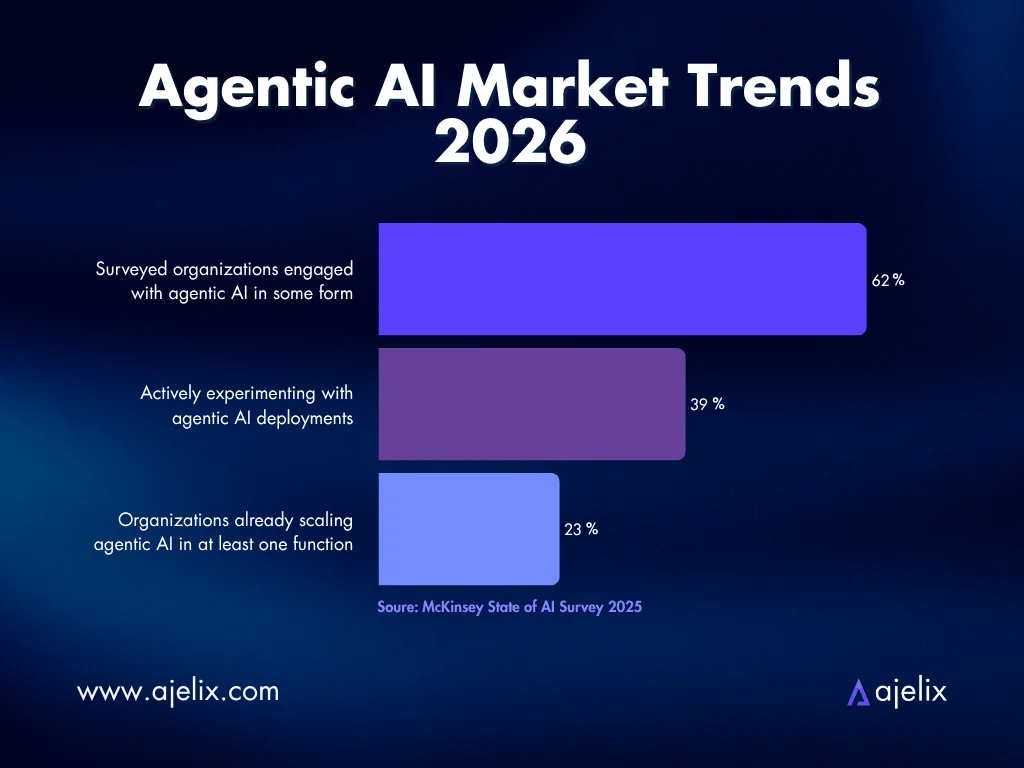
McKinsey’s 2025 State of AI survey found that 23% of organizations are already scaling agentic AI in at least one area, and another 39% are experimenting with it. That means close to two-thirds of companies are already involved with agentic AI in some way. The companies that are getting the best results from AI are moving even faster. Around 75% of them are already scaling it, compared to about one-third of the rest. From what we see at Ajelix, the biggest shift is around ROI.
A year ago, most teams were still asking if this even works. Now the question is more like, “Okay, this works.. so how do we scale it without things getting messy?” And that is exactly what we are trying to solve. We help teams use these workflows without losing control of what is going on. Whether it is one agent doing a simple task or a few working together across a bigger process, you still know what is happening and can step in when needed.
2. Agentic AI use in enterprise
In 2026, companies are using it in real workflows across different teams to automate IT operations, handle customer service, accelerate knowledge retrieval, and so much more. Currently, the focus is on using it more broadly and also trying to manage it properly.
IT operations
IT was one of the first areas where agentic AI was used in production. The work is repetitive, structured, and easier to measure, which makes it a good starting point. Today, agents are handling things like incident response, sorting support tickets, monitoring systems, and in some cases even fixing issues on their own in low-risk environments.
Customer experience
Customer support has moved far beyond simple chatbots, and I am sure that many of us have noticed it. Agentic systems can handle full conversations, check account data, process refunds, escalate when needed, and even follow up after the interaction. This has helped companies reduce response times and improve customer satisfaction.
Knowledge management
This is another area where adoption is growing rather quickly. Instead of digging through documents and hoping you find what you need, agentic retrieval systems can pull data from different sources, put it together, give you a straight answer and take action based on it too. McKinsey’s 2025 survey even highlights this as one of the most common ways companies are already using agentic AI. This is also where we see a lot of practical use at Ajelix.
Many teams use it to work with data, generate reports, and get answers without digging through spreadsheets manually. Over time, the system gets better at understanding what kind of answers are actually useful, which makes it even more valuable.
| What Agentic AI Is Doing | Deployment Stage | Human Oversight | |
|---|---|---|---|
| IT Operations | Incident response, support ticket triage, compliance monitoring, autonomous remediation in low-risk environments | Scaling | Low – recoverable mistakes, structured dat |
| Customer Experience | Multi-turn conversations, live account lookups, refund initiation, intelligent escalation, post-session follow-up | Scaling | Low to medium – escalation paths defined |
| Knowledge Management | Cross-source synthesis, direct answers with citations, triggering downstream actions from retrieved information | Scaling | Low – output reviewed, not decision-critical |
| HR & Recruitment | Candidate screening, interview scheduling, onboarding workflow automation | Active | Medium – hiring decisions remain human |
| Legal | Contract review, clause flagging, compliance cross-referencing, draft summarization | Active | Medium – attorney sign-off required |
| Finance | Transaction anomaly detection, fraud pattern flagging, automated alerts and case initiation | Active | High – regulatory and financial stakes |
Outside of that, companies are also using agentic AI in hiring, onboarding in HR, reviewing contracts, and spotting unusual activity in finance. Of course, in most cases, there is still a human involved, especially when the decisions carry higher risks.
3. Orchestration trends in 2026
In 2026, the leading agentic AI orchestration trends are multi-agent setups where different agents handle different parts of a task, standardized communication protocols like MCP (Model Context Protocol), improved memory systems, and tools that help teams understand and debug what is going on.
AI orchestration, or how multiple agents work together, has quickly moved from something experimental to something teams are actively building around. If you are not familiar with the basics, our guide on What Is AI Orchestration? explains it in more detail. Here are the main things to pay attention to.
Hierarchical architectures
Most real systems today use a simple structure. One main agent breaks a task into smaller parts and hands them off to other agents that each do one specific job. This makes things easier to build and fix. Instead of one big system trying to do everything, you have smaller pieces that are easier to manage and improve over time.
Standardized communication protocols
One example is Anthropic’s Model Context Protocol (MCP) which is designed to connect AI systems with data sources and business tools in a more consistent way. Instead of building custom integrations every time, teams are starting to rely on shared standards. If this trend continues, it will make it much easier for different tools and agents to work together, which matters a lot for companies choosing what to invest in.
Memory architecture
Most systems now use a mix of different approaches. Vector databases help with finding relevant information, structured storage keeps track of the current state, and another layer stores what happened during past tasks. This is usually where agents start acting weird. They forget context, repeat the same steps, or give answers that just don’t line up. It is one of those things you don’t really think about, until it breaks and becomes super annoying. That is also why, at Ajelix, we focus on making memory easier to manage instead of forcing teams to build everything from scratch.
Observability tooling
Tools like LangSmith help with that by showing how an agent reached a decision. This makes it easier to spot issues and improve the system. The Stanford HAI 2025 AI Index also points out that AI-related incidents are increasing, while proper evaluation standards are still not widely used. So having good monitoring and control is becoming more important.
4. Marketing Trends
In 2026, agentic AI in marketing is mainly focused on four things: personalizing content, running A/B tests automatically, managing campaigns across channels, and following up with leads based on how they behave. Marketing was one of the first areas to adopt this, mainly because it already relies heavily on data and experimentation.
The End of Generic Campaigns
With traditional marketing automation, you set up all the rules upfront and the system just follows them. It works, but it is pretty rigid. Agentic AI is different. You give it a goal, like improving conversions, and it figures things out as it goes. It tries different approaches, sees what works, and keeps adjusting without you having to constantly step in.
That is the direction we are building toward at Ajelix. Instead of sitting there tweaking campaigns all day, teams can focus on what they want to achieve. The system handles the testing, optimization, and execution in the background, so you are not stuck managing every little detail.
Key developments gaining the most momentum:
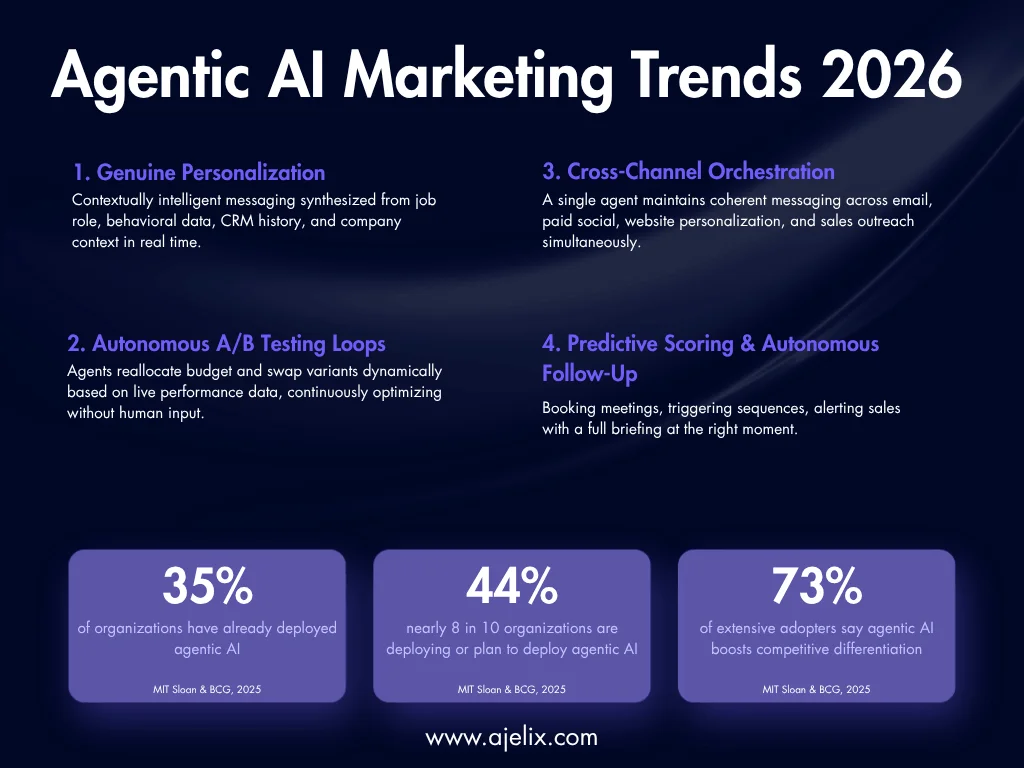
- Genuine personalization: Not just adding someone’s name to an email, but actually tailoring the message based on their role, behavior, CRM history and company context.
- Autonomous A/B testing loops: Instead of waiting for reports, the system tests things in real time, shifts budget, and updates what works on its own, based on live data.
- Cross-channel orchestration: One system keeps everything aligned across email, ads, website content, and even sales outreach, so the messaging stays consistent.
- Predictive scoring with autonomous follow-up: The system can act on leads, like booking meetings, starting follow-ups, or alerting sales with the right context at the right time.
Adoption is accelerating
A 2025 global study by MIT Sloan Management Review and Boston Consulting Group, based on responses from over 2,100 executives across 116 countries, shows that companies using agentic AI are already seeing an advantage. Around 73% of the more advanced users say it helps them stand out from competitors. And no – it is not just about saving money. The same report points to growth, faster innovation, and quicker learning as key benefits, all of which matter a lot in marketing.
Around 35% of companies are already using agentic AI, and another 44% are planning to. All of that is happening faster than what we saw with earlier AI trends.
From what I have seen, marketing is probably where the gap will grow the fastest, because the feedback loop is so quick. If something works, you see it in revenue almost immediately. That is also why we’ve put a lot of focus on marketing at Ajelix – it is one of the easiest ways to feel what agentic AI can do. If you are just getting into this, marketing is usually the easiest place to start.
Agentic AI News: The Biggest Developments
The biggest developments in agentic AI in 2026 are that more tools are becoming browser-based, a new wave of agent-first products is starting to appear, regulation like the EU AI Act is becoming something companies need to take seriously, and open-source tools are making it much easier for smaller teams to build these systems.
Browser-based agents are becoming normal
A few years ago, browser agents felt more like a demo. OpenAI’s Operator, released in early 2025, showed that agents could use a browser, click around, and complete tasks without needing custom integrations. However, by 2026, multiple companies are building this in – Ajelix, OpenAI’s Atlas browser, Perplexity’s Comet, and Microsoft’s Computer Use in Copilot Studio. Which means that if something works in a browser, agents can now interact with it directly.
Software is starting to feel completely different
A new type of product is starting to show up, and it works very differently from what we are used to. Instead of clicking through menus or setting up workflows step by step, you just describe what you want. The system figures out the steps, shows you the plan, and gives you the result. Now you are no longer operating the tool, the AI tool is doing the work for you.
Regulation began catching up
Regulation has started to catch up, especially in Europe. The EU AI Act is now actively shaping how companies build and use these systems, especially in areas like finance, healthcare, and legal. The Stanford HAI 2025 AI Index also shows how fast this is moving – in 2024 alone, U.S. federal agencies introduced 59 AI-related regulations, and mentions of AI in legislation across 75 countries went up by over 21% since 2023.
Open-source is making this accessible to everyone
Another big shift is how easy it has become to build these systems. Tools like LangGraph, AutoGen, CrewAI, and OpenDevin have lowered the barrier a lot. What used to require a full AI research team can now be done by a small engineering team. IDC even predicts that by 2026, 40% of G2000 job roles will involve working with AI agents.
Trends Predictions: Where We’re Headed Next
Looking at the next 12-24 months we will likely see more specialized agents focused on specific industries instead of one-size-fits-all tools, new marketplaces where agents can interact and work together, clearer rules around how humans stay in control, and growing pressure to make these systems more efficient.
Specialized agents will win over general ones
A general-purpose agent can do a lot, but a specialized one will usually do a specific job much better. For example, a clinical agent trained on medical workflows and connected to real hospital systems will outperform a general AI by a noticeable margin. This lines up with what Gartner has been seeing as well – their research consistently shows that domain-specific models perform better when companies actually test them in real scenarios.
Agent marketplaces will start to appear
We are likely heading toward something similar to the API economy, meaning that instead of building everything from scratch, companies will start combining different agents from different providers. Each one does a specific job, and together they form a full workflow – frankly, this is already starting to take shape.
Governance will become more structured
We will start seeing clearer rules around who is responsible for what, how decisions are tracked, and how systems are monitored. Things like audit logs, defined roles, and supervisor tools will become normal. The EU AI Act is a big reason for this shift. It requires human oversight for high-risk systems, especially in areas like hiring, infrastructure, and legal decisions. Because of that, companies are starting to take governance much more seriously.
Cost will become a real constraint
McKinsey’s 2025 State of AI report shows that smaller companies are scaling AI at about half the rate of large enterprises. At the same time, more than a third of top-performing companies are spending over 20% of their digital budgets on AI just to keep up. Because of that, efficiency will matter more. Things like smarter model routing, caching, and lighter versions of models will become a bigger focus.
Explainability will become a requirement
As these systems start making more important decisions, being able to explain them will matter a lot more. And it won’t be just about trust, but rather about compliance. The EU AI Act requires high-risk systems to be transparent and traceable, with human oversight built in. So teams that can clearly show why an agent made a decision will have a clear advantage, both when selling to enterprises and when dealing with regulators.
FAQ
A few things really stand out. Multi-agent systems are becoming the norm, browser-based agents are everywhere, and more companies are moving toward specialized agents instead of one general tool for everything. On top of that, explainability is becoming a requirement, not just a nice extra, and open-source tools are making this all accessible to smaller teams.
The shift is happening because the technology finally works reliably at scale. Businesses are now seeing clear ROI from automating complex workflows, not just simple tasks, which makes agentic AI a strategic priority rather than an experiment.
McKinsey’s 2025 State of AI survey found that 23% of companies are already scaling agentic AI in at least one area, and another 39% are experimenting with it. So roughly two-thirds are already involved in some way.
Agents lose track of what they are doing, repeat the same work, or give results that don’t really make sense. Sometimes things fail quietly, which is even worse. It almost always comes down to missing structure. No clear roles, no proper communication between agents, weak memory, or no visibility into what is going on.
Traditional platforms follow rules humans define upfront. Agentic systems set a goal, for example to improve trial-to-paid conversion, then reason, experiment, reallocate budget, and adjust messaging continuously without a human redesigning the campaign each time.
The biggest risk isn’t technology, but how it is being used. Many companies deploy autonomous systems without clear oversight, auditability, or decision boundaries, which can lead to errors, compliance issues, or loss of control at scale.
Small teams can absolutely use it. Tools have become much easier to access, so getting started is not the hard part anymore. The real challenge is making it work well over time without things becoming too complex or expensive.
It is starting to matter a lot more. Regulations like the EU AI Act are pushing companies to build systems that are more transparent and controlled. In some industries,especially in high-risk industries like finance, healthcare, and legal, you simply cannot ignore it anymore.
ChatGPT and Copilot wait for you to ask something, then respond. Agentic AI, like Ajelix works more independently. You give it a goal, and it starts working through it step by step. It can handle a whole process instead of just helping with one part, which changes how work gets done.
Agentic AI chat that helps you complete projects
AI for work that ingests, transforms, and delivers the exact deliverables your team needs, while you stay focused on strategy. No more chatting, agents can get the job done.