Agentic OS: The Guide For Enterprises (By AI Experts)

Enterprises have spent the last few years gradually implementing AI. While simple chatbots everyone’s using are capable of understanding company processes, agentic OS takes it much further by executing them.
Our team of AI experts have brought you this guide to help you understand everything you need to know about agentic operating systems.
Let’s dive in.
What Is Agentic OS
An agentic operating system is a software layer that manages, coordinates, and governs multiple AI agents working together in order to complete business tasks. Typically, minimal human involvement is necessary for the AI to execute them.
The agentic quality is what makes the AI act with intent and autonomy. The AI perceives the state of a workflow, determines what needs to happen next, then executes.
Ajelix Enterprise is an agentic OS that provides an operational layer for organizations to develop, deploy, and control AI. It connects AI agents to your workflows, data, and systems, in order to complete the work as usually would your trained employees.

Agentic OS vs. Other AI
Here is the difference in capability between chatbots, copilots, RPA, and agentic OS:
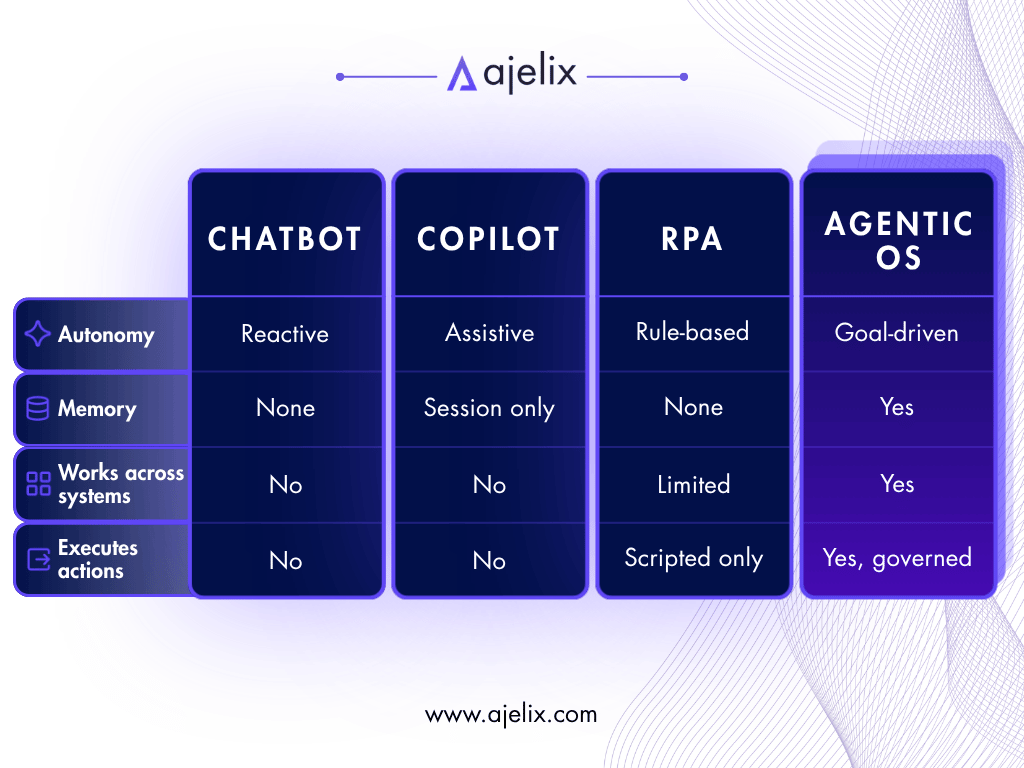
Chatbots answer questions. Copilots improve productivity inside a tool, but humans are still required in the execution. RPA bots automate pre-written tasks. An agentic OS performs the end-to-end workflow execution across systems, with built-in governance.
What Is Agentic OS Made Of
The following six components are what separate agentic OS from other AI:
- Orchestration Layer: it routes tasks between agents, sequences multi-step AI workflows, handles failures, and manages the steps requiring human input. This is what Ajelix Enterprise does at its core.
- Shared Memory: consists of short-term session context, long-term knowledge, and enterprise-specific documentation that the AI agents base their decisions on.
- Tool & Integration Layer: any good agentic OS should connect to other systems, databases, and tools your enterprise already uses.
- Workflow Logic: to make agent behavior predictable, defined triggers, conditions, and decision trees should be in place.
- Human-in-the-Loop Controls: in times where a human decision needs to be made, such as approvals, the enterprise AI orchestration platform should involve a human for their judgment.
- Governance & Audit Trail: this defines what agents can and cannot do, enforces permissions, and logs every decision.
If any of these components are missing, it’s likely not an agentic operating system, but a simpler AI workflow tool.
How It Works: Step By Step
Every agent task moves through the same five-stage lifecycle: Request → Planning → Execution → Verification → Reporting.
Here is an example of how an agentic OS works in the case of processing a vendor invoice:
- Request: A manager submits the invoice, or an automated trigger kicks off the process.
- Planning: The AI agent breaks the task into steps, such as, extracting invoice data, matching it to the purchase order, checking approvals, and identifying the right approver.
- Execution: The agent collects data from the system and routes the approval requests, while simultaneously logging every action it takes.
- Verification: The agent checks whether the results match the expected outcome.
- Reporting: The agent delivers a summary to the responsible manager and updates the audit trail.
In this scenario, the orchestration layer handled the routing, the memory layer maintained context, and the governance layer logged every action for compliance purposes.
Enterprise Use Cases
Enterprises are currently running agentic systems in production in fields such as these:
- Finance: for invoice processing and approval routing;
- Sales: for CRM auto-updates, outreach sequencing and follow-ups;
- HR: for employee onboarding, policy retrieval, document routing and approvals;
- Customer Operations: for multi-agent support escalation, SLA enforcement, and case resolution;
- Supply Chain: for shipment tracking, vendor communications, and exception handling.
Agentic OS are common for processes that involve multiple systems and varied inputs. What historically relied on human coordination can now be done with the help of AI, so that employees can focus on parts of their jobs that require human judgment.
What To Look For In Your Evaluation
When you’re searching for an AI vendor, you should ask these questions:
- Is orchestration part of the system’s core or simply added on? Agents must be able to route, persist through failures, and hand off tasks to humans.
- Is the governance strict enough? A good agentic operating system would enforce company policies at every single step.
- What’s the memory architecture like? The system must have role-based access controls, meaning each employee only has the information and context they need.
- What’s the integration depth? Depth is more important than how many integrations a system offers natively.
Ajelix Enterprise: The Orchestration Layer
Ajelix Enterprise is meant for business teams and enterprises who need AI agents built around their specific workflows, with full control over data, access, and deployment environment, regardless of industry.
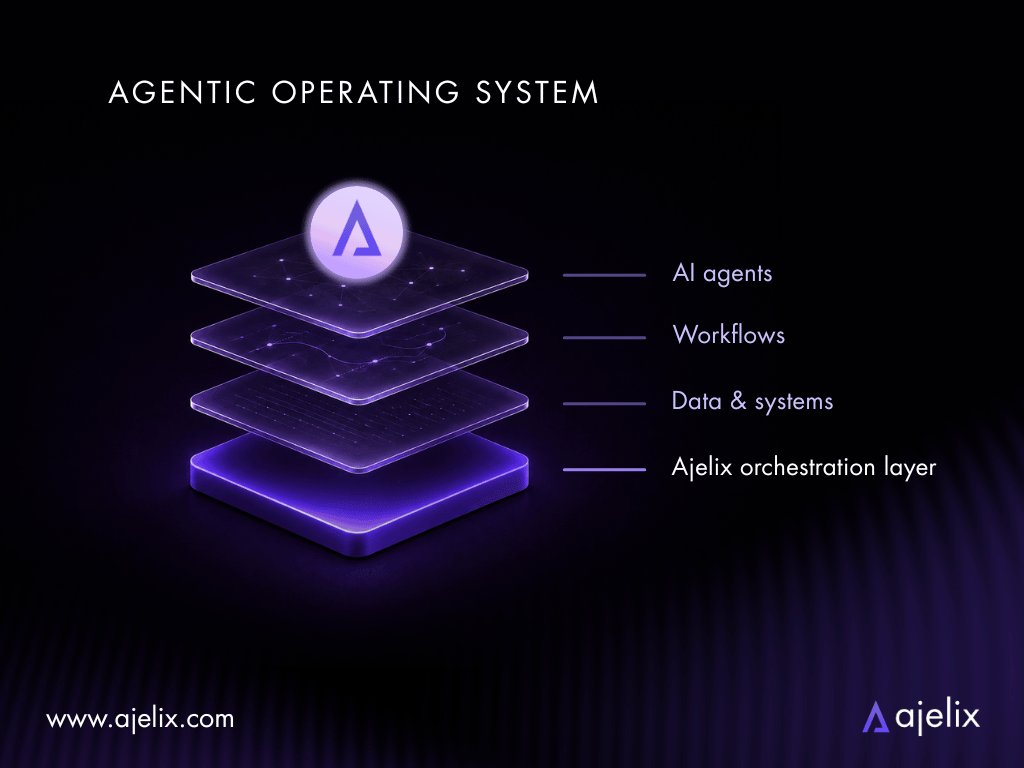
The platform is designed as an operational control layer for organizations to develop, deploy, and control AI. Granular role-based access keeps employees within their permissions, while a complete audit trail records every agent and employee action. Usage monitoring with quota management keeps deployment under organizational control.
Custom agents and connectors are built around the company’s specific processes, with a RAG system trained on company documentation, so agents abide by the organization’s own standards and knowledge.
Ajelix offers the options to self-host your own LLMs, ready to deploy on kubernetes, and connect to any third-party source easily through an API key (including any LLM provider). The team works with each client independently to customize workflows and make the organization AI-native.
Pricing is a transparent custom enterprise contract, tailored to team size and the scope of the deployment. Contact the team for a quote.
How To Get Started
To avoid the most common mistakes enterprise leaders make with agentic AI implementation, consider these steps:
Evaluate the current cost of coordination
Are the company’s processes currently affected by how time consuming or faulty the human coordination is? This is where agentic OS delivers the fastest ROI (return-on-investment). Look for platforms that allow complex, multi-system, and high-volume processes.
Start with one workflow to measure the outcome
Don’t start with a universal agent – it might seem appealing for one agent to do everything, but these kinds of agents aren’t the best at specific tasks. Start with a specialized agent for a specific process, so that you can prove its worth before expanding. Treat the first agent deployment as a trial.
Governance should come before building agents
Define what agents can and cannot do before deployment. Adding guardrails while they’re already working is going to make them run into a lot more failures, and might cause compliance violations. Build the control plane into the very first agent deployment.
Limitations
Several things should be kept in mind before deploying an agentic OS:
- Data quality determines agent quality: because the AI agents base their decisions on your enterprise data, you need to make sure it is complete, consistent and well-structured. Though agentic AI can still handle messy data, it’s better to make sure what is being fed to the AI applies to how you want the AI to build your files.
- Your systems need an API: because an agentic OS connects agents to systems through integrations, it is critical that your internal systems have an API or a modern connector.
- Complex processes must be designed, not simply automated: deploying agents on top of poorly designed workflows produces errors and failures. Design the process to make sure it works before involving the AI.
- Human judgment will always be needed: when it comes to high-stakes decisions, these still require human involvement. An agentic OS doesn’t replace strategic thinking.
- Governance remains something that needs to be overseen: instead of coordinating the tasks that the AI now performs, your team will be responsible for overseeing them by reviewing audit trails, managing escalation, and giving permissions.
FAQ
An agentic OS (agentic operating system) is the coordination layer that gives multiple AI agents shared memory, tool access, decision logic, and governance so they can complete multi-step work across enterprise systems without requiring human intervention at every step.
Agentic AI systems act with intent. They perceive a goal, plan the steps to reach it, and execute, all the while adapting to what they find along the way. This is different from reactive AI (chatbots) or assistive AI (copilots), which wait for human input before each action.
No. AGI (artificial general intelligence) refers to AI capable of performing any intellectual task a human can. An agentic OS coordinates today’s specialized AI agents to complete specific, defined business tasks.
Ajelix Enterprise is an enterprise agentic OS built as the orchestration layer. It connects AI agents to your workflows, data, and systems, enabling governed, multi-agent automation across your organization.
Yes, as long as your systems have an API or modern connector. An agentic OS connects to external tools, databases, and platforms through its integration layer. The depth of that integration is what determines whether it can run your existing workflows.
Workflow automation tools execute predefined sequences, while an agentic OS adds reasoning, meaning agents can evaluate context, handle exceptions, make decisions mid-task, and route work dynamically.
In most cases, yes. Agents automate the coordination work humans currently do and if the underlying process is poorly designed, the agent is likely to execute it poorly. Mapping and cleaning the process first is a step you should take before any deployment.
Agentic AI chat that helps you complete projects
AI for work that ingests, transforms, and delivers the exact deliverables your team needs, while you stay focused on strategy. No more chatting, agents can get the job done.