7+ Workflow Orchestration Tools You Must Try

Teams only pay attention to a faulty workflow process when something breaks and no one can explain why, or knows how to fix it. Workflow orchestration tools help companies optimize their processes by connecting otherwise disconnected tools into one complete system.
Our team of AI experts compiled a list of the seven leading workflow orchestration tools using AI to help automate your company’s processes. Additionally, we researched what the community says about the workflow orchestration software they choose.
Let’s dive in.
What Is Workflow Orchestration
Workflow orchestration is an automated coordination of multi-step processes, performed through different systems, tools, and teams simultaneously. This orchestration ensures tasks run in the right order and at the right time, handling errors and retry logic on the way.
Orchestration vs workflow are separate concepts: a workflow is the defined sequence of steps, while orchestration is the layer that manages the execution of these steps.
Workflow orchestration tools available these days offer:
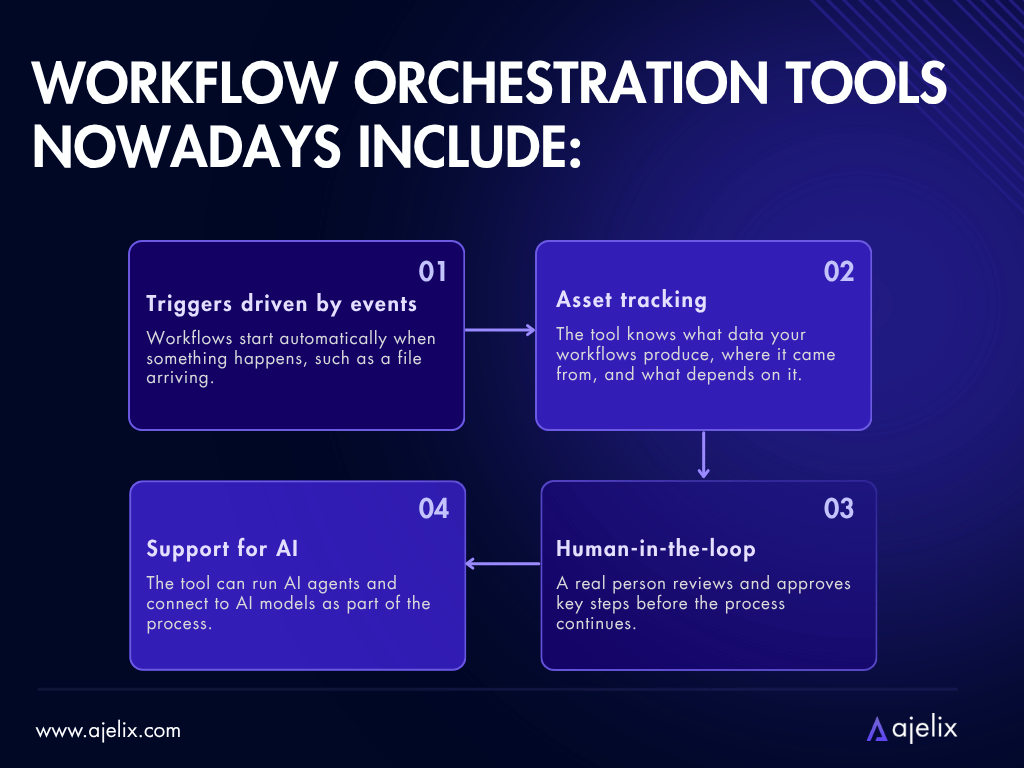
- Triggers driven by events (workflows start automatically when something happens, such as a file arriving);
- Asset tracking (the tool knows what data your workflows produce, where it came from, and what depends on it);
- Human-in-the-loop approvals (a real person reviews and approves key steps before the process continues);
- Support for AI workflow orchestration (the tool can run AI agents and connect to AI models as part of the process).
The AI aspect is what becomes useful in situations where autonomy is needed alongside automation, handling everything from using LLMs (Large Language Models) to multi-agent systems. Agentic AI is capable of making decisions without involving a human.
Most of our list features AI-powered workflow orchestration tools specifically, as this is the direction where the software is heading.
Top 7 Workflow Orchestration Tools
Here is our best workflow orchestration tools comparison:
| Tool | Best For |
|---|---|
| Ajelix Enterprise | Enterprise AI & business workflow automation |
| Apache Airflow | Large-scale data scheduling |
| Temporal | Long-running workflows that can’t afford to fail |
| Dagster | Data teams who need full visibility into their data |
| Prefect | Dev teams who need a fast, flexible setup |
| Kestra | Teams working across multiple languages and tools |
| Argo Workflows | Teams running heavy workloads on Kubernetes |
Below, we cover what each tool is good at, what not so much, and who it is for.
1. Ajelix Enterprise
Who is it for: Enterprise teams that need to automate business workflows, want custom AI agents, with governance, ease of use, and reliability.
- Pros: Flexible deployment types; AI-native platform with granular RBAC, audit trails, reasoning logs, usage monitoring and quota management; connects to any system through a custom API; offers ability to self-host LLMs; the capability of visually building agents and workflows; has their own AI infrastructure.
- Cons: Less suited for code-first users.
Ajelix Enterprise is an AI-powered workflow orchestration platform built for business teams that need to automate complex, multi-step processes.
Ajelix has an intuitive no/low-code interface with custom enterprise-level AI agents, governance controls, and deep integration capabilities, making it one of the best orchestration and workflow tools for AI-first teams.
Ajelix offers the options to self-host your own LLMs, ready to deploy on kubernetes, and connect to any third-party source easily through an API key (including any LLM provider). Ajelix optimizes models for enterprise needs, and fine tunes them for each specific workflow.
The Ajelix team works with clients independently to customize workflows and make the company AI-native, regardless of industry.

2. Apache Airflow
Who is it for: Enterprise data teams with existing Airflow investments, or large pipeline ops teams.
- Pros: One of the largest integration ecosystems of any orchestration tool; tested thoroughly for large teams; available as a managed service via Astronomer, Google Cloud, and AWS.
- Cons: A highly complex platform for teams without tech support, especially when self-hosted; significant kubernetes footprint.
Apache Airflow is a Python-based, open-source platform that has become the default standard for data pipeline scheduling.
Airflow 3.x introduced tasks that can remember the states between runs, support for Java and Go alongside Python, the ability to trigger workflows when data changes rather than on a fixed schedule, and a fully rebuilt interface.
Its Common AI Provider package includes LLM and AI agent operators with 20+ model providers, making it increasingly relevant as an AI workflow orchestration tool.
3. Temporal
Who is it for: Engineering teams building critical distributed systems, microservice orchestration, financial workflows, or any long-running process where data can’t be lost.
- Pros: If something breaks mid-process, it resumes automatically from where it stopped; works with multiple programming languages; strong fit for AI workflows that involve long-running or unpredictable processes.
- Cons: Designed for software engineers building applications, not regular business teams; requires deep technical investment to set up.
Temporal is a workflow orchestration software specifically for developers who need to run processes for a long time, and can’t afford them to fail. Its strongest suit is resilience – Temporal picks up where it left off in case of a crash or error.
It’s used by companies like Salesforce, Vodafone, and major financial institutions for their most critical automated processes. Recent updates added support for real-time AI output streaming, improved reliability across multiple cloud regions, and a full audit trail of who triggered each workflow execution.
4. Dagster
Who is it for: Data engineering teams who want more visibility and control over their data.
- Pros: Gives data teams clear visibility into where their data comes from and what gets affected when something changes; easy to test, build, and debug locally before deploying; works particularly well alongside dbt (a tool for transforming data).
- Cons: The way it models workflows is different from most other tools; focused specifically on data workflows, not designed for general business process automation.
Dagster is a data workflow orchestration tool built around the idea that, instead of just scheduling tasks to run, you define what data your team needs to produce and let the tool figure out everything else.
This makes it easy to see where your data comes from, what are the dependencies, and what breaks if something changes. The paid version includes user permissions, audit logs, cost tracking, and an AI assistant that lets teams build data-driven processes on top of their existing workflows.
5. Prefect
Who is it for: Developer and data science teams who need a flexible tool that is simple to adopt.
- Pros: Minimal setup, straightforward to learn; workflows can adapt and change direction as they run; clear visibility into every workflow run with automatic retries and failure alerts.
- Cons: Fewer integrations than other tools, meaning you may need to build some yourself; less structured than Dagster when it comes to managing and tracking data outputs (however, that may change as Prefect is in the process of acquiring Dagster).
Prefect is a workflow orchestration tool built for developer teams that want to start running quickly, without dealing with heavy infrastructure. Prefect lets workflows make decisions as it’s working, such as branching in different directions, looping, or generating new steps based on what happens along the way.
Your workflows run on your own infrastructure, while Prefect handles the monitoring and scheduling, keeping your data on your own servers. It also has growing support for AI and machine learning workflows, including running multiple experiments at once and managing model deployments.
Prefect is currently in the process of acquiring the previously listed tool, Dagster.
6. Kestra
Who is it for: Technical teams that need to orchestrate a mix of data, AI, and infrastructure workflows.
- Pros: Works with any programming language or tool; the 2.0 update lets compute workers run inside secure or private environments without exposing the core database; both a no-code visual editor and a text-based editor are available.
- Cons: Fewer tutorials and third-party resources available due to a smaller community.
Kestra is an open-source workflow orchestration software platform that recently released version 2.0. It lets you combine scripts written in any language within the same workflow, making it one of the most versatile data workflow orchestration tools available.
It now has over 2,000 integrations, a visual no-code editor that stays in sync with the original text-based one, an improved AI assistant with memory that can explain failures and propose fixes, and the ability to turn any workflow into a tool that AI agents can use.
7. Argo Workflows
Who is it for: Engineering teams already using Kubernetes who need to run parallel jobs at large volumes, typically for AI model training, large data processing tasks, or automated software deployment.
- Pros: Ideal for heavy compute work like AI model training; works across any cloud provider; part of a broader ecosystem of tools that work well together.
- Cons: Requires significant Kubernetes knowledge to set up and manage; only relevant if your team is already using Kubernetes.
Argo Workflows is an open-source workflow orchestration tool built specifically for teams using Kubernetes. It’s a system many large engineering organizations use to manage and scale their software infrastructure.
Argo is designed to run hundreds or thousands of tasks simultaneously, making it well-suited for heavy workload like training AI models or processing large volumes of data. It connects with other tools in the Argo ecosystem, and can be triggered automatically by specific events like a code push, a file arriving, or an API call.
What The Community Recommends
The data engineering community on Reddit consistently mentions a handful of AI workflow orchestration tools outside our top 7 that are worth your attention:
- n8n: A visual automation tool with a strong self-hosted following, which is a popular choice for connecting SaaS tools and building AI agent workflows without writing code.
- Windmill: A tool that combines script execution, internal app building, and workflow orchestration in one platform. It supports multiple programming languages and is increasingly praised by startups.
- AWS Step Functions: A serverless workflow tool built into Amazon Web Services. It has zero infrastructure to manage, connects with 200+ AWS services, and now supports AI agent workflows.
- Mage AI: A more visual tool for building data workflows. Popular with data scientists who prefer an interactive building experience over writing code.
- Orchestra: A newer managed platform that combines orchestration and monitoring. Gaining traction with teams who want to reduce the burden of managing their own infrastructure.
Choose The Right Tool For Your Needs
To decide what is the best workflow orchestration tools for your needs, here is an overview comparison by use case:
| You need… | Best tool |
|---|---|
| A multi-tenant platform to build custom agents and visual agent workflows for your company’s processes, with hash-chained audit logs, spend controls and custom guardrails, isolated code sandboxes and secure inference | Ajelix Enterprise |
| A well-established, widely supported tool with a huge integration ecosystem for large-scale data workflows | Apache Airflow |
| A mission-critical process that cannot lose progress mid-run, such as payment flows, order management, financial systems | Temporal |
| Full visibility into where your data comes from and what breaks when something changes | Dagster |
| Fast setup and flexible workflows that can adapt and change course as they run | Prefect |
| Orchestration across multiple programming languages, tools, and environments in one place | Kestra |
| Running large-scale parallel jobs on Kubernetes for AI model training or heavy data processing | Argo Workflows |
Also Worth Considering (Community Picks):
| You need… | Best tool |
|---|---|
| Visual workflow automation for connecting SaaS tools and building AI agent workflows | n8n |
| Scripts, internal app building, and workflow orchestration in one platform | Windmill |
| Serverless workflow orchestration fully inside the AWS ecosystem | AWS Step Functions |
| An interactive, notebook-style experience for building data workflows | Mage AI |
| Managed orchestration and monitoring without the burden of running your own infrastructure | Orchestra |
Unsure where to start? Consider Ajelix.
FAQ
Workflow orchestration tools are platforms that automatically manage and coordinate multi-step processes, such as scheduling tasks, handling dependencies, recovering from failures, and giving teams visibility into what’s running and what’s broken.
A workflow is the defined sequence of steps in a process. Orchestration is the layer that runs it, managing what triggers each step, what happens if something fails, and what depends on what.
Yes. Apache Airflow, Prefect, Dagster, Kestra, Temporal, and Argo Workflows are all open source and free to self-host. Most also offer paid cloud-managed versions with additional enterprise features. Self-hosting does come with its own infrastructure and maintenance overhead, so factor that into the decision.
Ajelix Enterprise for teams that need AI automation with minimal technical setup. n8n is also a strong pick for smaller, technical-leaning teams who want a self-hosted visual tool. Both avoid the infrastructure complexity of platforms like Airflow or Temporal.
Prefect announced the acquisition of Dagster Labs in July 2026. Both tools are keeping their names, open-source licenses, and separate roadmaps for now, meaning existing users don’t need to migrate. The combined company began operating under the Prefect name from August 2026, with the goal of building a unified platform for AI and data workflow automation.
AI-native orchestrators, like Ajelix Enterprise and Kestra 2.0, have features purpose-built for AI workloads: autonomous agents that can make decisions mid-process, human approval steps, integration with LLM providers, and built-in guardrails. Traditional tools like Airflow have added AI capabilities through plugins, but they weren’t designed with AI execution as the primary use case.
Yes, for the right team. Airflow 3.x addressed many long-standing complaints and added AI integrations. Its ecosystem, 1,700+ modules, 100+ providers, and the largest community of any orchestration tool, remains unmatched. It’s best for large data engineering teams with existing Airflow investments, not for teams starting fresh who lack dedicated engineering support to run it.
Agentic AI chat that helps you complete projects
AI for work that ingests, transforms, and delivers the exact deliverables your team needs, while you stay focused on strategy. No more chatting, agents can get the job done.