AI Platforms For MSPs: What To Look For

An AI platform for MSPs is no longer optional, as it is quickly turning into a race between MSPs that build AI revenue and MSPs that watch clients buy it from unapproved vendors. Your clients are already pasting sensitive data into consumer chatbots, and when something goes wrong, they will call the partner they trust – you.
In this guide, our AI experts explain what an AI platform for managed service providers is, which risks catch unprepared MSPs off-guard, what to look for in your evaluation, and how to safely implement AI for MSPs and their clients.
Let’s dive in.
What Is An AI Platform For MSPs
An AI platform for MSPs is a centralized, multi-tenant system that lets managed service providers build, deploy, govern, and monitor AI across their entire client base from one console.
The multi-tenant aspect is important. A regular AI tool for MSPs used internally helps your technicians; a platform built for MSPs treats every client as a separate workspace with its own users, permissions, policies, spend limits, and audit logs.
It helps to separate three categories that often get confused:
- AI tools for MSPs: solutions your own team uses, like an AI ticket triage assistant or a writing helper.
- AI agents for MSPs: autonomous agents that complete multi-step work, such as onboarding a user, summarizing tickets, or generating client reports.
- AI platforms for MSPs: the governance and delivery layer, where agents, workflows, and knowledge bases are deployed per client, controlled, and billed.
Most MSPs already have the first two in some form, but the third one is quickly becoming an essential addition.
Why Must MSPs Act Now
Proven demand can be seen in the industry as of 2026:
- Nearly half of MSPs (48%) rank AI and automation as the number one client need in 2026, according to a 2026 State of the MSP Report, which surveyed more than 1,000 MSPs worldwide.
- 87% of MSPs plan to increase AI spending this year, per Datto’s 2026 Global State of the MSP survey, and 55% of US businesses expect their MSP to adopt AI by the end of 2026.
- On the client side, 58% of SMBs plan to increase AI spending in 2026 and 47% already use AI in some form, according to Bredin’s 2026 SMB research.
Right now, clients are asking for AI services more than any other offering. The good part is that your competitors might not have figured out how to sell it yet, so you can get ahead if you act now.
The Risks Of Getting It Wrong
The main risk categories for selling AI without governing it are:
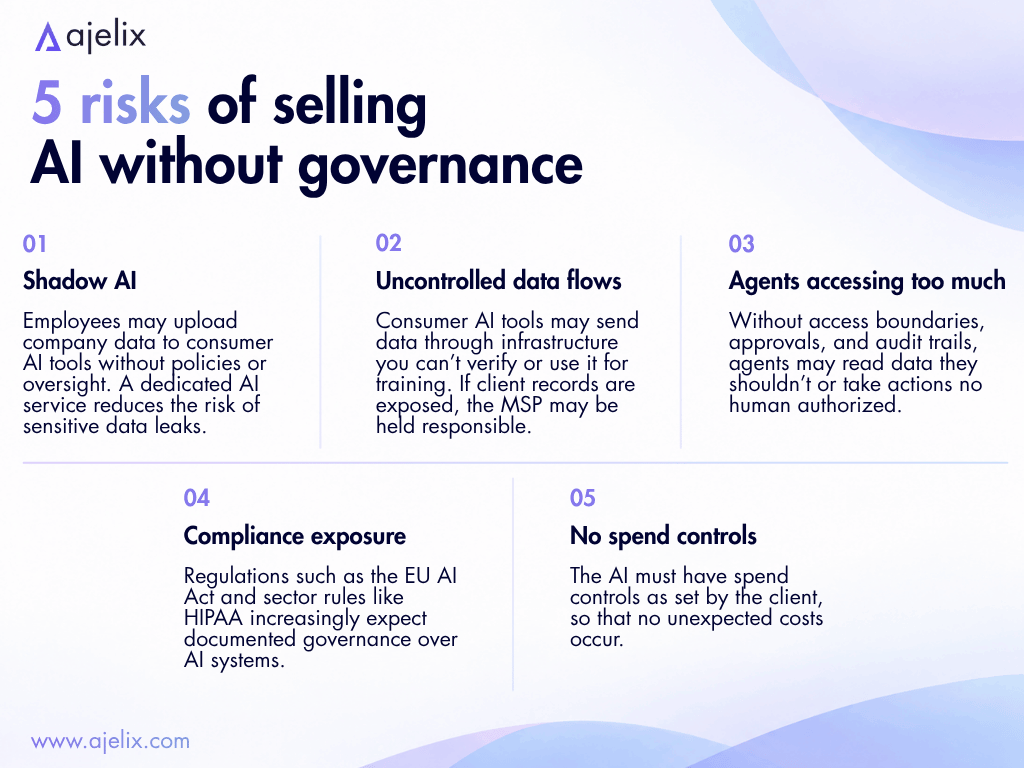
- Shadow AI. Employees at client organizations use consumer AI tools, where they enter company data with no policy, logging, or oversight. If a dedicated AI service is implemented, there is significantly less risk of leaked sensitive data. The average cost of a data breach is currently $4.99 million.
- Uncontrolled data flows. These consumer AI tools route data through infrastructure that you can’t verify, and some tools’ terms permit training models on user data. Data outages and exposure risks would become the MSP’s responsibility to fix.
- Agents accessing too much. Without access boundaries, approvals, and audit trails, agents may read data they should never see or take actions that no human approved.
- Compliance exposure. Regulations such as the EU AI Act and sector rules like HIPAA increasingly expect documented governance over AI systems.
- No spend controls. Spend limits and usage reporting set per client, so the client never gets a surprise invoice.
What MSPs Should Look For
When you assess any AI platform for MSPs candidates, judge them against this checklist:
- True multi-tenancy. Separate workspaces per client, with roles, teams, and access configured per tenant.
- Governance built in, not simply added. Role-based access control, guardrails that catch sensitive data before it leaves, banned-topic and keyword blocking, and policy enforcement on every message in and out.
- Complete audit trails. Every prompt, agent action, and output must be logged and traceable. This will be your evidence in a compliance review or incident investigation.
- Per-client spend controls. Spend limits, usage reporting, and cost allocation per tenant.
- No training on your clients’ data. Verify it in the terms of the platform, instead of blindly trusting how the platform markets itself.
- Flexible deployment. Options to run in the vendor’s cloud, on provider clouds, or fully self-hosted inside a client’s environment.
- Bring-your-own-LLM. One governance layer that covers any model a client wants to use.
- White-label and partner economics. If you’re building a client-facing service, the platform should carry your brand and support your margin.
How To Safely Implement AI For MSPs
The basic principle of a safe AI implementation for MSPs is: governance → technology → scale. This order ensures security comes first.
- Set the policies before deploying. Define what agents may access, what data may never leave, and which decisions require human approval.
- Start with one client and workflow. Pick a repetitive, low-risk process, then prove its value and log everything before expanding.
- Keep tenants isolated. Every client should get its own workspace, access rules, and audit logs. Don’t let one client’s data or agents touch another’s.
- Involve human decisions in workflows. Build a decision branch, so that the AI escalates to your technicians in uncertain or high-value cases.
- Discover shadow AI. Before rolling out the AI, find out which consumer AI tools are already being used inside the client’s organization, then replace them with the governed platform.
- Report consistently. Cover usage, spend, logged actions, and avoided incidents.
- Train the client’s team. This can be an onboarding session or a guide, so that people who will use the AI know what is allowed and what isn’t.
3 AI Platforms For MSPs To Consider
The following platforms are not sold to your clients by the vendor, but you, the MSP, deliver AI to your clients through them. The platform is simply the infrastructure for your service, while the client relationship, the pricing, and the responsibility remain yours.
1. Ajelix
Best for: MSPs that want to build a fully governed, white-labeled AI service with deep control over data residency and per-client policy.
Ajelix is a multi-tenant AI platform that provides an operational layer for MSPs to develop, deploy, and control AI for their clients. Ajelix gives you the platform to implement AI safely for your clients, under your brand and management. It features:
- Multi-tenant console: workspaces, teams, roles, spend limits, and audit logs.
- Governance as the core: acceptable-use policy enforcement, shadow AI elimination, guardrails that catch sensitive data before it leaves, full audit trails, and no training on client data.
- Full AI lifecycle: client-facing chat and AI agents that produce outputs, such as reports, Excel files, presentations, a visual workflow builder, and RAG grounded in each client’s own documents.
- Bring your own LLM: one governance layer across any model, including hosted options and self-hosted LLMs.
- Deployment flexibility: Ajelix’s sovereign cloud hosted in the EU, or AWS, Azure, Google Cloud, or fully self-hosted inside the client’s environment.
- White label available: the platform runs under your brand.
2. Hatz
Best for: MSPs that want a productized, repeatable AI-as-a-service motion across many small business clients.
Hatz is an AI operating system for SMBs, delivered through MSPs rather than sold directly to end users. It is SOC 2 Type 2 compliant. It features:
- PSA sync and client enrichment: connect your PSA or import a CSV, and Hatz enriches each account by domain and industry, generating industry-specific AI use cases.
- Shadow AI reporting: flags risky consumer AI usage across client organizations before it becomes an incident.
- AI readiness assessments: send clients a short quiz about how prepared their business is for AI. The results show you who to approach first; running it monthly keeps a steady flow of new AI opportunities.
- Smart cost routing: routes requests across models to balance quality and cost, with built-in security guardrails.
3. Rewst
Best for: MSPs that want to automate their own team’s daily work using AI-powered automation, rather than running a client-facing AI service.
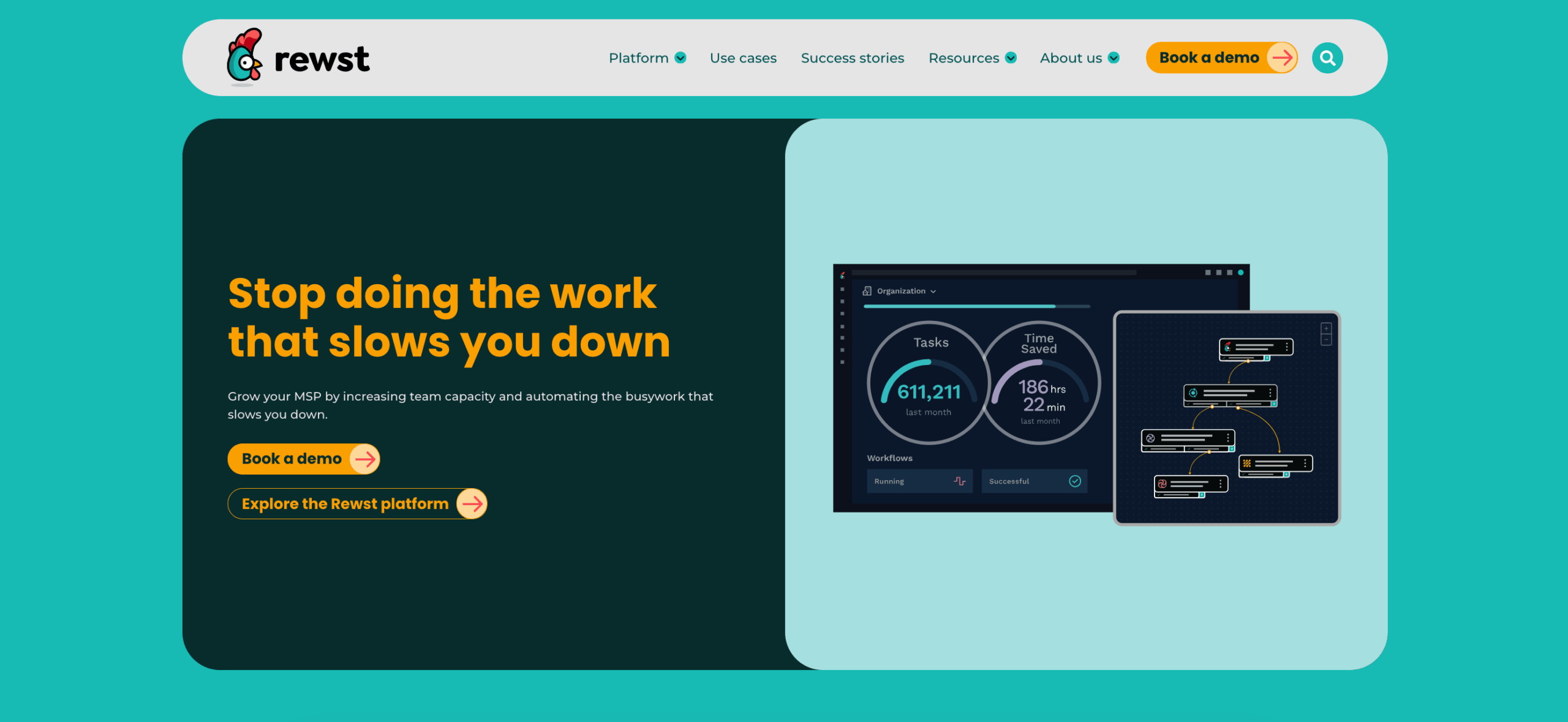
Rewst is the automation platform purpose-built for MSPs, used by more than 1,500 MSPs worldwide, and it has been continuously adding AI-native capability in 2026.
- RoboRewsty: AI assistant that builds, troubleshoots, and documents workflows from natural-language prompts.
- MCP Server: lets external AI agents discover and execute Rewst automations through a secure, structured interface.
- AI-native engine: a newly announced describe-it-and-it-builds workflow generator and an upgrade of its execution engine to Temporal.
If secure, white-labeled AI delivery is the priority, talk to the Ajelix team about launching your governed AI service.

FAQ
A multi-tenant AI system that lets a managed service provider build, deploy, govern, and monitor AI agents, workflows, and chat across its entire client base from one console, with per-client permissions, policies, spend limits, and audit logs.
The best AI platform for MSPs is the one that combines multi-tenancy, built-in governance and audit trails, per-client spend controls, flexible deployment, and partner economics like white labeling. Ajelix fits MSPs building a governed, white-labeled AI service; Hatz.ai fits productized AI-as-a-service rollout at scale; Rewst fits MSPs automating their own service delivery. Match the platform to the service you intend to run.
Set an acceptable-use policy before deployment, start with one client and one low-risk workflow, keep every client tenant isolated, route uncertain decisions to humans, run shadow AI discovery, report monthly, and train the client’s team on what the platform may and may not be used for.
Chat is the entry point; agents are where the service becomes durable. Agents that read client documents, execute multi-step workflows, and produce deliverables create recurring value that a chat window alone does not. That value holds only if they run inside governance, with human escalation built in.
Microsoft AI for MSPs is strong inside the Microsoft 365 ecosystem, where many of your clients already work, because of familiar tooling, existing licensing relationships, and a large integration surface. Copilot’s strength is M365-native grounding (SharePoint/Teams data, existing licensing), but it doesn’t give you per-client multi-tenancy across your whole book of business or bring-your-own-LLM governance – which is why MSPs typically pair it with a platform layer.
The platform is what you use; AI consulting for MSPs is what you sell on top of it. A typical engagement: readiness assessment, a shortlist of concrete use cases, a governed pilot, then a monthly retainer for maintenance, policy reviews, and reporting.
Yes. Platforms such as Ajelix offer white-label deployment, meaning the AI service runs under the MSP’s own brand while the vendor remains invisible to the client. The MSP owns the relationship, pricing, and service level.
It is shared, but there’s a division of labor: the platform vendor provides the technical controls, the MSP defines and enforces policy per client, and the client’s leadership owns the acceptable-use decisions for their own organization.
Agentic AI chat that helps you complete projects
AI for work that ingests, transforms, and delivers the exact deliverables your team needs, while you stay focused on strategy. No more chatting, agents can get the job done.