AI Agent Cost Breakdown For Enterprise Teams

AI agent cost is one of the most searched questions among companies wanting to implement AI. A lot of different platform fees turn up, but the underlying costs of the technology aren’t publicly disclosed.
To help you understand the stack of costs that deploying AI agents consists of, our team of AI experts have compiled a guide that breaks down each cost layer.
Let’s dive in.
Why Is AI Agent Cost Hard To Quote
AI agent cost is the sum of decisions you make about the infrastructure, integration depth, governance requirements, and internal capacity. A company that already has a cloud data warehouse, a skilled IT team, and clean internal documentation will spend a different amount from one building all those foundations from scratch.
If you were to ask five different vendors “how much does an AI agent cost?”, you’ll get five different answers.
What Makes An AI Agent Expensive
Every time an AI agent does something, it calls a language model, which costs money. An AI agent can make dozens of model calls to complete a single task – it’s the core reason AI agents cost more than simpler AI tools.
The components that create this cost:
- Token consumption. Language models charge by the token, with every call having an input and output token count. Because the inputs are large, carrying context, results from tools, and reasoning history, agents are more expensive than a simple chatbot.
- The agentic capability. A well-designed agent takes multiple autonomous steps to execute a task, with each step being a separate model call.
- Choice of model. Frontier models cost significantly more per token than smaller or open-source models. Use simpler models for simpler tasks, and more powerful models for multi-step tasks.
- Context window size. The longer and more detailed your agent memory is, the more tokens take up each call because they’re carrying a large amount of context.
- Memory. If the agent remembers previous conversations and tasks, that history is stored and fed back into every new call.
- Storage. Every document, embedding, and conversation log the agent keeps has to be stored somewhere, and it gets read back on every call.
- Database. Agents that look up business data rely on vector or SQL databases. Every search, index update, and data sync carries its own infrastructure cost.
- Sandbox and code execution. When an agent writes and runs code, it needs an isolated sandbox environment for every execution.
- Parallel execution. When agents run workflows across multiple users or data sets at the same time, the calls multiply. The more agents are working, the more the cost scales.
AI agent cost is not fixed, as it depends on your usage and how you use the AI, which will be different each month. But you can somewhat prepare by choosing the right models for each task type, and building the workflows in a way that minimizes unnecessary calls.
The Cost Layers Of An Enterprise AI Agent
Here is the AI agent cost breakdown:
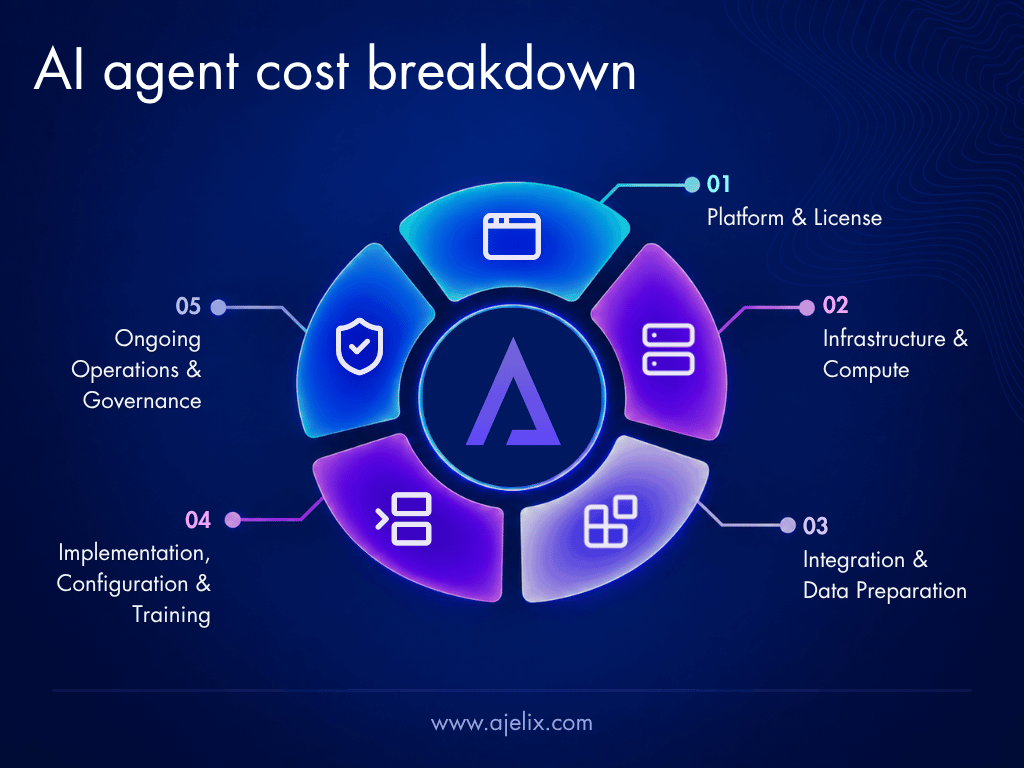
1. Platform & License
This is the cost you may find on a vendor’s pricing page, covering the core agent infrastructure. It includes the ability to build, deploy, and run agents. This cost is typically scaled depending on user count and volume, meaning smaller teams will have a lower AI agent cost per month.
Some platforms will have specific features at higher pricing points, such as multi-agent orchestration, workflow automation, and audit logging.
Ajelix Enterprise combines all needed functions into one platform. Their enterprise plan includes:
- Agent building;
- Workflow automation;
- RAG system;
- Governance – RBAC, audit trails, guardrails, spend control.
2. Infrastructure & Compute
Whether you’re using a cloud-hosted platform or running a self-hosted deployment, inference has certain costs that scale with usage. These include:
- LLM API costs: which model you’re using and how often;
- Retrieval costs: in cases where you’re using the RAG system;
- Storage: all the documents, embeddings, and logs.
On-premises AI environments might appear more financially appealing, but they require more engineering, patching, and uptime management. The on-premises cost of adopting an enterprise AI agent can exceed the managed environment cost.
3. Integration & Data Preparation
Before AI agents can be useful to your company, they need to access your systems, such as a CRM, ERP, internal documentation, and compliance documents, which takes up significant engineering resources.
Here the AI agent implementation cost includes:
- API integrations and connector maintenance;
- Setting up how documents flow into the AI;
- Data cleaning and formatting for knowledge bases;
- Ongoing updates as systems change.
Ajelix Enterprise handles reading across PDF, Word, email, and scanned documents natively, and connects to any data source through its workflow layer.
4. Implementation, Configuration & Training
Someone on your team has to configure the agents, define the guardrails, write the system prompts, test everything, and train the employees who will be using the AI. This can be handled by one power user, or even several teams, meaning the AI agent development cost varies widely.
Ajelix Enterprise uses the “Assess → Build → Govern → Adopt → Support” model to ensure everything is mapped correctly, built and tested against real scenarios, and that the access and audit are configured and stable. This reduces the need to reimplement the AI later.
5. Ongoing Operations & Governance
Running AI agents in production means:
- Monitoring outputs for accuracy;
- Maintaining guardrails as business rules change;
- Managing user access as teams grow or change;
- Reviewing audit logs for compliance;
- Updating knowledge bases as documents and policies evolve.
Compliance is crucial, especially in regulated industries. Ajelix, for example, reduces time spent on compliance review because it logs every decision in a clean format that can be read by auditors. Even so, someone still needs to own this process internally.

AI Agent vs. Human Cost
It’s important to note that agents don’t replace human roles, but simply handle some tasks previously manually performed by humans. AI gives human employees the time to focus on aspects of their jobs that they didn’t have capacity for before.
Instead of looking at it as the AI agent replacing the human, see it as the human and AI working together – the human is no longer working all on their own.
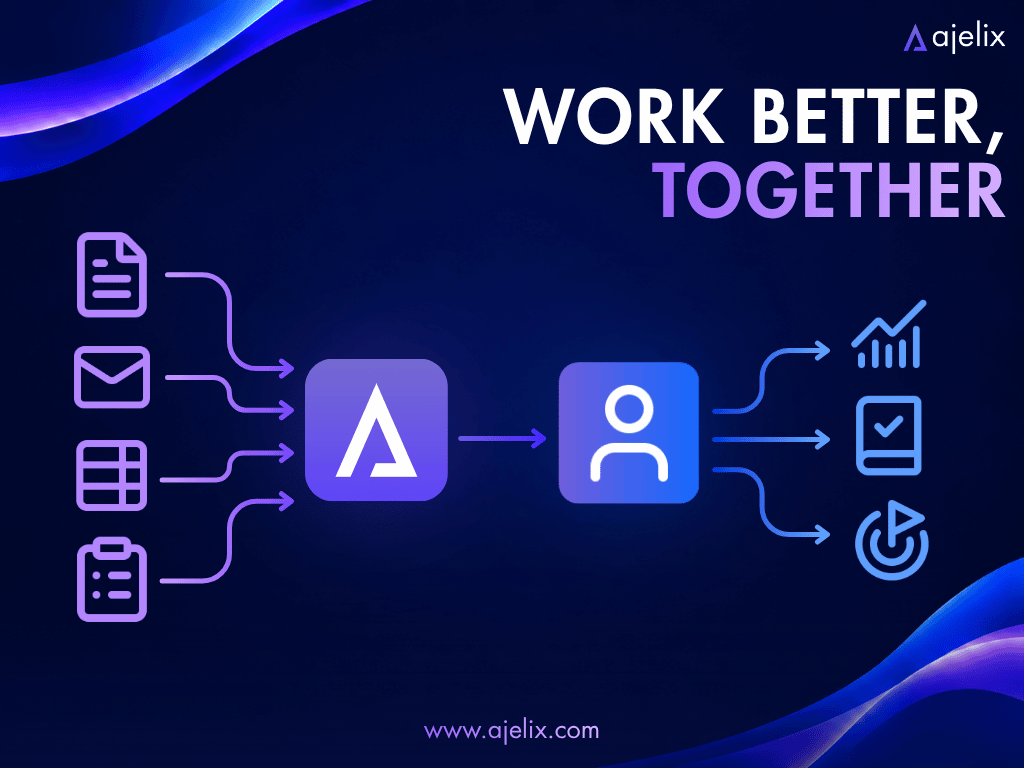
When it comes to high-volume tasks, a human analyst, for example, can handle a certain amount of reports a day, while the AI agent isn’t so limited by time. That’s why AI agents are especially beneficial for larger enterprises handling far more incoming data than smaller teams.
Implementing AI is all about unlocking what wasn’t possible before, rather than whether using AI is cheaper than hiring more employees.
Possible Hidden Costs
Some costs are rarely included in vendor proposals, but they may be relevant to your enterprise:
- Organizational change management: There might be teams or employees that don’t trust the AI technology and won’t use it. It’s important to establish clear communication about what the agents can and can’t do, have visible sources cited so people can verify the information, and escalate a task to a human in high-value cases.
- Opportunity cost of bad implementation: If an agent is configured poorly and fails to deliver value, it creates more work to remedy the situation, potentially facing regulatory challenges and reputational damage. Implementation must be done right from the start, not only after something goes wrong.
How Deployment Types Affect The Cost
There are three possible deployment types that greatly affect the AI agent cost:
| Type/Model | What You Control | What You Pay For |
|---|---|---|
| Vendor cloud | Configuration, usage | Subscription + usage; no infra ops |
| Self-hosted | Everything | Engineering time, infra, maintenance |
| Cloud provider | Workloads | Infrastructure through your existing cloud account |
Ajelix Enterprise supports all three: its own EU-hosted cloud, fully self-hosted (nothing leaves your infrastructure), and deployment through AWS, Azure, or Google Cloud through accounts you already have.
Questions To Ask The Vendor
Use these questions in your communication with a potential AI vendor:
- What’s included in the platform fee vs. what’s billed by usage? LLM API calls, storage, and retrieval often have separate pricing.
- What does establishing an integration require? This is to know how much engineering resources will be needed.
- What governance features are included, and at which pricing tier? Audit logs, RBAC, guardrails, and spend controls are a must for enterprises.
- What does implementation support look like? Figure out how the vendor will support you through the process, for example, whether they have prepared documentation.
- What happens to our data if we leave? This is to find out how the data will be handled in case the collaboration ends, whether it will be deleted or can be exported.
- How does the cost scale as usage grows? To find out whether the scaling cost is predictable.
Which AI agent is the most cost-effective for your organization depends on how you answer those questions against your requirements.
Unsure where to start with AI? Consider Ajelix.
FAQ
There’s no universal number. Platform fees, infrastructure compute, integration engineering, and ongoing governance all contribute. An honest total cost of ownership estimate requires mapping all five layers described above against your specific systems, team size, and compliance requirements.
Building from scratch (custom LLM stack, custom RAG pipeline, custom UI) typically requires a dedicated engineering team and months of work. Using an enterprise platform like Ajelix significantly compresses that timeline by providing the infrastructure layer, leaving configuration and use-case customization as the primary investment.
For high-volume, repeatable tasks agents can process a lot more at lower marginal cost. The upfront AI implementation investment is high, but at scale automation is preferred. The better question is what the agent enables your existing team to do with their recovered time.
Implementation cost covers: integration with existing systems, document ingestion and knowledge base setup, agent configuration and testing, guardrail and governance setup, user access configuration, and team training. Ongoing operations are a separate recurring cost.
Vendor-hosted cloud minimizes internal infrastructure work but may have data residency limitations. Self-hosted maximizes control but adds the need for significant engineering. Cloud provider deployment lets you leverage existing infrastructure commitments and potentially offset costs through existing contracts.
Agentic AI chat that helps you complete projects
AI for work that ingests, transforms, and delivers the exact deliverables your team needs, while you stay focused on strategy. No more chatting, agents can get the job done.