Vertical AI Agents: Meaning, Examples & How To Build

Vertical AI agents exist to fix a frustration every company experiences: that one process that quietly takes up more time than it should. A general AI assistant is able to help, up to the point where the output has to be correct, follow your rules, and move to the system of record.
That last step is where you need an agent that understands one kind of work instead: the documents it uses, the fields it has to fill, and the decision it has to hand to a person.
Our guide covers what vertical agents are, how they compare to horizontal ones, and how to build one for a narrow company process.
What Are Vertical AI Agents
A vertical AI agent is an AI system built for one industry or one business function. It runs on the knowledge, system connections, compliance rules, and quality checks that the specific industry process needs.
If you can sell the same agent to a hospital and a law firm without rebuilding it, the agent is horizontal.
Vertical agents trade versatility for the depth that one buyer needs. Market research splits vertical agents into healthcare, legal, financial services, manufacturing, and retail. A bank and a hospital may need the same technology capability, but completely different guardrails.
Vertical AI Agents vs Horizontal AI Agents
A vertical AI agent is built for one industry or one workflow, while a horizontal agent is built to be useful everywhere, which means the customer supplies the context, integrations, and configuration.
Vertical agents provide depth and a fast path to production inside a narrow scope, while horizontal ones are broader, providing general knowledge instead of being tied to one specific workload.
| Vertical AI agents | Horizontal AI platforms | |
|---|---|---|
| Buyer | One function or industry | Cross-functional, bought centrally |
| Scope | One workflow, done completely | Many workflows, none complete |
| Integrations | Pre-built | Customer assembles them |
| Success metric | Domain KPI: resolution rate, days to cash | Adoption and activity |
| Pricing | Per unit of work | Per seat, per token, per credit |
Examples
Here are some tools and platforms where vertical AI agents either come pre-built or you can build your own depending on your needs:
| Tool | Vertical | What it delivers |
|---|---|---|
| Ajelix | Any industry your teams work in | Agents your team builds for your own process |
| Sierra | Customer experience | Resolves support conversations end to end |
| Harvey | Legal | Research, drafting, document review |
| Abridge | Healthcare documentation | Ambient clinical notes |
| EvenUp | Personal injury law | Demand packages |
| IBM + Microsoft | Finance, retail, insurance | Pre-built industry agents with governance |
| Decagon | Technical support | Support agents |
The vertical AI agents examples worth knowing:
Ajelix Enterprise
Ajelix offers a workspace where the agent gets defined by the client rather than by the vendor. An Excel-using ops team might build an agent that cleans and models workbooks. A marketing team may build campaign and reporting agents. An MSP can build durable AI revenue on a governed service, setting policy, auditing usage, managing access through the Ajelix MSP setup.
Agents get tools, skills, connections, guardrails, tone, and a scope, running in the background on a schedule. Knowledge is grounded in your company data. Governance, security, and sovereignty are included.

Sierra

Sierra builds customer experience agents that work across chat, SMS, WhatsApp, email, voice, and ChatGPT. An agent gets assembled from your SOPs, transcripts, and instructions, then tuned through testing, experiments, and monitoring. The team can see which conversations were resolved and which were handed to a person.
Harvey
Harvey offers agents for legal teams, such as for contract review, due diligence, litigation research, and legal intake. It includes a document vault, a research layer for law and regulation, and shared workspaces with ethical walls between cases.
Abridge

Abridge offers agents for healthcare teams, turning a clinical conversation into documentation. It summarizes the patient history before the visit, captures the encounter in real time, and drafts the note with coding specificity and patient instructions afterward.
EvenUp
EvenUp assembles demand packages for personal injury firms. It reads the medical records and bills, puts the treatment in date order, flags missing records and bills, and drafts the demand letter with the liability story, the medical costs, and the damages explained clearly.
Decagon
Decagon runs an AI concierge across chat, voice, and email, taking on support work and the wider customer lifecycle around it. Workflows are written in natural language. Testing, live experiments, and continuous quality checks are included.
IBM and Microsoft

IBM and Microsoft partnered up to create Imagine Enterprise, which is built from two halves.
IBM contributes more than 6,000 pre-built agents and assets built on its own delivery platform, along with the industry knowledge that came from building and running them. Meanwhile, Microsoft supplies what the agents run on: Microsoft Foundry, Copilot Studio, and GitHub Copilot for building and coordinating the agents and reaching enterprise systems, as well as Fabric, Microsoft 365, Entra, Purview, Defender, and Azure for data, identity, permissions, security, and compliance.
How To Build Vertical AI Agents
All you need is one workflow, and a workspace where the process can be written down. To build vertical AI agents that survive contact with real work, follow these six steps in order.
1. Name the workflow and the number. Instead of writing something vague like “handle supplier invoices,” try “match every invoice over €5,000 to a purchase order and flag rate exceptions before payment.” The more narrow is the statement, the faster the build will be.
2. Collect the knowledge the agent should use. Gather all the needed policies and documentation to then use it as the agent’s knowledge base. In Ajelix, every answer links back to the exact passage it came from.
3. Connect the systems. In Ajelix, connections come through MCP servers, native Google Workspace add-ons, Microsoft 365 at workspace level, or a custom integration request. Each connection is scoped and logged.
4. Build the agent without code. Set the task, tools, skills, guardrails, tone, and boundaries. Skills can be imported from GitHub or written from scratch when the process is specific to your company.
5. Make the process into a playbook. A playbook records the steps in order, what each one needs, and what counts as finished. It turns a valuable conversation into a repeatable run.
6. Involve a person on the decisions that carry liability. Route anything high-value to a relevant human employee, and continuously review the reasoning log.
An example prompt that shows the shape of a working vertical agent:
Accounts payable prompt:
For each invoice in this batch, match it to a purchase order, check the supplier against the approved list, and flag any line item more than 2% above the contracted rate. Output one table with invoice ID, match status, exception reason, and recommended action. Do not approve anything above €10,000. Put those in a second table for the AP lead with your reasoning.
You can switch any information in the prompt to match your situation, and reuse it for other teams with needed alterations.
Ajelix reports consumption per user, agent, and model, and admins can put a monthly limit on each. This means you can calculate cost per completed unit before you quote a price to a customer.
How Ajelix Can Help You
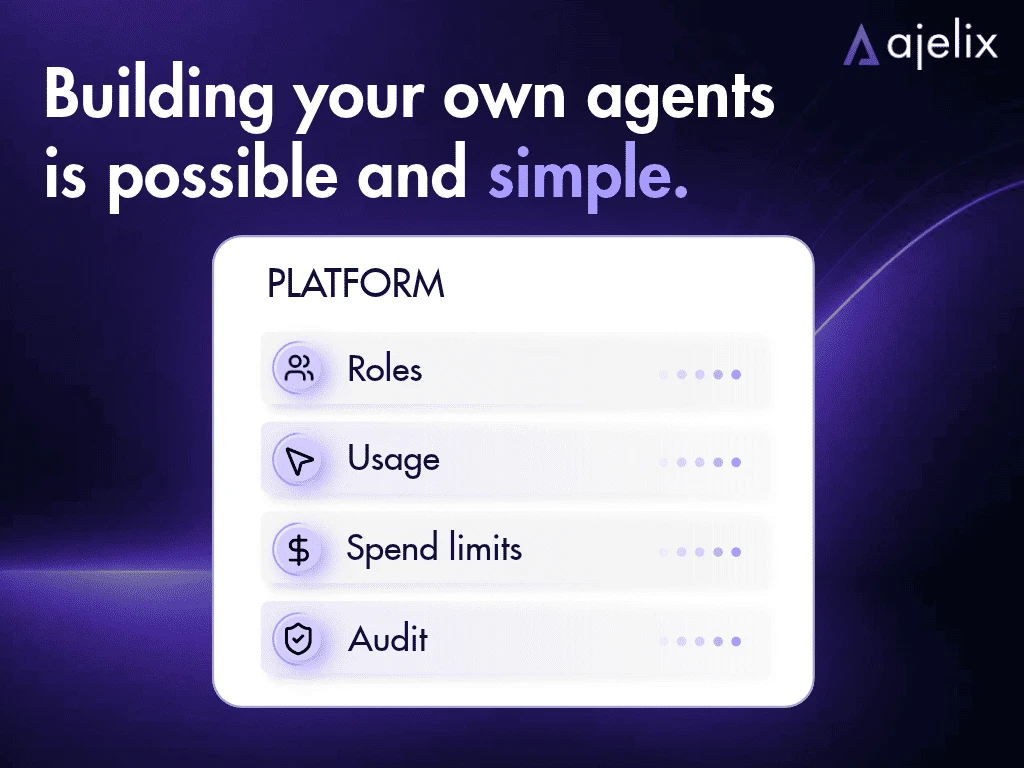
Many companies work in niche industries that AI providers don’t pre-build specific vertical agents for. To them, it’s more worth it to find an agent platform where building your own agents is possible and simple. Ajelix Enterprise offers this.
It gives your team the workspace where a department’s agents, knowledge, connections, and budget are all together. It offers a no-code agent builder, playbooks (workflows) that keep the process repeatable, and governance controls with custom roles, audit trails, and per-agent spend reporting.
The vertical agents are built based on whatever your business does, defined by the people who do it, keeping your options open.
Ajelix runs its own GPU inference in the EU, deploys into your AWS, Azure, OVHcloud, or Google Cloud account, or runs fully on-premises with an air-gapped option, and it does not route prompts through third-party model APIs.
It earns its place when the processes your teams perform are specific enough that no vendor has packaged them yet.
What To Check Before You Sign
Ask a vendor these five questions:
- Can you show me your test set, as well the cases of failure?
- Which of my systems can it change, and can it only read them or also update records?
- What in this workflow requires a human, and who defined it?
- What is the unit I am paying for, and what counts as a delivered unit?
- If I leave, what happens to my configured workflows and my data?
“Vertical agents AI” sounds like a market category, but it is really one question about your own work: has someone already built software that finishes this process, or will you build it yourself?
If covering a process nobody has packaged yet is your priority, contact the Ajelix team and ask them to look at that workflow with you.
FAQ
A software built to finish one specific job in one industry, with the data sources, rules, and approvals that job needs already included. The opposite is a general assistant that knows a bit about everything, but isn’t scoped to one niche.
Support resolution agents such as Sierra, legal drafting and review agents such as Harvey and EvenUp, clinical documentation agents such as Abridge, and company-built agents on a platform like Ajelix, where a finance, marketing, or operations team builds an agent for its own process.
Vertical means depth for one buyer and one workflow, priced on a unit of work. Horizontal means breadth across functions and teams, priced on seats or usage, with the customer doing the configuration. Vertical reaches production faster, horizontal covers more ground once it is running.
Yes, if the platform gives you a knowledge base, connectors, and a no-code builder. The hard part is not the build, but writing down the process precisely enough that an agent can run it without you.
Agentic AI chat that helps you complete projects
AI for work that ingests, transforms, and delivers the exact deliverables your team needs, while you stay focused on strategy. No more chatting, agents can get the job done.