Leading AI Solutions For Enterprise (Compiled By AI Experts)

Finding the right AI solutions for enterprise teams is all about finding what fits your existing data, your compliance requirements, and the workflows you need to improve. There is no single solution that fits every business, so, before committing to anything, make sure that your research is thorough.
To help you get started, our team has compiled a list of the best AI solutions for enterprise automation, as well as other enterprise AI examples and tips for implementation.
This list is brought to you by experts who continuously research up-to-date AI trends, tools, and terminology, working for an AI-native platform, and reviewed by the team’s leadership.
Table of Contents:
What Are AI Solutions For Enterprise
Enterprise AI solutions cover any AI system built to operate inside complex organizational environments, handle sensitive data under strict policies, with all the enterprise-ready compliance. They include data governance, role-based access controls, integration with existing systems, audit trails, and autonomous agents that can run complete workflows.
AI solutions for enterprise these days include these categories:
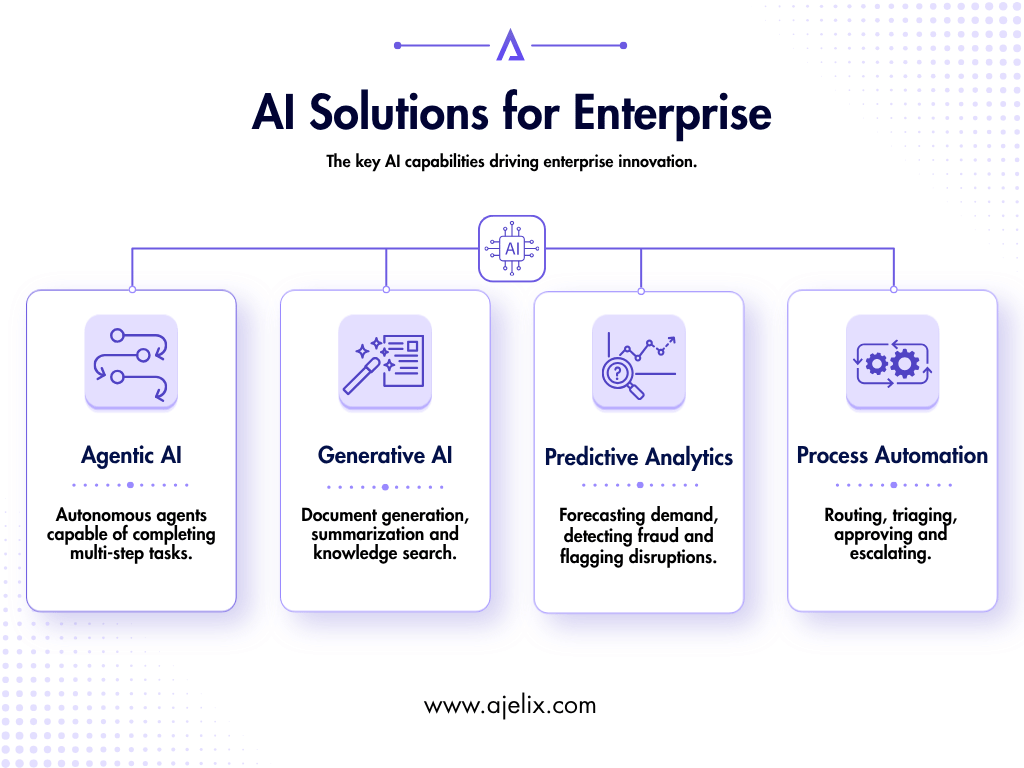
- Agentic AI: autonomous agents capable of completing multi-step tasks.
- Generative AI: document generation, summarization and knowledge search.
- Predictive analytics: forecasting demand, detecting fraud and flagging disruptions.
- Process automation: routing, triaging, approving and escalating.
Deloitte’s survey earlier this year found that of 3,235 leaders, 74% of them achieved positive ROI from AI within the first year. It’s definite proof that AI implementation is worth it.
Top 4 Platforms That Bring AI Solutions For Enterprises
Here is an overview of the top enterprise AI solutions that all feature agentic and generative AI capabilities, predictive analytics and process automation:
| Platform | Best For | Key Features | Pricing Model |
|---|---|---|---|
| Ajelix Enterprise | Enterprise teams that need the AI as an operational layer. | An agentic chat with custom agents, accessible across your company Visual workflow builder for process automation + an Agent Builder Custom RAG layer for the entire organization Open-source LLMs, bring-your-own LLM API | Custom Enterprise contract |
| Microsoft Azure AI Foundry | Large enterprises already running on Microsoft infrastructure that need the widest model selection and deepest Azure-native integration. | Access to 1,700+ models Native integration with Microsoft 365, Entra ID, SharePoint, and Azure Fabric Managed Identity authentication across Azure services | Free to explore the Foundry platform; Individual services (models, agents, tools) billed as pay-as-you-go per token/action |
| ServiceNow | Enterprises that run IT, HR, or customer service operations on ServiceNow and want AI agents operating natively inside the existing system. | Autonomous AI agents that triage, assign, execute, and close tickets end-to-end within the ServiceNow platform Now Assist generative AI bundled into all three 2026 tiers (Foundation, Advanced, Prime) for incident summaries, knowledge articles, and conversational ticketing AI Control Tower for centralised governance and monitoring of all agents | Three AI-native tiers; All tiers include Now Assist AI; Heavier agentic use consumes additional assist tokens; Enterprise Pricing is quote-based |
| IBM watsonx | Finance, healthcare, government, and other regulated industries that require audit logging, data protection and strict compliance. | Built-in model governance, bias detection, and explainability Air-gapped and on-premises deployment Three integrated products in one governed suite: watsonx.ai (model inference), watsonx.data (data lakehouse), watsonx.governance (compliance and audit) | Metered consumption model; Full enterprise deployments are quote-based |
Some immediate insights from the table:
- Pricing for AI implementation for enterprises mostly depends on the size and usage of the team. You find out the exact pricing only when you’re in talks with the platform. Important to add that pricing can vary based on the AI usage.
- AI is no longer optional for ServiceNow – all of their tiers include AI implementation now. This is a clear sign that AI is only becoming more relevant, even for platforms that weren’t originally built to be AI-native.
- Ajelix Enterprise offers the best agentic AI solutions for enterprise agents due to their Enterprise plan featuring a chat that can be used by any employee in your company and advanced AI control layer.
Below, I cover what AI solutions companies do well, what not so much, and who they’re built for.
1. Ajelix Enterprise
Who is it for? Business teams and enterprises that need a fully compliant AI agent platform with custom agents, workflows and an API provider that connects to any external tool, platform and LLM.
- Pros: Their Enterprise plan is fully enterprise-compliant with granular RBAC, full audit trail and reasoning logs, usage monitoring and quota management. The custom agents and connectors are built around your company’s processes. Offers self-hosted LLMs and any third-party API.
- Cons: Run by a smaller team than giants such as Microsoft.
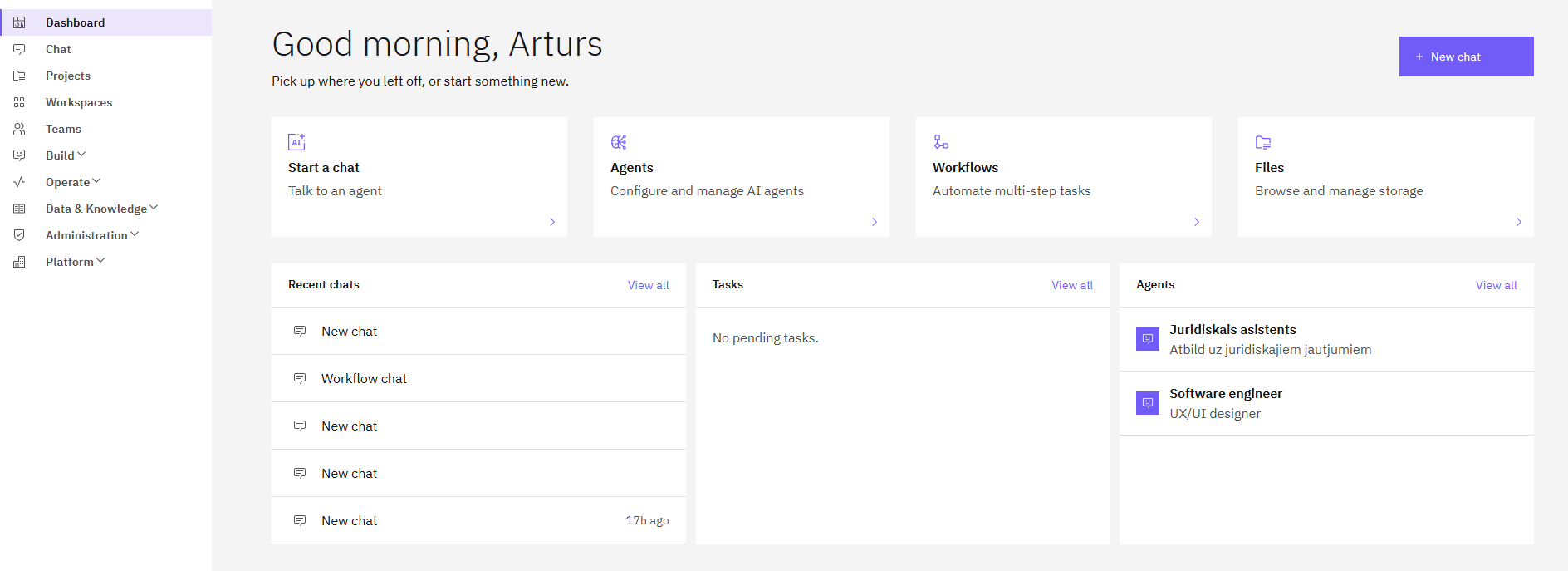
Ajelix is built as an operational layer for enterprise AI. Granular role-based access ensures employees work within their permissions, guardrails, a full audit trail for every agent and employee action. Usage monitoring with quota management by project or team keeps the platform under your control.
Custom agents and connectors are built around your company’s specific workflows. A RAG system trained on your company’s documentation guides the AI to carry out processes that match your company’s standards or knowledge.
Ajelix offers an option to self-host your own LLM and has the option to connect to any third-party source through an API key. This makes it the best AI agents for enterprise solutions.
Ajelix works with clients independently to customize workflows and make the company AI-native, regardless of industry. Pricing is a transparent custom enterprise contract, tailored to team size and the scope of the deployment. Contact the team for a quote.

2. Microsoft Azure AI Foundry
Who is it for? Enterprises already running on Microsoft infrastructure that need the widest model selection and the deepest Azure-native integration.
- Pros: 1,700+ model catalog, deep integration with Microsoft 365, Entra ID, SharePoint, and Azure Fabric, built-in agent evaluation, tracing, and monitoring, strong compliance coverage.
- Cons: High learning curve, requires significant engineering, more relevant for enterprises already using Microsoft.
Azure AI Foundry is Microsoft’s unified platform for building, deploying and operating AI applications for enterprises. It handles model access, agent orchestration, RAG retrieval, monitoring and governance across the platform. Their LLM model catalog contains over 1,700 options, including OpenAI’s GPT-5.
Foundry is a good choice for companies already using Microsoft 365, Entra ID, Azure, or SharePoint, as it fits into the existing technical stack without having to rebuild your company’s identity or security infrastructure.
Microsoft is becoming one of the leading enterprise AI companies with their implementation of AI into the foundation of their originally non-AI platform.
3. ServiceNow
Who is it for? Enterprises that run IT, HR, or customer service operations on ServiceNow already and want AI that works inside that existing system.
- Pros: Agents operate natively inside ServiceNow. Includes autonomous end-to-end ticket triage, assignment, change execution, and closure. Offers multi-agent orchestration.
- Cons: A sensible fit only for teams already needing ServiceNow. Limited flexibility for cross-platform AI orchestration outside the ServiceNow environment.
In 2026, ServiceNow has shifted its AI strategy toward agentic workflows. Assist handles generative AI tasks, while their AI Agent Studio builds autonomous agents. AI Control Tower manages governance across all agents running in the company’s environment.
Conversational AI is also possible, so that non-technical employees can submit requests and get answers in the chat. This makes it one of the leading generative AI solutions for enterprise.
However, ServiceNow is only worth it for specific teams, who already use the platform for their IT, HR and customer service needs. Industries outside these should look at more generalist enterprise AI tools and platforms.
4. IBM watsonx
Who is it for? Teams in finance, healthcare, government, and other regulated industries.
- Pros: Built-in model governance, bias detection, and explainability. Air-gapped deployment for maximum data sovereignty with no external cloud dependency. Offers the strongest regulated-industry compliance frameworks available.
- Cons: More narrow LLM model selection than other platforms on this list. High tech expertise required. Built for compliance-first use cases.
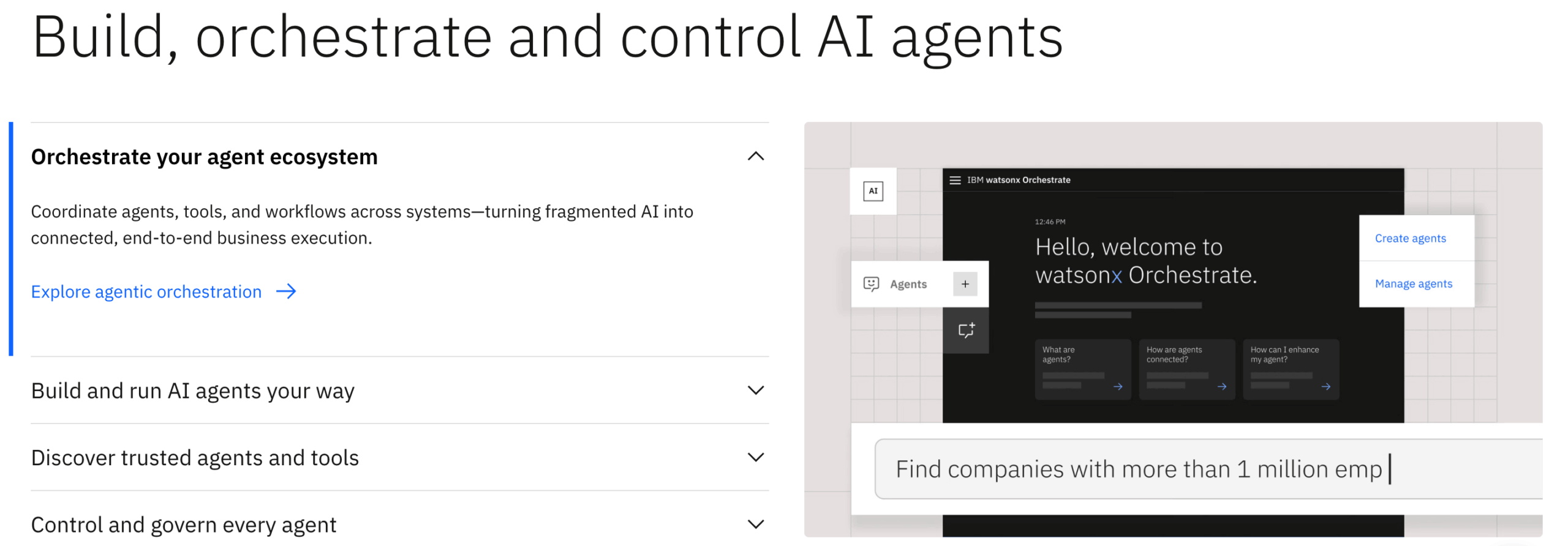
IBM watsonx is the best AI solution for enterprise if your enterprise is part of a regulated industry, where an AI model making a wrong call can mean a compliance violation. watsonx works hard for that not to be the case. The governance layer is built into the platform.
watsonx can run in fully isolated environments with no dependency on external clouds. It is competing on being the most auditable, explainable, and defensible AI platform in the market.
Other Enterprise AI Solution Examples
Here are what AI solutions for automating work in big companies look like in practice, when running across specific functions of your business:
Invoice Processing (Finance)
An AI agent extracts data from incoming invoices, validates it against purchase order records, and routes to a human only in exceptional cases and for review. AI agents are autonomous enough to do most of the work on their own, giving your team more time to focus on the more complex cases.
New Hire Onboarding (HR)
A signed offer letter triggers an AI workflow that consists of:
- Accounts getting created;
- Equipment requests going out;
- Training getting assigned;
- The manager getting notified.
With AI as part of the flow, a lot more time is saved.
Simple Ticket Solving (Customer Service)
AI agents can handle the majority of standard customer service requests without involving a human agent. Account questions, password resets, order status and basic troubleshooting can be solved by the AI most of the time.
Supply Chain Disruption Detection
AI agents monitor supplier data, news feeds and logistics signals to detect any upcoming disruptions before the damage is done. They can trigger procurement workflows to find alternatives before the inventory runs short.
IT Incident Management
Let’s say a major IT incident requires manual coordination across four of the company’s teams. Multi-agent systems can trigger all four at the same time, with shared context and automated handoffs at each step.
Enterprise AI Implementation Tips
Before implementing AI for enterprise solutions, make sure you have covered all the necessary ground. That includes:
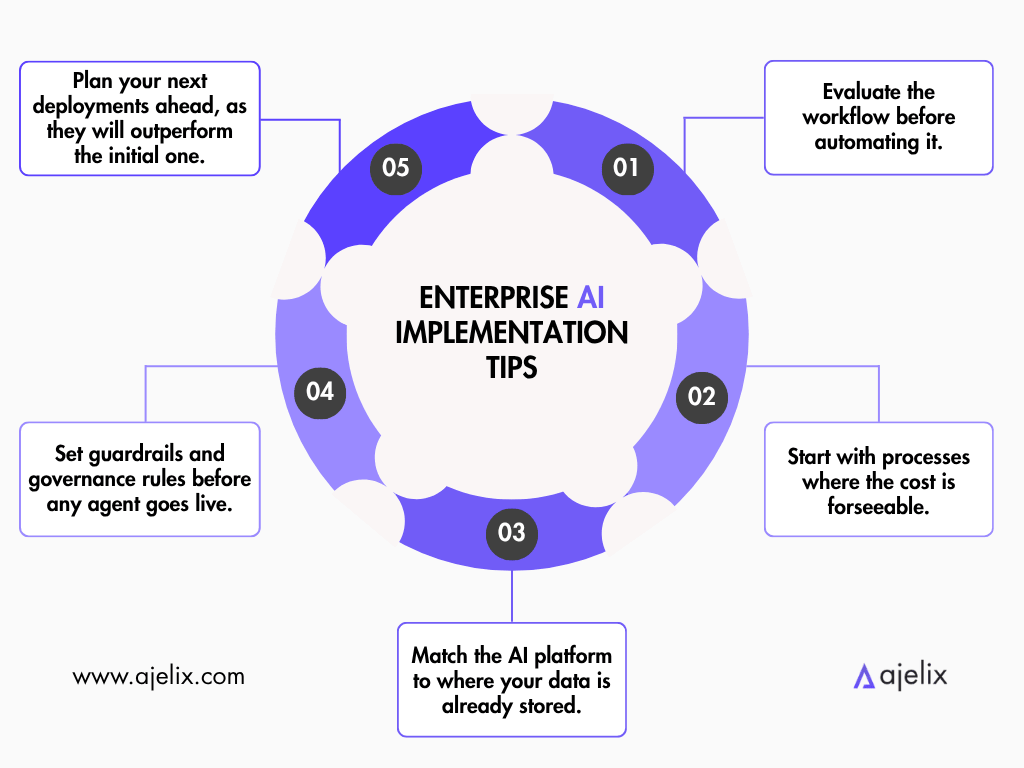
- Evaluate the workflow before automating it. If the workflow is not working manually, bolting AI or automation onto it isn’t going to fix it. You get the best results from redesigning the workflows around what the AI is capable of doing. Make sure you understand first where AI comes in and what the employee should still be responsible for.
- Start with processes where the cost is obvious and foreseeable. That way, the results and baseline costs are measurable, building credibility to your higher-ups who would be later funding larger developments. This could be processes such as invoice processing, customer service tickets, onboarding task coordination and compliance data validation.
- Match the AI platform to where your data is already stored – if relevant. For example, if your company is already using the Microsoft workspace, it makes sense to implement Azure AI Foundry. If your operations are already inside ServiceNow, the AI available eliminates the orchestration layer.
- Set guardrails and governance rules before any agent goes live. Access controls, audit trails, human override mechanisms and escalation logic should come with agents immediately, not only added after something goes wrong.
- Plan your next deployments ahead, as they will outperform the initial one. The first deployment will handle the most obvious, highest-volume work. All the deployments that will come after will be built on cleaner data, teams that are better trained and clearer patterns.
Choose The Right AI Solutions For Your Enterprise
The right platform depends on your existing infrastructure, your industry, and how your teams work currently. Match your situation to the use case below.
| “I need an enterprise AI platform that acts as an operational layer for my company, with custom agents, workflow automation, and a RAG system trained on our own documentation, accessible to every employee.”→ Ajelix Enterprise. The platform is built as a fully compliant operational layer. Custom agents and connectors are built around your company’s specific processes. A RAG system trained on your documentation guides the AI to carry out work that matches your standards. It includes granular role-based access controls, a full audit trail and reasoning logs, usage monitoring, and quota management by project or team. Supports self-hosted LLMs and any third-party API connection. Pricing is a custom enterprise contract tailored to team size and deployment scope. |
| “My organization already runs on Microsoft 365, Entra ID, and Azure, and I need a platform with the widest model selection and native integration into the tools we already use.”→ Microsoft Azure AI Foundry. Azure AI Foundry connects to Microsoft 365, Entra ID, SharePoint, and Azure Fabric without rebuilding your identity or security infrastructure. The model catalog covers 1,700+ options including GPT-5 under enterprise data protection terms. Managed Identity authentication removes the need for stored credentials across Azure services. Strong compliance coverage. Best suited for enterprises already operating on Microsoft infrastructure. |
| “Our IT and customer service operations already run on ServiceNow and I want AI agents that work natively inside that existing system.”→ ServiceNow. ServiceNow’s AI agents operate natively inside the platform. Now Assist handles generative AI tasks including incident summaries, knowledge articles, and conversational ticketing. AI Agent Studio builds autonomous agents that triage, assign, execute, and close tickets end-to-end. AI Control Tower manages governance across all running agents. Worth it for teams already on ServiceNow for IT, HR, or customer service. Less relevant outside that ecosystem. |
| “We are in a regulated industry and explainability, auditability, and air-gapped deployment are non-negotiable requirements.”→ IBM watsonx. watsonx is built specifically for regulated environments. The governance layer covers bias detection, explainability tooling, and full model lifecycle management as core features, not add-ons. Supports fully air-gapped deployment with no external cloud dependency, covering full data sovereignty. Their three integrated products (watsonx.ai, watsonx.data, watsonx.governance) operate as a single governed suite. Every model decision can be traced and explained for regulatory audit purposes. Best fit for finance, healthcare, government, and insurance. |
If Ajelix sounds like the right fit for your company, contact us.
FAQ
They are AI systems built to operate inside complex organizations. That includes data governance, role-based access controls, integrations with existing business tools, audit trails, and autonomous agents that can run complete workflows without manual oversight at each step.
Consumer AI tools are built for individual use. Enterprise AI is built for scale, compliance, and organizational complexity. That means access controls, audit logs, integrations with ERP, CRM, or ITSM systems, and the ability to deploy in regulated or air-gapped environments.
It depends heavily on the platform and scope. Most enterprise deployments do not have public pricing. ServiceNow, IBM watsonx, and Ajelix Enterprise are all quote-based at scale.
A focused deployment covering one workflow and one department can go live in four to eight weeks. Cross-department rollouts with custom integrations typically take six to twelve months. The biggest variable is data readiness: clean, accessible data shortens the timeline significantly.
IBM watsonx is the most purpose-built option for finance, healthcare, government, and insurance. It supports air-gapped deployment, has built-in bias detection and explainability as core features, and every model decision can be traced for regulatory audit purposes.
Not always. Platforms like Ajelix Enterprise are designed so that business teams can configure and manage agents without deep technical resources. Platforms like IBM watsonx or Azure AI Foundry benefit from dedicated technical ownership. The answer depends on the platform and the complexity of the deployment.
Automating a broken process. If a workflow does not work well manually, adding AI makes it faster but does not fix the underlying problem. The organizations getting the best results redesign the workflow around what AI can do before deploying it.
Yes, that is a core requirement for any serious enterprise platform. Ajelix Enterprise connects to any third-party source via API. Azure AI Foundry integrates natively with Microsoft 365 and Azure. ServiceNow agents operate inside the ServiceNow platform itself. IBM watsonx supports integration across regulated environments, including on-premises systems.
Agentic AI chat that helps you complete projects
AI for work that ingests, transforms, and delivers the exact deliverables your team needs, while you stay focused on strategy. No more chatting, agents can get the job done.