Agentic AI vs Hyperautomation: Choose the Right Automation

Just when people started implementing hyperautomation into their company processes, a new beast entered the space, agentic AI. Welcome to the Agentic AI vs hyperautomation debate – their differences matter more than ever now, as businesses aren’t certain which technology is right for their needs.
This article explains how they’re different and what you should be using for your company.
Table of Contents:
- What Is Hyperautomation
- How Hyperautomation Works
- Agentic AI vs Hyperautomation: Core Differences
- Hyperautomation In Action Today
- Where Agentic AI Is the Better Choice
- Agentic AI vs Hyperautomation: Competition or Evolution
- Choosing The Right Process For You
- FAQ
What Is Hyperautomation
Hyperautomation is expressed through the quick identification, evaluation and automation of as many IT and business processes as possible. It combines multiple technologies to create seamless automated workflows.
What was once known as basic task automation has now turned into an orchestration with the progress made in the field. Traditional automation, such as an RPA bot, was able to handle just one system, while hyperautomation is capable of working across multiple.
For example, it can connect a company’s customer service, finance and operations platforms and optimize them as they work.
How Hyperautomation Works
Hyperautomation operates through five stages:
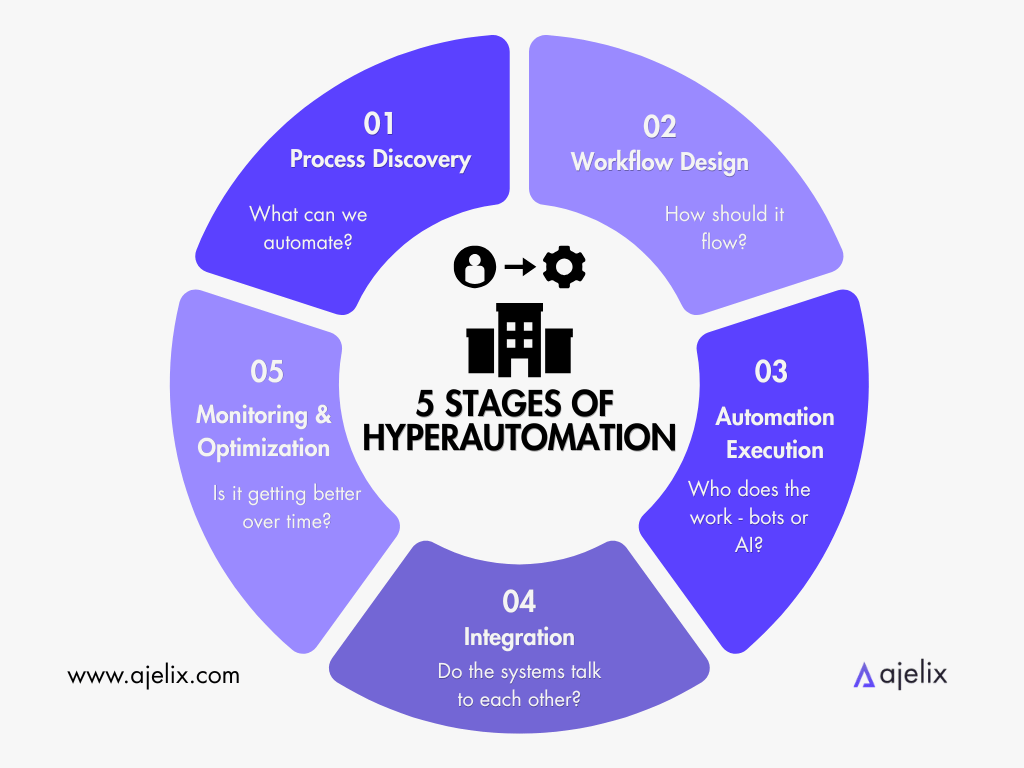
- Process Discovery: Hyperautomation identifies automation opportunities, while simultaneously determining which processes humans currently perform.
- Workflow Design: It then builds the logic of the orchestration, using low- or no-code platforms that define how multiple automation technologies work together.
- Automation Execution: Hyperautomation decides which processes only require a RPA bot, and which are more based on cognitive work, requiring AI.
- Integration: Hyperautomation uses APIs to ensure seamless data flow across applications.
- Monitoring & Optimization: Hyperautomation tracks KPIs through analytics dashboards and uses AI for process improvement suggestions.
Agentic AI vs Hyperautomation: Core Differences
While hyperautomation orchestrates predefined workflows, agentic AI creates systems that perceive environments, reason about goals, and take independent action. Instead of being automated, agentic AI is autonomous.
Agentic AI:
- Understands objectives and breaks them into sub-tasks;
- Selects appropriate tools;
- Adapts when conditions change.
Here is a compiled list of the differences between agentic AI and hyperautomation:
| Hyperautomation | Agentic AI | |
|---|---|---|
| Approach | Orchestrates predefined workflows | Sets goals and finds paths to achieve them |
| Decision-making | Rule-based with AI assistance | Autonomous reasoning and planning |
| Input handling | Structured data and clear triggers | Unstructured data, ambiguity, context |
| Failure response | Escalates to humans or stops | Recovers, re-plans, and continues |
| Maintenance | Requires playbook updates when processes change | Adapts dynamically to changing conditions |
| Integration | Connects existing automations | May replace or bypass traditional workflows |
Because agentic AI is autonomous, less manpower needs to be involved in its processes.
Hyperautomation In Action Today
Hyperautomation excels at processes that are already well-understood, with clear inputs, defined decisions, and measurable outcomes. That’s why organizations are seeing solid results with their hyperautomation processes in the following fields:
Finance Operations
Good for: Invoice processing, payment dispute resolution, financial close processes.
Hyperautomation in finance ops can reduce payment dispute resolution from weeks to days. All while maintaining compliance, it also automates evidence collection and decision workflows.
Healthcare Administration
Good for: Clinical documentation, eligibility verification, claims processing.
When combining RPA bots with hyperautomation, noticeable reductions in operational overhead have been reported.
Supply Chain Management
Good for: Order-to-cash processes, inventory optimization, supplier onboarding.
Because hyperautomation connects systems and platforms, it ensures visibility throughout.
Customer Service
Good for: Triage, routing, resolution.
Hyperautomation can handle most common user requests before involving a human agent.
Where Agentic AI Is the Better Choice
Agentic AI works best in environments that are unpredictable and dynamic:
Security Operations Centers (SOCs)
While hyperautomation is capable of triggering alerts and executing predefined workflows in case of specific errors, agentic AI goes considerably further.
Agentic AI reasons about threat context, connects signals across tools, and develops response strategies. It catches errors before they’ve even occurred.
Reportedly, 40% of hyperautomation’s security alerts go uninvestigated – because there are so many of them, mostly being false positives. Agentic AI would only alert a human about threats it can’t solve.
Software Development
Agentic platforms can autonomously plan code development, carry out security reviews, and handle incident response. Without human involvement, the AI agents can plan actions, connect tools, and adapt to unforeseen circumstances.
The CEO of Ajelix uses agentic AI to develop our own AI agent platform. He compiled a list of processes that agentic AI helps him with throughout the software development stages:
- Architecture planning – agentic AI maps out system structure, component relationships, and technology choices.
- Linux management – handles server configuration, permission handling, package installation, and shell scripting.
- Infrastructure management (containers, virtual machines, networking, security reviews) – configures networking rules and runs automated security compliance checks.
- Unit test generation and execution – writes test cases that cover edge cases and boundary conditions, then runs them to catch bugs before they spread.
- Code conversion (for example, from Python to C#, or from C# to any other language) – translates working code from one language to another while preserving logic.
- Code reviews & refactoring – flags anti-patterns, suggests cleaner implementations, and turns messy code into maintainable modules.
- API endpoint testing & exploration (for integrations) – discovers available endpoints, validates request/response schemas, and ensures integrations behave as documented.
- Actual code generation based on pre-defined rules – produces implementation code that strictly follows conventions, patterns, and constraints defined in the prompt.
- UI/UX planning and iteration on concepts – generates wireframes, proposes interaction flows, and refines designs based on feedback.
- Debugging – finds both existing and potential errors.
DevOps and Infrastructure Management
Devs rely on agentic AI because of its capability of producing self-healing systems. AI agents are proactive and detect potential problems before they arise. They deal with these errors themselves, without involving a human.
Agentic AI vs Hyperautomation: Competition or Evolution
Agentic AI isn’t a replacement for hyperautomation, but an addition to it. This means that hyperautomation remains a process that companies should implement, RPA bots and all. Orchestration platforms still connect systems, which is an essential aspect of maintaining them.
What truly changes is how autonomous the process becomes.
With hyperautomation, the humans are responsible for setting defined boundaries, designing workflows, and configuring logic for decisions. It executes them well, but only within these predefined rules.
With agentic AI, humans only set objectives and constraints for the AI. The AI does the rest of the work, without needing further human prodding. It executes tasks, handles unforeseen circumstances and learns from everything it does.
Even when the time comes for every platform to implement agentic AI, some aspects of hyperautomation will still remain. Why get rid of something that’s been proven to work?
Choosing The Right Process For You
If you’re deciding between investing in hyperautomation or agentic AI, consider these factors:
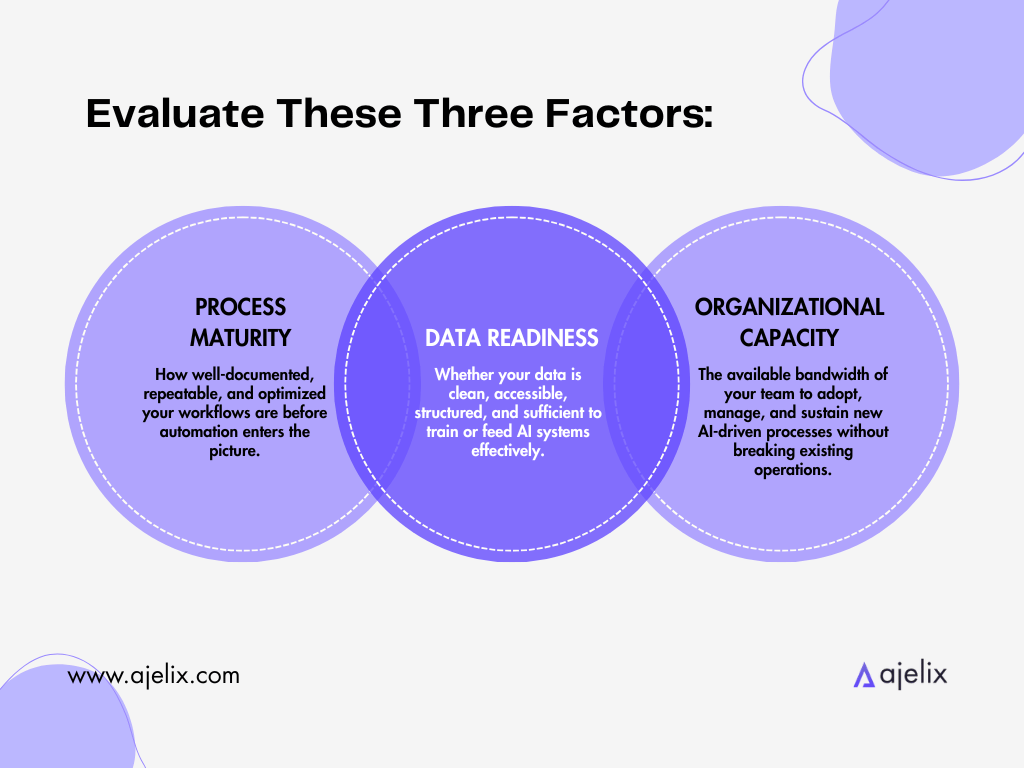
Process Maturity
- Well-documented, predictable processes → Hyperautomation
- Dynamic, ambiguous, rapidly changing processes → Agentic AI
Data Readiness
- Clean, structured, integrated data sources → Hyperautomation
- Unstructured data requiring interpretation and analysis → Agentic AI
Organizational Capacity
- Strong process engineering and IT governance → Hyperautomation
- Tolerance for experimentation and learning → Agentic AI
Most enterprises will end up using both, but enterprises have the financial resources for it. If you’re a founder of a new product reading this, I would recommend starting with AI agents, such as Ajelix.
Ajelix is an easy-to-use agentic tool that goes from a simple prompt and/or data source to finished projects.
Ajelix is also available for enterprise use.

FAQ
Hyperautomation orchestrates predefined workflows using rules and RPA bots, while agentic AI operates autonomously, setting its own goals, reasoning through problems, and adapting without human intervention.
No. Agentic AI adds capabilities to existing automation infrastructure rather than replacing it. Hyperautomation still excels at connecting systems and handling well-documented, predictable processes.
Choose hyperautomation when you have clean structured data, well-documented processes, and strong IT governance. It’s ideal for finance operations, healthcare administration, and supply chain management.
Agentic AI shines in dynamic, unpredictable environments like security operations centers, software development, and DevOps, where conditions change rapidly and require adaptive decision-making.
No. Unlike hyperautomation, agentic AI handles unstructured data, ambiguity, and context. It can interpret and synthesize information from varied sources without pre-formatting.
Hyperautomation requires playbook updates whenever processes change. Agentic AI adapts dynamically to changing conditions without manual reconfiguration.
Start with agentic AI tools like Ajelix that go from simple prompts to finished projects. They’re faster to deploy and require less upfront process engineering than full hyperautomation platforms.
Agentic AI chat that helps you complete projects
AI for work that ingests, transforms, and delivers the exact deliverables your team needs, while you stay focused on strategy. No more chatting, agents can get the job done.