Best AI Agent Platforms For Teams In 2026 (Reviewed and Ranked)

Every company that hasn’t implemented one yet is in search for the best AI agent platform that could improve their processes. A lot of options are out there, so to make it easier, I have compiled a comprehensive list of the top enterprise AI agent platforms for your consideration.
This list is coming to you from an expert who continuously researches up-to-date AI trends, tools, and terminology, working for an AI-native platform.
Let’s dive in.
What Is An AI Agent Platform
An AI agent platform is at its core a software that lets you build, run, maintain and coordinate autonomous AI agents inside an environment where your company’s data and processes are shared with the AI platform.
The most important aspect is its autonomy. A platform-level AI agent is completing work even before you prompt it – planning, calling tools, retrieving data, writing files and code, and orchestrating the other agents.
Across those agents an infrastructure is shared, which makes one-off tools become a coordinated system:
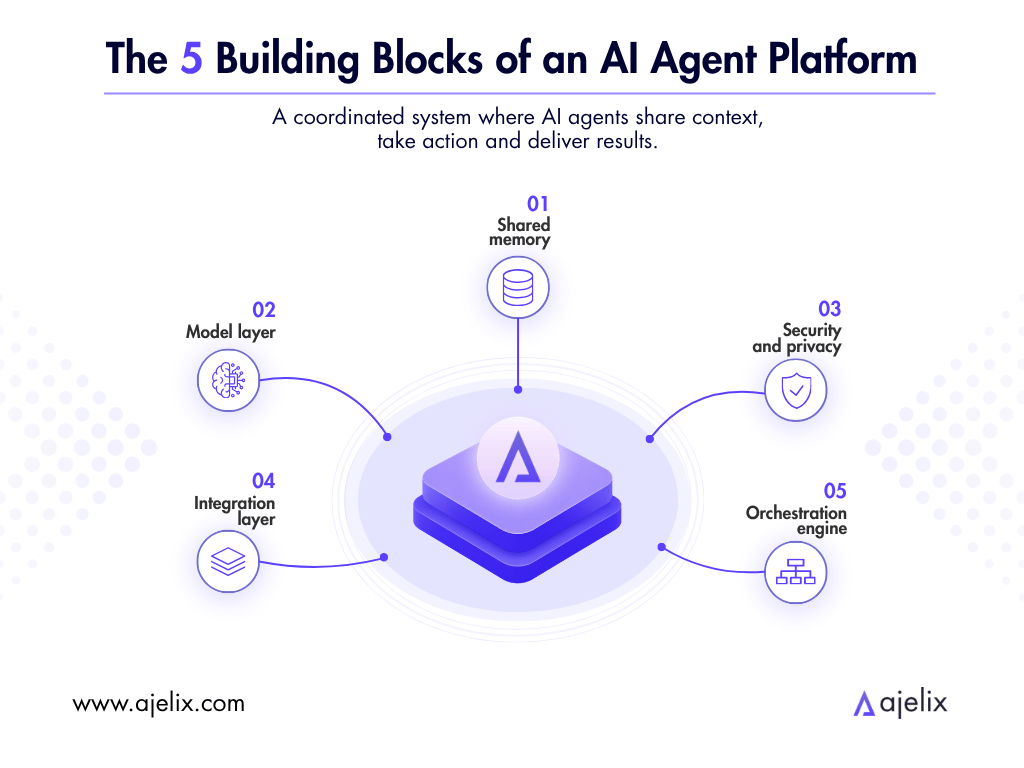
- Shared memory ensures agents carry context across all conversations.
- A model layer routes agent requests between providers, hosts its own LLMs, or lets you connect your own API.
- Security and privacy is applied to every agent through role-based access, audit logs, policy enforcement and compliance certifications.
- An integration layer connects agents to your data sources, systems and environment.
- An orchestration engine combines agents, tools and manual steps that should be performed by a human into workflows.
These are the basics of AI agent creation platforms. If you’re looking at an AI that calls itself a platform but doesn’t feature these, it’s likely that it’s wearing the wrong label.
What Is A Multi-Agent AI Platform
A multi-agent AI platform is a type of AI system composed of multiple, independent (but interactive) agents, each capable of perceiving their environment and taking actions.
More simply, it means multi-agent AI platforms run several different AI agents at once, where each one has a specific job, but they can talk to each other and share information to get a bigger task done together.
Instead of one agent trying to do everything – and likely stumbling in some aspect – the work is split across several agents.
How Platforms Are Different From Tools
A tool does one specific task well. For example, Google Translate translates your text from Spanish to English or a single LLM chatbot answers questions. Tools tend to be easy to adopt and replace, and are only loosely connected to anything else you use in your work life.
A platform is an environment wherein multiple components, services, and workflows run together. Platforms integrate, govern, and orchestrate. Switching platforms is hard and its costs are high because your data, workflows, and ecosystem are entangled with them.
Tools do one thing, while platforms do many things through shared architecture.
This is important to note because you will see many tools call themselves platforms, when they are lacking the components of a real platform. If you’re in search of an AI agent orchestration platform, it’s important you find exactly what you’re looking for.
What Makes “The Best” AI Agent Platform: My Evaluation Criteria
I evaluated every platform in this article against five criteria. Each is concrete enough that you can score it against your own priority list:
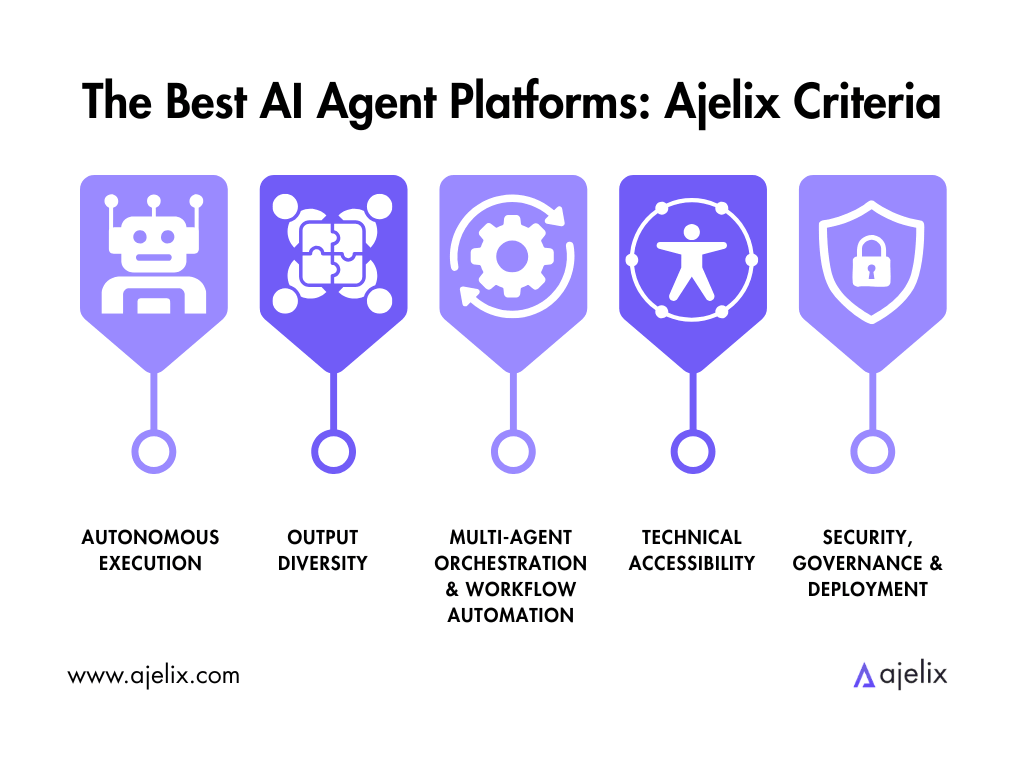
- Autonomous execution: Is the platform working without prompting it? Does it produce finished or nearly-finished work you can use after a human review?
- Output diversity: What kind of finished projects can it generate? Can it natively work with spreadsheets, dashboards, presentations, apps, scripts, documents and code?
- Multi-agent orchestration & workflow automation: Can it coordinate multiple specialized agents and automated steps into workflows you can use? Are agents connected to one another, working in sync?
- Technical accessibility: Can a regular business user work with the platform after minimal training, or is it too technical? (Not build anything, but simply use it). Are the agents autonomous enough that only a human review or minimal prompting is needed?
- Security, governance & deployment: Is it fit for regulated industries and companies that work with sensitive data? Does it log audits, have role-based access control and compliance certifications? Can you self-host, bring your own LLM and place the platform inside your own system?
These are all crucial aspects when deciding what is the best AI agent platform. Each platform ranked below was scored against these criteria.
The Top 5 AI Agent Platforms Now
Here are the best AI agent platforms for enterprises and teams at a glance:
| AI Agent Platform | Best For | Key Features | Pricing Model |
|---|---|---|---|
| Ajelix Enterprise | Autonomous execution Output diversity Security, governance & deployment | An agentic chat with custom agents, accessible across your company Visual workflow builder for process automatization + an Agent Builder Custom RAG layer for the entire organization Open-source LLMs, bring-your-own LLM API | Custom: Enterprise Contract |
| IBM watsonx Orchestrate | Multi-agent orchestration Security, governance & deployment | Governed control plane for agents across departments Connects to 700+ enterprise systems without replacing your stack Hybrid deployment | Consumption-based + VPC licensing |
| Microsoft Agent Framework + Copilot Studio | Technical accessibility Multi-agent orchestration | 1,500+ business app connectors inside Microsoft 365 Computer Use agents can click and type across browser apps MCP server support | Platform add-on + consumption |
| Snowflake Cortex Agents | Security, governance & deployment Multi-agent orchestration | Agents inherit Snowflake’s security Combines text-to-SQL (Cortex Analyst) and document search (Cortex Search) Multi-agent orchestration via Snowflake Tasks | Consumption-based |
| Anthropic Claude Managed Agents | Security, governance & deployment Autonomous execution | Self-hosted sandboxes run tool execution in your own software MCP tunnels connect agents to private servers Long-running autonomous sessions with built-in memory | Consumption-based |
Based on this table overview alone, we can draw these conclusions:
- Security, governance and deployment are crucial for an AI agent platform. Without proven guardrails and security certificates intact, companies are never going to want to deploy the AI.
- All of the platforms feature multi-agent orchestration, but only one of them goes further by featuring native output diversity – Ajelix Enterprise. Before their Enterprise plan became available, Ajelix already focused on creating deliverables through agentic AI and AI agents.
- The pricing of most of these platforms is based on consumption. This makes sense, as team sizes and needs vary.
Below, I cover what each one does well, what not so much, and who it’s built for.
1. Ajelix Enterprise
What teams is it for? Teams and enterprises that need a fully compliant AI agent platform with custom agents, workflows and an API provider that connects to any external tool, platform and LLM.
- Pros: Fully enterprise-compliant with granular RBAC, full audit trail and reasoning logs, usage monitoring and quota management. The custom agents and connectors are built around your company’s processes. Offers self-hosted LLMs and any third-party API.
- Cons: Run by a smaller team than giants like IBM, Microsoft, and Snowflake.
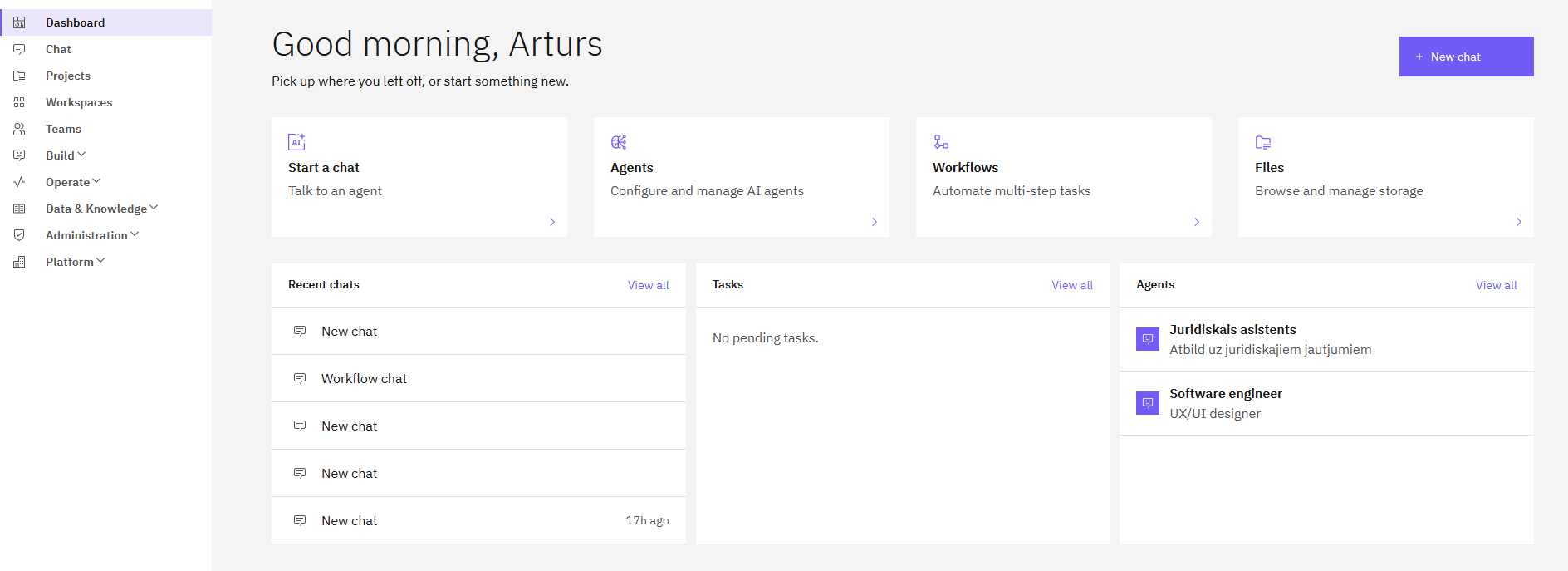
Ajelix is built as an operational layer for enterprise AI. Granular role-based access ensures employees work within their permissions, guardrails, a full audit trail for every agent and employee action. Usage monitoring with quota management by project or team keeps the platform under your control. Agents alert humans for review when necessary to ensure high-value actions aren’t performed without permission.
Custom agents and connectors are built around your company’s specific workflows. A RAG system trained on your company’s documentation guides the AI to carry out processes that match your company’s standards or knowledge.
Deployment is very flexible because Ajelix offers an option to self-host your own LLM and has the option to connect to any third-party source through an API key. Meaning, the full platform – or components a company wants – can be placed inside the company’s own servers, making a platform that shines with its enterprise-ready security measures even more secure.
Ajelix works with clients independently to customize workflows and make the company AI-native, regardless of industry. Pricing is a transparent custom enterprise contract, tailored to team size and the scope of the deployment. Contact the team for a quote.

2. IBM watsonx Orchestrate
What teams is it for? Enterprises that need one central place to manage, oversee, and coordinate AI agents across different departments.
- Pros: Multi-agent orchestration with shared context across workflows, open architecture connects to 700+ enterprise systems, hybrid deployment.
- Cons: Heavier implementation that can take a long time, with separate infrastructure costs. Mostly used by IBM Cloud or Cloud Pak customers, meaning teams that are Google or Azure first may find less native integration support.
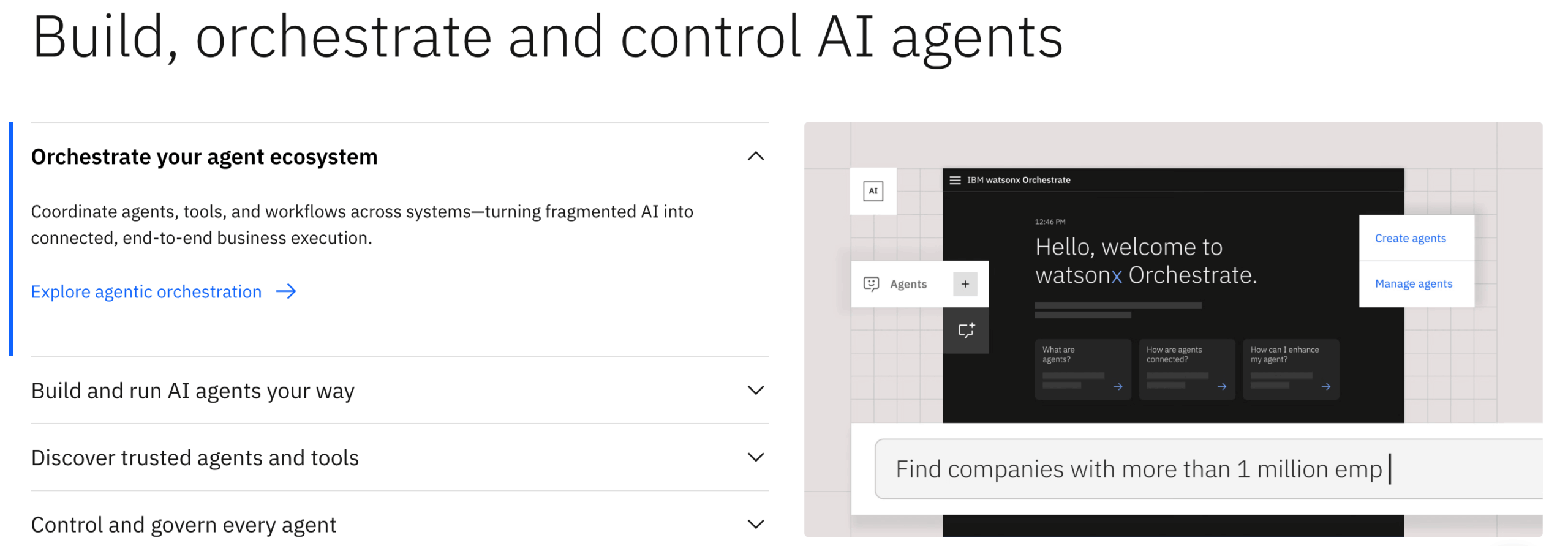
watsonx Orchestrate’s strongest suit is its multi-agent orchestration, which acts as a router across your agent ecosystem. It coordinates specialized agents across HR, sales, finance, procurement and customer service. It has a catalog of 100+ pre-built agents and 400+ tools from IBM and partners. Agents built outside Orchestrate can be imported, so that agents you’ve already invested in aren’t abandoned.
The platform enforces policies and provides the ability to observe the entire agent lifecycle, from the moment it’s built into production. Agent Observability provides insights into agent health, such as accuracy. Its hybrid deployment means you can run the agents where it makes sense for your specific business.
No-code visual builders let business users create agents, but it’s also an option for developers to build more advanced agents and have full control. Pricing is consumption-based, starting at approximately $500 per month for the Essentials plan, with custom enterprise pricing for advanced governance and deployment.
3. Microsoft Agent Framework + Copilot Studio
What teams is it for? Teams and enterprises already working with Microsoft 365 that want to build and deploy agents without leaving the platform.
- Pros: Over 1,500 pre-built connectors, business users can build agents visually in Copilot Studio with no code required, governance built into the Microsoft stack.
- Cons: Cloud-only deployment, only working inside Microsoft and requiring an additional Azure subscription, pricing is hard to predict.
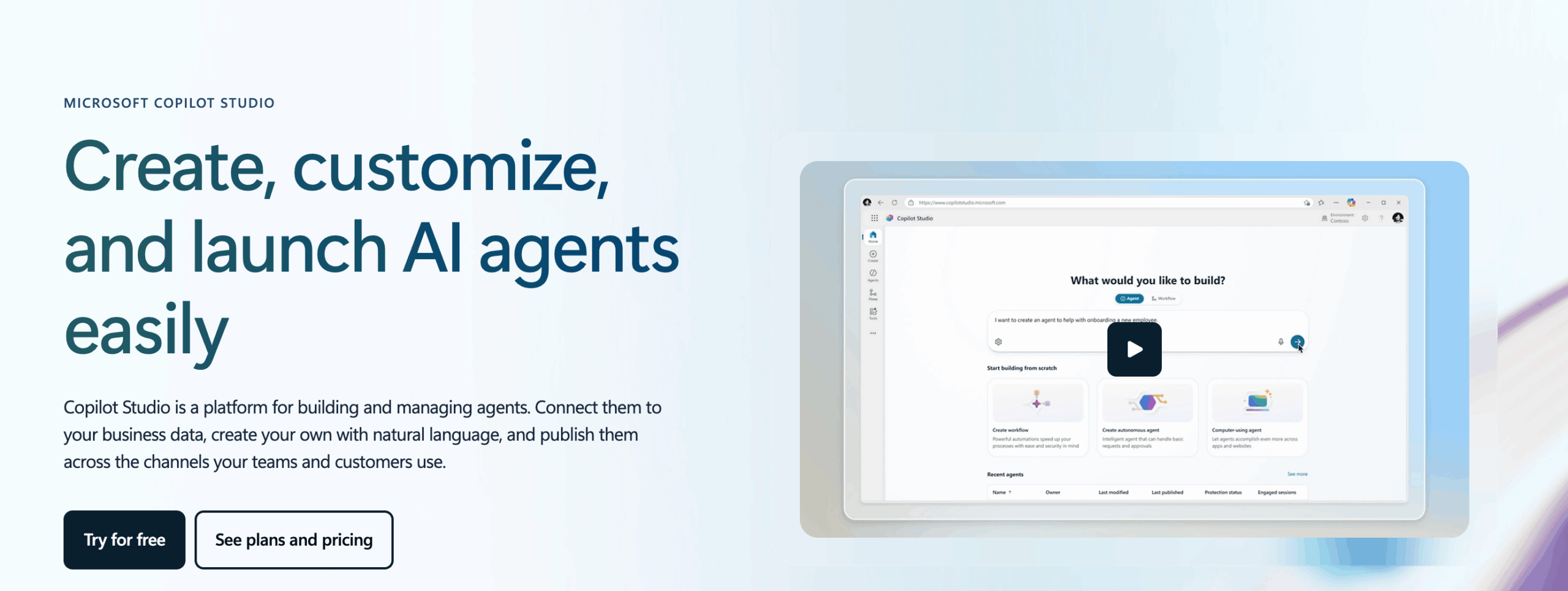
Copilot Studio offers the chance to be used by both developers and business users. Developers get Agent Framework, while non-technical team members can use a drag and drop function to build conversational agents visually, connect them to data sources and publish them. For that reason, it is partly a no code AI agent platform. Teams can choose between Microsoft models, OpenAI, and Anthropic Claude within the same platform.
Microsoft has recently implemented new multi-agent orchestration functions:
- Microsoft Fabric integration lets Copilot Studio agents work alongside Fabric agents with access to the full enterprise data estate.
- The Microsoft 365 Agents SDK lets teams compose cross-application workflows by reusing logic across agents.
- Agent-to-Agent communication uses an open protocol, so that agents built on other platforms can delegate work to and receive work from Copilot Studio agents.
The platform inherits Microsoft’s enterprise compliance certifications, which include SOC 2, ISO 27001, HIPAA, and GDPR. Audit trails and logs for admin review are available. One downside is the platform is cloud-only with no self-hosted or on-premises path.
4. Snowflake Cortex Agents
What teams is it for? Data-centric teams and enterprises already using Snowflake that need AI agents to operate on the warehouse data.
- Pros: Agents inherit Snowflake’s functions, such as role-based access control. Combines text-to-SQL (Cortex Analyst) and document search (Cortex Search) in one workflow. Multi-agent orchestration via Snowflake Tasks and stored procedures keeps failure handling predictable.
- Cons: Narrow scope due to agents operating inside Snowflake, requiring external MCP connectors for any other system. Pricing is hard to predict.
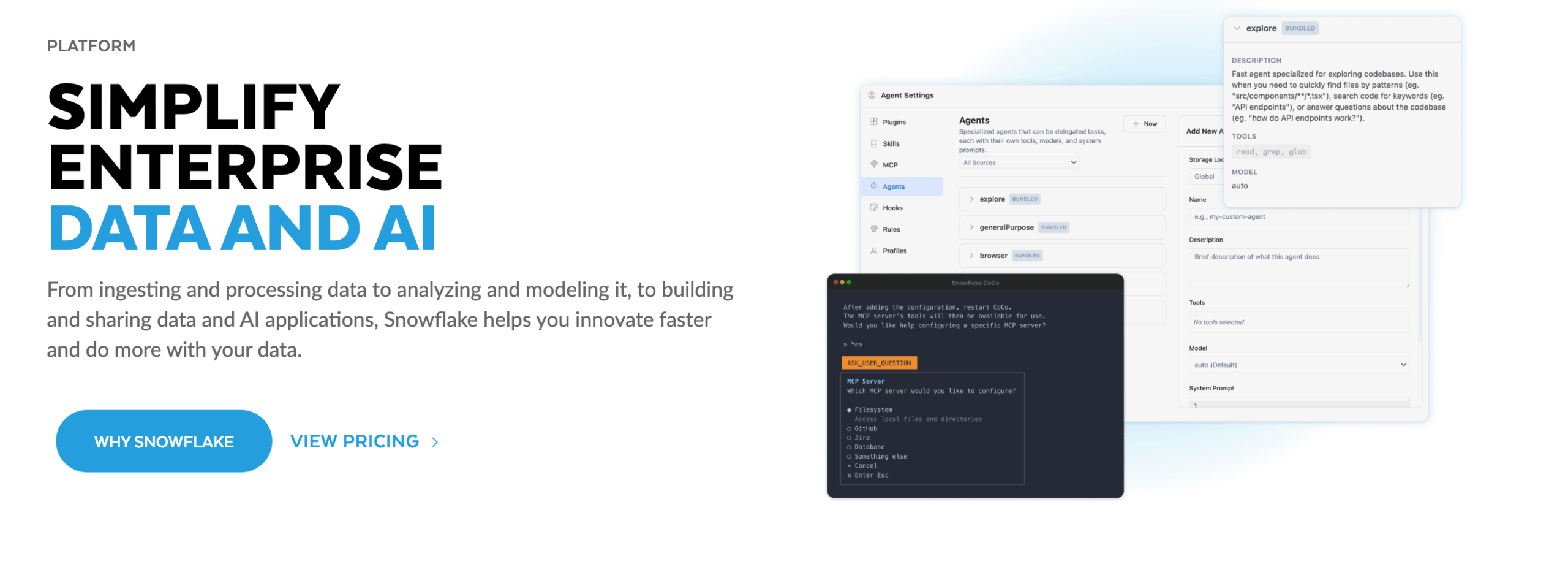
Due to Snowflake’s built-in governance, observability, and lifecycle management of agents – its strongest suit, it can be considered an AI agent management platform. Snowflake’s AI Observability adds evaluation metrics such as relevance, groundedness and harmfulness, and teams get transparency before pushing agents to production. Its MCP connectors let agents reach external systems like Jira, Salesforce, or Slack.
The platform is capable, but its main scope is data workflows, specifically data analysis, document summarization, report generation and natural-language-to-SQL. Data analysts can reasonably work inside Snowflake.
This is a platform to invest in if you’re already using Snowflake for your company, not teams looking for a general-purpose AI agent platform.
5. Anthropic Claude Managed Agents
What teams is it for? Engineering teams that want explicit control over where code runs and how private systems are accessed.
- Pros: Developers define what an agent should do while Anthropic handles the infrastructure. Offers self-hosted sandboxes in Beta. Pricing is transparent and usage-based.
- Cons: Developer-first. Several features are still only in preview or Beta. Agents run on Anthropic models only.
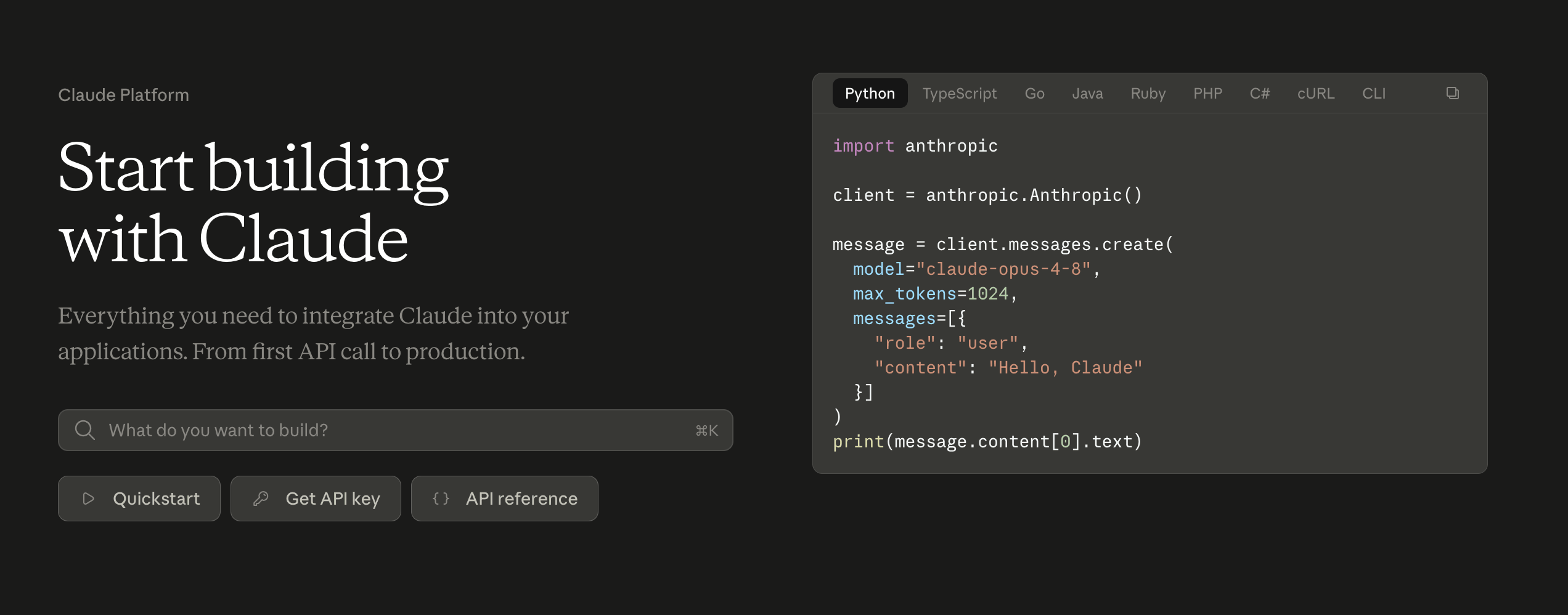
Claude Managed Agents are built for long-running, multi-step tasks that deliver a finished result. Sessions can run for multiple hours and persist through disconnections, with the agent picking up where it left off. The platform handles the operational work, so that devs don’t need to write their own retry logic.
The agent architecture is split for self-hosted sandboxes, meaning Anthropic keeps the orchestration (reasoning) layer, while the customer’s own cloud runs the sandbox wherein code is executed and files are written. MCP connections let agents reach internal databases, private APIs and ticketing systems.
The platform is capable but focuses mostly on technical workloads, like code generation, file processing, data analysis and conversational responses. This is definitely not a no-code platform dedicated for business users.
Choose The Right AI Agent Platform For Your Business Needs
The right AI agent platform depends on your team’s skills, your existing tech, and how much control you need over data and infrastructure. I’ve compiled a list of use cases to help guide your decision.
| “I need an enterprise-ready AI agent platform with custom agents, connectors, a knowledge base (RAG system), role-based access, audit and reasoning logs, and the option to self-host, that my whole team can use.”→ Ajelix. Any employee can describe what they need and get a project finished, while IT keeps control through RBAC, audit and reasoning logs, usage monitoring, quota management, and human-in-the-loop guardrails. The full Ajelix platform – or just the components you choose – can run on your own enterprise servers, with self-hosted LLMs and bring-your-own API, meaning you are never locked into a single model provider. |
| “I’m accumulating agents across vendors, frameworks, and departments, and I need one governed control plane to coordinate, route, and monitor them all.”→ IBM watsonx Orchestrate. A multi-agent orchestration platform built to unify a mixed agent estate with 100+ prebuilt agents and 700+ enterprise integrations, a low-code studio for business users and pro-code for developers, plus embedded guardrails, observability, and lifecycle governance. |
| “My organization already runs on Microsoft 365 and Azure, and I want governed agents that live inside the tools my employees already use.”→ Microsoft Copilot Studio + Agent Framework. A low-code agent platform grounded in SharePoint, Dataverse, and 1,500+ prebuilt connectors, with native HIPAA, SOC 2, ISO 27001, and GDPR compliance, plus Azure Sovereign Clouds (GCC High / Azure Government) for FedRAMP High and ITAR workloads. |
| “My AI agents need to reason directly over governed enterprise data, such structured tables and unstructured documents, without moving or exposing it.”→ Snowflake Cortex Agents. Agents live inside the Snowflake AI Data Cloud, so they plan, call tools, reflect, and act on governed data with native Horizon access controls, meaning every user sees only the data they are entitled to. The natural pick when your data warehouse is already Snowflake. |
| “I have an engineering team and I want long-running autonomous agents that plan, write code, call tools, and recover from errors, without us building the infrastructure.”→ Anthropic Claude Managed Agents. Anthropic handles the orchestration part, while self-hosted sandboxes (public beta) let code execution run inside your own infrastructure and MCP tunnels (research preview) connect agents to private systems over outbound-only connections. Developer-first, with no visual builder. |
If Ajelix sounds like the right fit for your company, contact us.
FAQ
An AI agent platform is software that lets you build, run, maintain, and coordinate autonomous AI agents inside a shared environment, with shared memory, a model layer, security, an integration layer, and an orchestration engine. Unlike a chatbot or single tool, it’s built into your company’s processes and acts before you prompt it.
It depends on your stack and priorities. Ajelix Enterprise leads for autonomous execution, output diversity, and deployment flexibility. IBM watsonx Orchestrate is best for governing a mixed-agent estate. Microsoft Copilot Studio fits teams already using Microsoft 365. Snowflake Cortex Agents is the pick for governed data workloads. Anthropic Claude Managed Agents suits engineering teams that want long-running autonomous agents.
A tool does one task well and is easy to swap to a different one. A platform is a shared environment where multiple agents, data sources, and workflows run together with shared governance, making it harder to replace because your data, workflows, and ecosystem get entangled with it.
A multi-agent AI platform runs several specialized agents at once, each with its own job, while they communicate and share context to complete a larger task together. Instead of one agent trying to do everything, the work is split across coordinated agents.
Ajelix Enterprise supports self-hosted LLMs, bring-your-own API, and deployment on your own servers. IBM watsonx Orchestrate offers hybrid and on-premises deployment. Anthropic Claude Managed Agents offers self-hosted sandboxes (public beta) for tool execution, though the orchestration layer stays on Anthropic’s side. Microsoft Copilot Studio and Snowflake Cortex Agents are cloud-only.
Ajelix Enterprise, IBM watsonx Orchestrate, and Microsoft Copilot Studio all offer RBAC, audit trails, and compliance certifications. Snowflake Cortex Agents inherits Snowflake’s native governance and Horizon access controls. Anthropic’s self-hosted sandboxes and MCP tunnels are aimed at regulated teams but are still in beta or research preview.
Yes, on a few of them. IBM watsonx Orchestrate and Microsoft Copilot Studio offer no-code or low-code visual builders. Snowflake Cortex Agents is accessible to data analysts. Anthropic Claude Managed Agents is developer-first.
Most platforms are consumption-based. IBM watsonx Orchestrate Essentials starts around $500 per month, Microsoft Copilot Studio starts at $200 per tenant/month plus usage, and Snowflake Cortex Agents and Anthropic Claude Managed Agents bill per use. Ajelix Enterprise uses a custom contract tailored to team size and deployment scope.
Agentic AI chat that helps you complete projects
AI for work that ingests, transforms, and delivers the exact deliverables your team needs, while you stay focused on strategy. No more chatting, agents can get the job done.