AI Agents Explained: What They Are and How To Use Them

AI agents are one of the most searched topics in tech right now – and for good reason. Every few years, a technology comes along that changes the rules. AI agents are that shift for the mid-2020s.
Chatbots answer questions. AI agents complete tasks and entire workflows. Where a chatbot stops at a response, an agent keeps going – browsing the web, running calculations, making decisions – until the job is done. You set the goal, and the agent figures out how to reach it.
Whether you’re a business owner, a marketer, or just AI-curious, this is your starting point.
What Are AI Agents?
An AI agent is a system that plans, executes, and delivers a finished output toward a goal – without needing step-by-step guidance. Unlike a generative AI chatbot that stops at a response, an AI agent completes the work.
The simplest way to put it: an AI chatbot responds, an AI agent acts.
A chatbot follows a script. Ask it something outside its rules, and it hits a wall. An AI agent, by contrast, is built around a large-language-model (LLM) that can reason, plan, and decide. It’s connected to tools like web search, APIs, databases, and code execution to carry out those plans.
Example. Ask a chatbot to “research [your company’s] top three competitors and summarize their pricing.” It’ll likely hit a wall. Give the same task to an AI agent, and it searches the web, pulls the data from each page, and hands you a structured summary.
What makes an AI agent distinct comes down to four core properties:
- Autonomy. It operates independently, without step-by-step human direction.
- Goal-orientation. It works toward an outcome, not just a single response.
- Tool use. It connects to external systems to gather information and take action.
- Adaptability. It adjusts its approach based on what it finds along the way.
Those four properties, working together, are what make an AI agent something fundamentally different from any automation tool that came before it.
The true definition of an AI agent is an intelligent entity with reasoning and planning capabilities that can autonomously take action. – IBM
How Do AI Agents Work?
An AI agent runs a continuous loop: it takes in information, thinks about what to do, then acts. That cycle repeats, sometimes dozens of times in a single task, until the goal is complete. It’s less like a search engine giving you one answer and more like a colleague working through a problem, step by step.
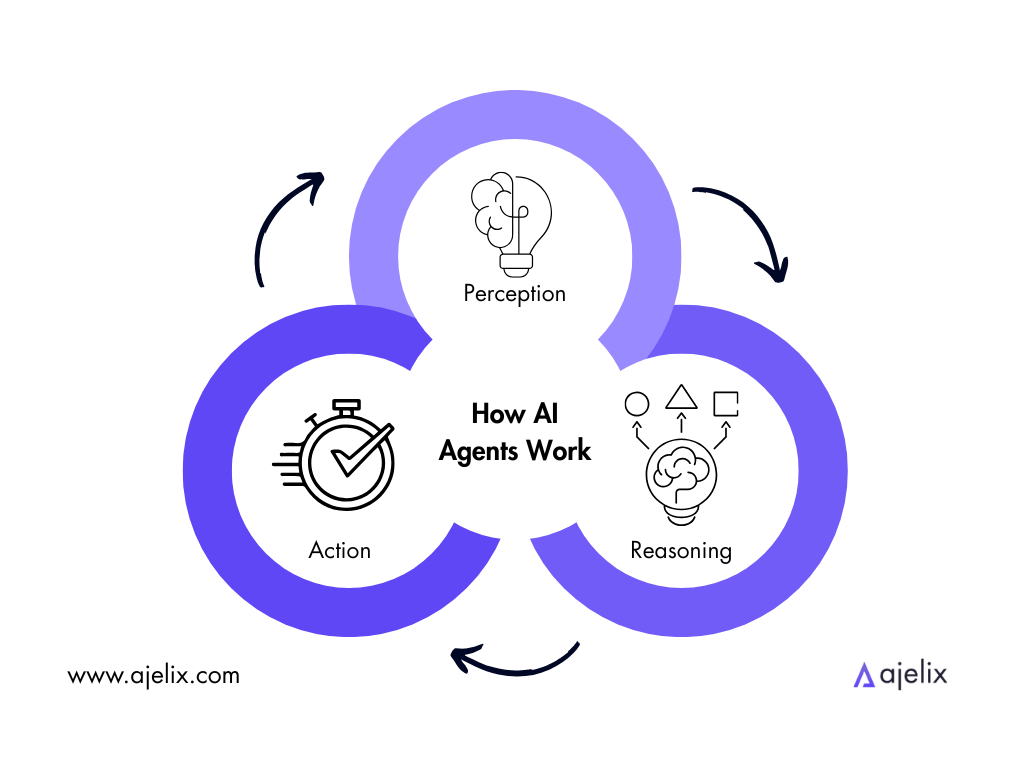
Perception: How Agents Perceive Input
Before an agent can do anything, it needs to understand what it’s working with. This is the perception stage, where the agent gathers and interprets input from its environment.
Input can come from your prompt, uploaded documents, web searches, database queries, or even its own previous actions. The agent builds a fuller picture of the situation before making any decisions.
The richer and more accurate the context is, the better every subsequent step will be. Poor perception at this stage cascades into poor decisions later. This is why well-designed agents are built to pull from multiple sources before moving on.
Author’s Note: Too much context can end up becoming “context rot”, which doesn’t result in better results. The information you provide needs to be precise – avoid quantity over quality.
We at Ajelix work with context engineering and introduce technologies (such as compaction, summaries, agent memory) to improve it.

Reasoning: How Agents Make Decisions
Once the agent has a clear picture of the situation, the reasoning begins. This is where the LLM acts as the “brain”. It breaks the overall goal into smaller steps, deciding which tools to use, and planning the sequence of actions needed to get there.
This process is often called chain-of-thought reasoning: the agent talks itself through the problem before acting. It weighs its options, considers what it knows, and maps out a path forward. For complex tasks, it might plan several steps ahead and anticipate what it’ll need at each stage.
This is what separates AI agents from simpler automation. It’s thinking through the problem dynamically, based on what it’s dealing with.
Action: How Agents Execute Tasks
With a plan in place, the agent acts. That might mean running a web search, executing code, filling a form, sending an email, or calling an API – whatever the task requires.
Crucially, the agent doesn’t just fire off an action and stop. After each step, it checks the result. If something’s off, it loops back, adjusts, and tries again. This self-correction is one of the defining features of a true AI agent. It’s what allows agents to handle tasks that are too unpredictable for rigid, rule-based automation.
The full cycle – perceive, reason, act, check, repeat – runs until the goal is reached.
6 Types of AI Agents
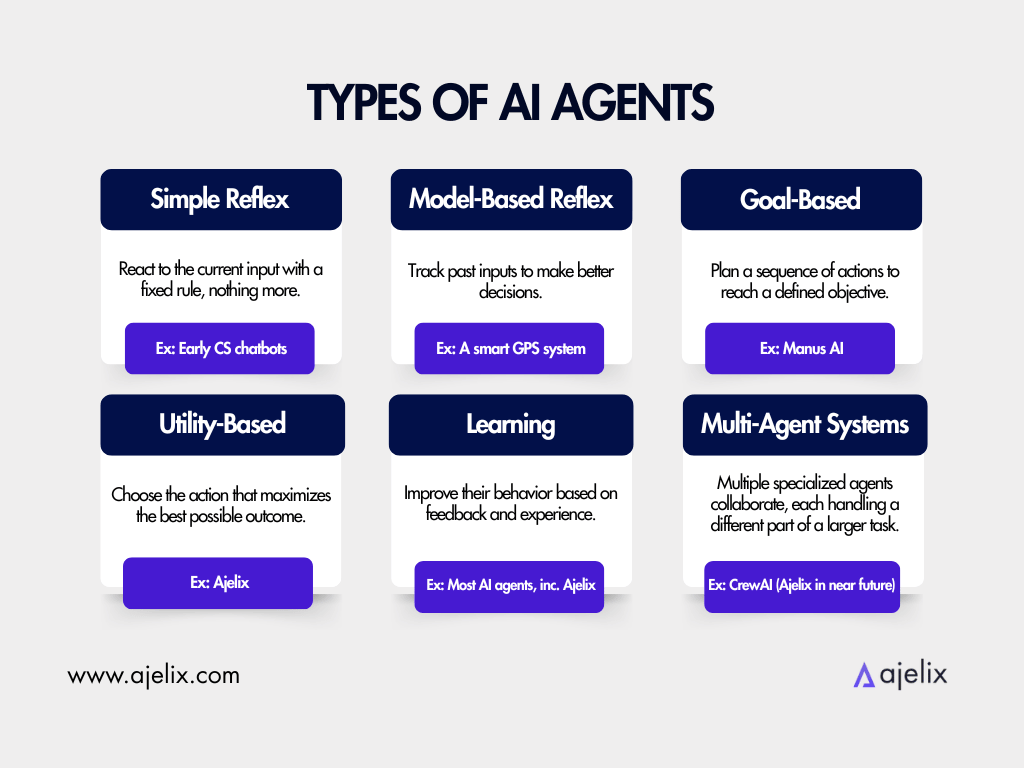
Not all AI agents are built the same. In Artificial Intelligence: A Modern Approach, Russell and Norvig classify agents into five types, each more capable than the last.
A 2025 taxonomy sharpens that framework further, drawing a hard line between single-agent systems and the multi-agent ecosystems now emerging – what I refer to as a sixth type.
Here’s how the full spectrum breaks down:
Understanding the differences explains why some agents only answer questions while others run entire workflows.
1. Simple Reflex Agents
The most basic type. Simple reflex agents look at the current input and fire back a response based on a fixed set of rules. They match the input to a rule and respond without memory, context, or reasoning about what came before.
Example: Early customer service chatbots. They scan for a keyword like “refund” or “hours” and return a scripted reply.
Useful in narrow, predictable environments. Rigid everywhere else.
2. Model-Based Reflex Agents
Model-Based Reflex agents keep an internal record of past inputs to make better decisions when the current snapshot isn’t enough.
Example: A GPS system tracks your route, monitors traffic, and reroutes based on an evolving model of the environment.
Smarter than simple reflex, but still fundamentally reactive.
3. Goal-Based Agents
Given an objective, Goal-Based Agents reason about which actions will get them there – planning ahead, weighing paths, adapting as they go. This is where current LLM-powered agents mostly live.
Example: OpenAI’s Operator can take a goal like “book a restaurant for Friday night” and navigate websites, fill forms, and see it through. Manus AI runs complex multi-step workflows – browsing, coding, file manipulation – from a single instruction with minimal hand-holding.
4. Utility-Based Agents
Goal-based agents ask: did I achieve the goal? Utility-based agents ask: which outcome has the best quality? They score possible outcomes and act to maximize the result. This is critical when there are competing priorities or multiple valid paths.
Example: Ajelix. When you provide raw data or a prompt with a goal, it evaluates which output format, structure, and approach will be most useful before delivering a finished file
5. Learning Agents
Learning agents do everything the previous types can, plus improve over time. They observe outcomes, integrate feedback, and adjust behavior based on what worked.
Example: Spam filters recalibrate every time you correct them. Claude is built around long-context reasoning and honest uncertainty disclosure, adapting within complex workflows.
Most commercial AI agents today, including Ajelix, have elements of learning built in.
6. Multi-Agent Systems
The newest type, and where the field is heading. Multi-agent systems aren’t single agents with better specs. Think of them as a team: specialized agents handle different parts of a goal, with an orchestrator directing the whole operation.
Example: Platforms like AutoGen, CrewAI, and MetaGPT assign distinct roles – retriever, planner, reviewer – to separate agents working in parallel.
A useful way to see the difference: an AI agent that writes a blog post from a brief is one system doing one job. A multi-agent system is a researcher, writer, editor, and publisher each handling their role simultaneously, coordinated by an orchestrator.
This comes with challenges – coordination failures, error cascades, and governance gaps. But the direction is clear.
Ajelix currently operates as a utility-based agent and is actively working toward becoming a multi-agent system.
How To Use AI Agents? Real-Life Use Cases
AI agents apply to any workflow that involves repeating the same steps, processing data, or producing structured outputs. Here are three high-impact areas where they’re already changing how people work:
Business & Finance
Finance work follows a predictable structure: pull data, run numbers, format the report, build the slide. AI agents like Ajelix can handle all of it.
A single prompt can produce a complete Excel financial model – revenue projections, variance analysis, scenario planning, formatting included – without spreadsheet expertise required. Month-end reports, investor pitch decks, and executive dashboards follow the same pattern.
In this video, we cover 5 Excel use cases that benefit anyone working in business.
Marketing & Content
In marketing, the main gap is between strategy and execution. AI agents close it. Give an agent a brief or a URL and it builds the asset – landing page, blog post, lead-gen app, or dashboard. No designer briefing, copy rounds, or manual formatting needed. The output is ready to deploy.
In this video, we cover how chat.ajelix.com created a website with a landing page.
Data Analysis
Most teams lack time to deal with data. With an AI agent, you can upload a spreadsheet, CSV, or PDF, describe what you need, and the agent handles cleaning, analysis, visualization, and summary. No formulas or coding are required. The result is an interactive dashboard or finished report built in minutes.
In this video, we showcase how our AI agent used raw data to complete a polished analyst workflow.
Author’s Note. AI agents handle the repetitive work and deliver a project that’s roughly 90% complete. The final review, adjustments, and sign-off are still on you – and that’s intentional. The goal is to remove the grind, not the human.
What to Look for When Choosing an AI Agent
There is no universally best AI agent. The right one depends entirely on your workflow, your role, and what a finished result looks like for you. There are three practical ways to narrow it down.
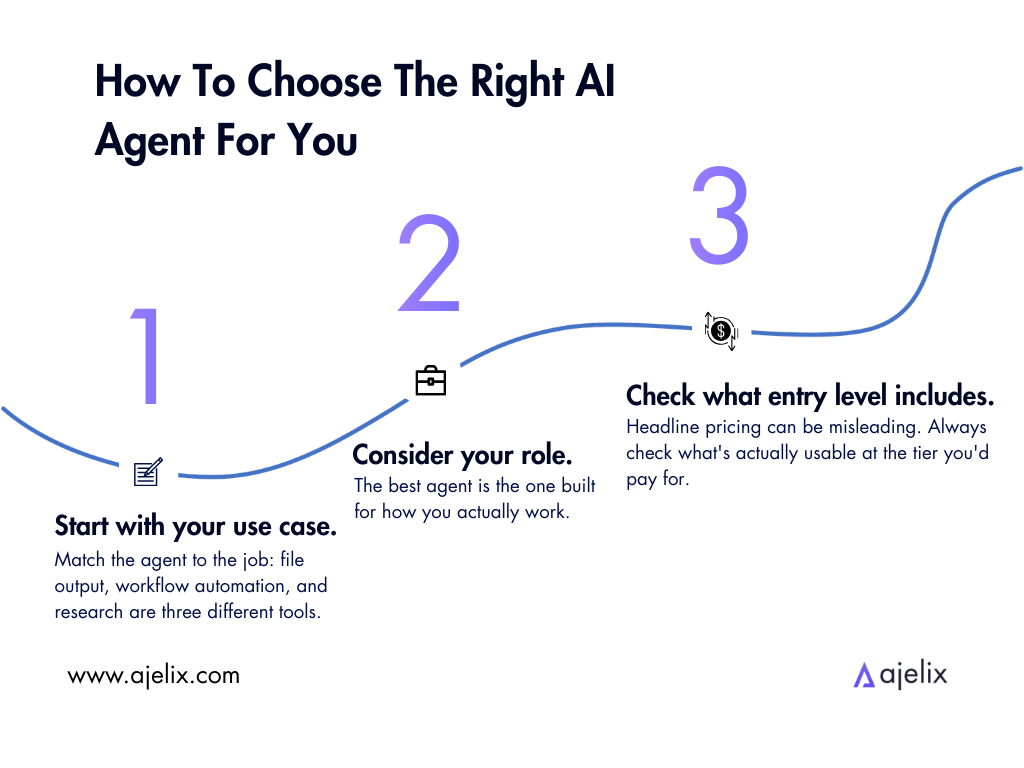
Start with your use case.
To turn raw data into a finished project, you need an agent built for end-to-end file output. To automate workflows across multiple apps, you need one built for integrations. If you need deep research with cited sources, that’s a different tool entirely. Matching the agent to the job type eliminates most bad choices immediately.
Consider your role.
Founders, managers, and digital professionals who need finished deliverables will get the most from a tool like Ajelix. Operations teams automating cross-app processes are better served by Zapier AI. Researchers and strategists doing heavy synthesis lean toward Gemini Deep Research. Developers running complex autonomous workflows should look at Manus AI.
The best agent is the one aligned to how you actually work, not the one with the most features.
Check what you actually get at entry level.
Pricing across agents ranges from free to $250/month, but the gap between what’s advertised and what’s usable at the lowest tier is significant. Some agents unlock file creation and full workflows at $20/month. Others restrict agentic features to top-tier plans, making the headline price misleading for most users.
For a full use case breakdown, role-by-role comparison, and entry-level pricing for each tool, read our complete guide on the Best AI Agents now →
Are AI Agents Right for You?
AI agents aren’t for everyone. But they’re right for more people than you’d think.
If you regularly do work that follows a predictable structure, an agent can handle the repetitive parts and hand you something close to finished. Not replacing your judgment, but removing the grind before your judgment is needed.
You’re a good fit if:
- You spend hours on tasks that follow the same steps each time
- You produce structured outputs: reports, spreadsheets, dashboards, content
- You’re not a developer but want more from AI than a chatbot can offer
You’re probably not ready yet if:
- Your work is highly unstructured or relationship-dependent
- You need outputs reviewed by compliance or legal before any AI involvement
- You haven’t yet identified a specific, repeatable workflow to hand off
The honest test: think of one task you do every week that you’d rather not do. If that task has a clear input and a defined output, an AI agent can likely take it. Start there.
If you want somewhere to test an AI agent, Ajelix offers a free trial.
FAQ
An AI agent is a system that takes a goal, plans the steps to reach it, and executes them without needing step-by-step human guidance. Unlike a chatbot that stops at a response, an agent completes the work.
A chatbot responds. An AI agent acts. Chatbots follow scripts and answer single questions. AI agents reason, use tools like web search and code execution, and work through multi-step tasks from start to finish.
They run a continuous loop: perceive (gather context), reason (plan the steps), act (execute), then check the result and adjust. That cycle repeats until the goal is reached.
There are six main types, from basic to advanced: Simple Reflex, Model-Based Reflex, Goal-Based, Utility-Based, Learning, and Multi-Agent Systems. Most commercial AI agents today are goal-based or utility-based.
Yes, for most everyday and business tasks. The main thing to keep in mind is that agents work best when a human reviews the final output. They handle the execution, but judgment and sign-off stay with you.
No. Most consumer-facing AI agents are built for non-technical users. You describe the goal in plain language and the agent handles the steps.
They can build financial models, write and format reports, create landing pages, analyze data, generate dashboards, research competitors… Any task with a clear input and a structured output.
An AI agent is a concrete system – a program, bot, or software – designed to take actions toward a goal. Agentic AI is the property that makes an agent autonomous. Think of agentic AI as an adjective: it describes the quality of an AI agent that can plan, adapt, and act with minimal human guidance.
Pricing ranges from free to around $250/month depending on the tool and tier. Some agents unlock full workflow capabilities at $20/month. Others restrict the most useful features to higher-tier plans, so it’s worth checking what’s actually included at entry level.
Roughly 90% of the way there. Agents handle the repeatable, time-consuming work and deliver something close to finished. A final review and light polish from you is still the right practice before anything goes live.
Agentic AI chat that helps you complete projects
AI for work that ingests, transforms, and delivers the exact deliverables your team needs, while you stay focused on strategy. No more chatting, agents can get the job done.