Back Office AI: How It Works & Top Tools In 2026

In most companies, the back office still runs on spreadsheets, email, and manual data transfer between systems. But back office AI can automate all of it, from invoice processing and payroll checks, to compliance reviews and employee requests.
Our team of AI experts compiled a guide on AI for back office automation, what it is, what it’s already been replacing, what to look for in a tool, and the four platforms that can help your company. We also looked at what the community recommends.
Let’s dive in.
What Is Back Office AI
Back office AI is the use of AI to handle administrative, financial, and operational work that happens behind the scenes of a business. This includes processes such as accounts payable, receivable, payroll, procurement approvals, HR onboarding, compliance checks, data entry, and reporting.
Back office tasks are high-volume, depend on company rules, and handle a lot of work with documents, which is exactly what AI models execute best.
AI back office systems in 2026 typically handle the following:
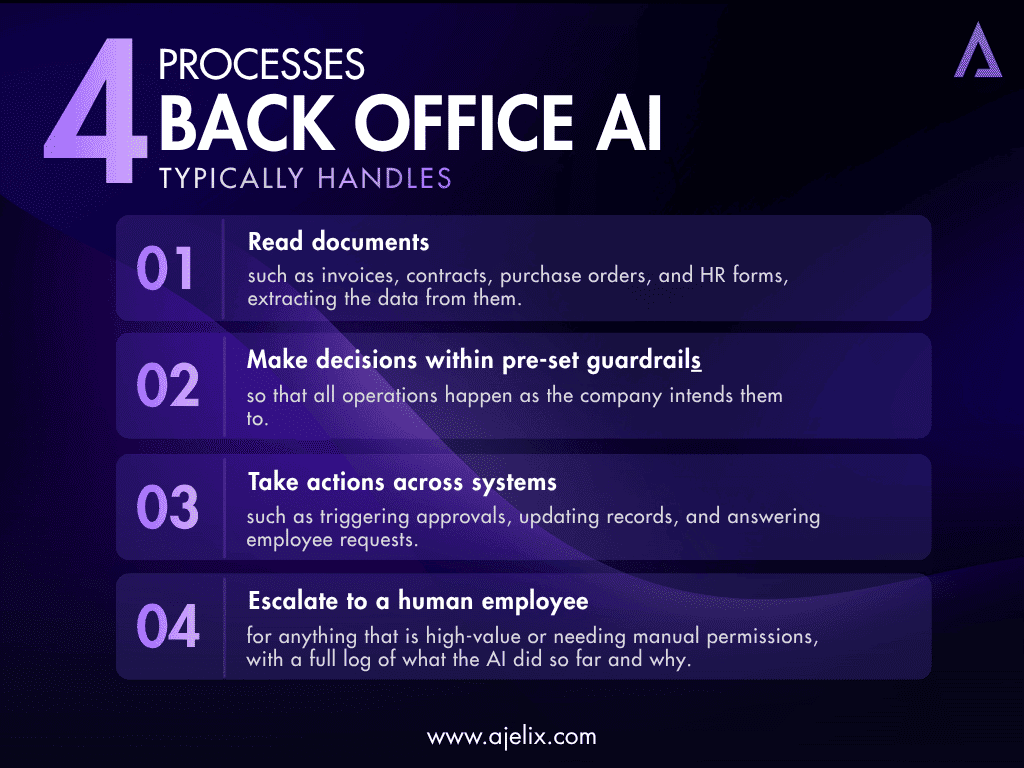
- Read documents, such as invoices, contracts, purchase orders, and HR forms, extracting the data from them;
- Make decisions within pre-set guardrails, so that all operations happen as the company intends them to;
- Take actions across systems, such as triggering approvals, updating records, and answering employee requests;
- Escalate to a human employee for anything that is high-value or requires manual permissions, with a full log of what the AI did so far and why.
Unlike RPA, which executes fixed sequences, AI back-office automation makes decisions in non-standard situations.
The AI Impact On Back Offices And Employee Roles
Reports show that AI implementation and automation are cited for 116,175 of 529,914 job cuts as of August 2026.
Employees state that AI replacing back office jobs in 2026 is their reality. However, employers are increasingly redeploying back-office staff toward exception handling, oversight, and process design that AI can’t perform.
The AI impact on back office transformation means roles will be cut, but it doesn’t necessarily mean that the employees can’t stay in the company and be responsible for tasks still needing human judgement. Companies can and some will use the time freed up by AI to focus on tasks that the AI can’t yet perform.
What AI Tools For Back-Office Process Automation Need
Back office processes regularly feature working with sensitive data that must be protected. When evaluating AI tools for back-office process optimization, here are the aspects that should be non-negotiable:
- SSO (single sign-on) and SCIM (System for Cross-domain Identity Management) provisioning: an authentication process that lets users log in once with a single set of credentials to access multiple independent applications, as well as a protocol to automate user lifecycle management across different systems.
- Role-based access control (RBAC): users can access only the data and functions their role requires (least-privilege access).
- Audit logs: so you can prove what the AI did, when, and with what data.
- Data residency controls: for regulated industries to keep data in the relevant country or state.
- Human-in-the-loop controls: so that AI agents can route to a human in high-value cases and when needing permissions.
- Usage and spend monitoring: for the finance team to avoid surprising costs.
The AI vendor must provide all of the above to ensure a secure environment for your company data.
The 4 Leading Tools And Platforms
Here are the leading AI automation companies that our experts recommend for back-offices:
| Tool/Platform | Best For |
|---|---|
| Ajelix Enterprise | Governed AI agents and workflows across finance, HR, and operations |
| UiPath | High-volume transactional processes with legacy systems and RPA estates |
| ServiceNow | Employee-facing IT, HR, and shared-services requests |
| Hypatos | End-to-end agentic invoice and accounts payable processing |
Below, we cover what each tool does well, what not so much, and who it’s for.
1. Ajelix Enterprise
Who is it for: Companies that want custom AI agents and workflows built around their back-office processes, with governance, reliability, and top-tier security.
- Pros: AI-native platform with granular RBAC, hash-chained audit trails, reasoning logs, usage monitoring and quota management; connects to any system through a custom API, including any LLM provider; can self-host LLMs on its own AI infrastructure; visual no/low-code agent and workflow builder.
- Cons: Less suited for code-first engineering teams that want to write their own agent frameworks.
Ajelix Enterprise is built as an operational layer for companies wanting to implement AI for office automation. Employees and agents work within role-based permissions, guardrails, and a full audit trail, while usage monitoring with quota management by team or project keeps AI costs under your control.
Custom agents and connectors are built around your company’s specific processes. A powerful RAG system grounded in your documentation keeps the outputs aligned with your standards.
Because Ajelix runs on its own AI infrastructure, it supports self-hosted deployment of the platform and LLMs inside the client’s own environment. The team works directly with clients to make processes AI-native, regardless of industry.
Contact the team to learn more.

2. UiPath
Who is it for: Large enterprises with high-volume transactional processes, especially those already running legacy systems or existing RPA bots.
- Pros: Coordinates AI agents, RPA bots, and human approvals in one control plane through its Maestro engine; automates applications with no API via computer vision; on-premises and self-hosted deployment; strong governance and audit capabilities for regulated environments.
- Cons: Implementation is a long, technical project; the most powerful capabilities require technical expertise; not a good fit for smaller teams.
UiPath, originally a RPA vendor, successfully rebuilt itself as an agentic automation platform. Its deterministic robots handle the reliable execution parts, while AI agents handle the judgment and the exceptions, and Maestro orchestrates both alongside humans.
For companies with thousands of existing bots, UiPath is a natural step to upgrade the automation.
3. ServiceNow
Who is it for: Enterprises that want employees to handle IT, HR, finance, and facilities requests in one governed place.
- Pros: ServiceNow Otto combines Now Assist, Moveworks, and AI Experience into one unified interface that understands a request, routes it to the right agent, and executes it to completion; AI Control Tower governs the full AI lifecycle across 30+ integrations; its MCP server lets third-party agents, including ones built on Claude or Copilot, execute inside governed ServiceNow workflows.
- Cons: Best for companies with an existing ServiceNow commitment; strongest for conversational, employee-facing workflows.
ServiceNow rebuilt its entire AI platform in 2026. The Moveworks acquisition provides the conversational assistant and enterprise search that are now available inside Otto. EmployeeWorks uses Otto’s conversational AI to resolve employee requests end to end across Teams, Slack, and web.
Its AI Control Tower covers the whole AI lifecycle across agents, models, datasets, and identities, with runtime agent observability, identity governance, cost tracking and ROI measurement for AI deployments.
4. Hypatos
Who is it for: Finance departments whose primary back-office target is accounts payable and finance document processing.
- Pros: Agentic architecture for finance documents; posts to the ERP using native transaction logic; 85-92% straight-through processing rate, vendor-reported.
- Cons: Narrow focus, dedicated mostly to finance departments; performance figures are vendor-reported.
Hypatos’ AI Agent for Accounts Payable validates against live ERP data, applies coding rules, and resolves routine exceptions (price tolerance variances, missing PO references, partial deliveries, duplicates, vendor status issues) without escalating. Cases it can’t resolve are pre-searched when they reach reviewers, with the full investigation context attached.
If AP is your first and biggest automation target, Hypatos is built for you.
What The Community Recommends
Outside the mentioned companies, the Reddit communities practicing AI automation mention a few more options worth knowing:
- n8n: the default visual automation tool in self-hosted communities; teams use it to connect SaaS tools and build AI agent workflows without writing code.
- Lindy: frequently mentioned for no-code AI agent workflows with reasonable compliance options; it’s a common pick for teams without deep technical setup capacity.
- Automation Anywhere: a company known for RPA, who is now pushing AI agents through its AI Agent Studio; praised by teams with existing RPA investments.
- Ramp Intelligence: comes up in finance communities for AI-driven expense, AP, and procurement automation.
- Zapier: still the starting point for smaller teams connecting SaaS tools; includes agent capabilities.
Choose The Right Tool For Your Needs
To decide what is the best office AI tool for your needs, here is an overview comparison by use case:
| You need… | Best tool |
|---|---|
| A multi-tenant platform to build custom agents and workflows for your company’s processes, with hash-chained audit logs, spend controls, custom guardrails, and self-hosted LLMs | Ajelix Enterprise |
| High-volume transactional processing across legacy systems, with AI agents and RPA robots governed in one control plane | UiPath |
| Employees handling IT, HR, and finance requests conversationally, with centralized agent governance | ServiceNow |
| Agentic, end-to-end invoice and accounts payable processing with high straight-through rates | Hypatos |
Also Worth Considering (Community Picks):
| You need… | Best tool |
|---|---|
| Visual automation connecting SaaS tools, self-hosted | n8n |
| No-code AI agent workflows without deep technical setup | Lindy |
| AI agents on top of an existing RPA estate | Automation Anywhere |
| AI-powered expense and AP automation in one finance platform | Ramp Intelligence |
| The starting point for smaller teams connecting SaaS tools, with agent capabilities | Zapier |
If governed, self-hosted AI is your priority, contact Ajelix for more information.
FAQ
Back office AI is the use of AI and AI agents to automate administrative and operational work that happens behind the scenes of a business.
AI agents for back offices are software systems that complete multi-step processes autonomously: they plan actions, use tools like APIs and ERPs, handle variation without breaking, and log every decision. An agentic invoice processor, for example, extracts data, matches it to the purchase order, applies GL coding, resolves routine exceptions, and posts to the ERP. If anything is unusual, the agent routes it to a person.
It’s replacing tasks first, and headcount where companies choose not to reuse resources. Employees currently working in back offices are encouraged to learn additional skills.
For governed, company-wide agent platforms: Ajelix Enterprise, UiPath, and ServiceNow. For finance and AP specifically: Hypatos. The right choice depends on which systems your agents need to work with and who will build them.
Start with one high-volume, rules-heavy process on a platform that provides RBAC, audit trails, and human approval thresholds from day one. Prove accuracy on a month of real work, expand to adjacent processes, and build the governance layer (usage monitoring, escalation rules, exception review) before scaling.
Agentic AI chat that helps you complete projects
AI for work that ingests, transforms, and delivers the exact deliverables your team needs, while you stay focused on strategy. No more chatting, agents can get the job done.