Predictive Analytics in Marketing: From Data to ROI

Most marketing teams spend their time looking backward – analyzing past campaigns to figure out how to proceed with future content. Predictive analytics in marketing pushes this process a step further.
Instead of guessing what will convert or engage your audience, you can forecast marketing outcomes before your budget has even been approved.
What Is Predictive Analytics in Marketing
Instead of reporting the past, predictive analytics in marketing uses historical data to predict what’s likely going to happen next. It is not a 100% foolproof forecast, but it can significantly impact how your company can plan for the future.
Descriptive/diagnostic analytics is what you might already be familiar with – they simply tell you what already happened, without giving you predictions.
Think of their differences like this:
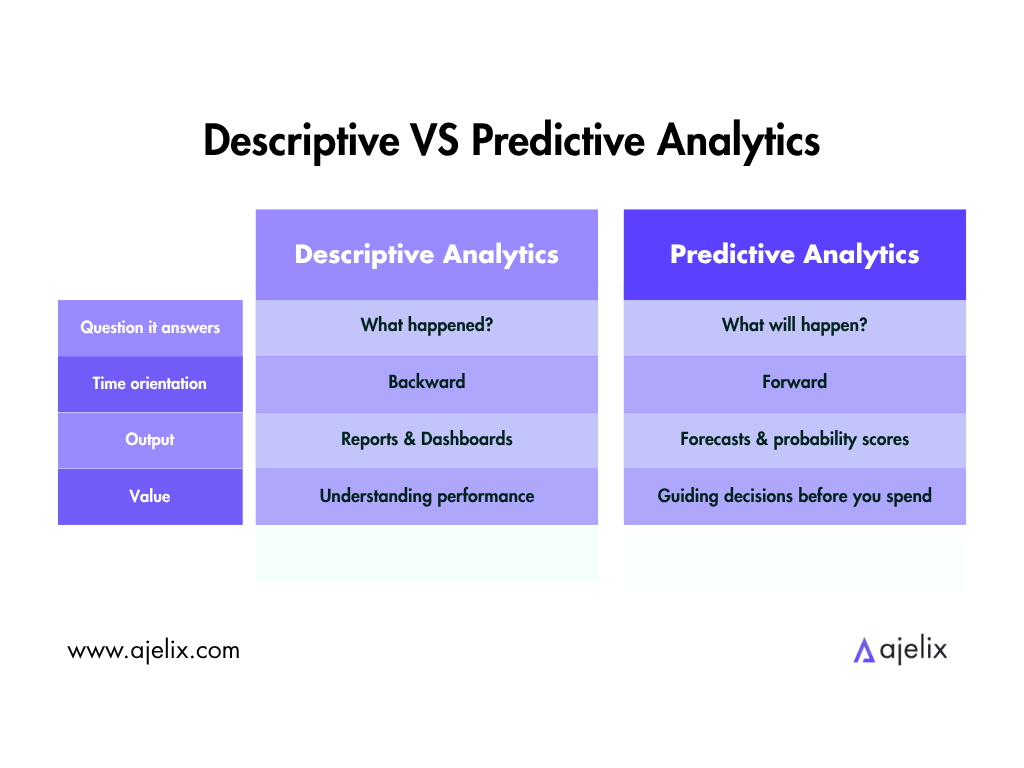
This means that descriptive analytics simply understand your marketing performance, but predictive analytics guide you on how to act.
Grand View Research valued the global predictive analytics market at $18.89 billion in 2024, and it is projected to hit $82.35 billion by 2030. It’s no longer a question about whether you shouldbe implementing predictive analytics, but how soon.
How It Works
Here’s how predictive analytics works in practice:
Data collection
Collect your marketing data – statistics, campaign results, records, engagements, history of your sales. The more data you gather, the more accurate the results will be. You can export all this data as CSV files.
Pattern recognition
If you use an AI agent like Ajelix, the agent uses its trained models to scan data for patterns that humans can’t spot. For example, those could be which customer behaviors lead to a purchase and which campaign settings correlate with a higher ROI.
The agent does the work for you – and in practice, a human doing this manually wouldn’t achieve equally descriptive results.
Forecasting
The AI agent applies collected patterns to current data and hands you a prediction, for example, a conversion probability, a revenue forecast and a churn risk score. This output can build confidence for your future marketing campaigns.
Action
A prediction is only useful if it impacts the way you work ahead. This is when your team needs to make decisions in accordance with the analytic results. That could mean adjusting the budget, suppressing a certain audience, or doubling down on content you make for a social media channel. Action is the most crucial step.
The data sources marketing specialists usually use are Google Analytics 4, Meta campaigns, email platform metrics, CRM data, and engagement statistics on social media platforms.

Key Use Cases For Your Brand
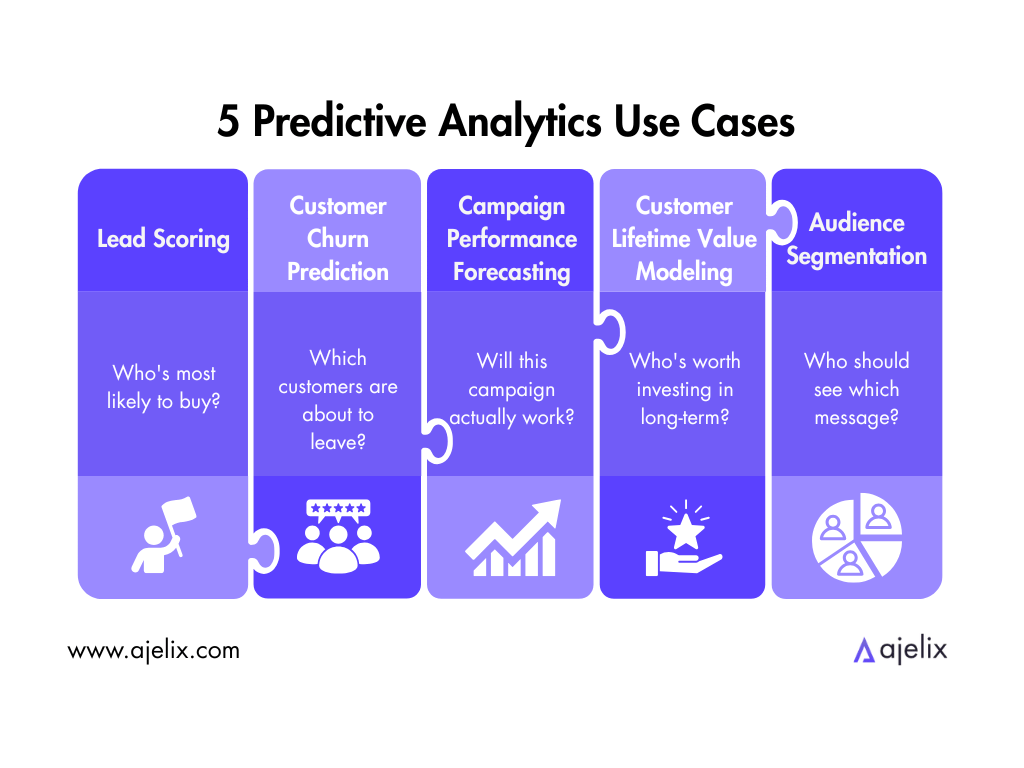
The most suitable predictive analytics use cases may depend on your company and brand, but I’ve compiled a list of five use cases that deliver results for most marketing teams:
1. Lead Scoring
Instead of having to manually decide which customer actions are worth more points, you can let agentic AI do it for you. Agents like Ajelix can look at your historical data, particularly which people bought your product, and figure out which behaviors were the strongest predictors of a sale.
The agent will set the scoring rules automatically, and remember to apply them for future data.
2. Customer Churn Prediction
Predictive analytics can flag which customers are likely to leave your service before they even do so. An AI agent would base this on engagement drops, gaps between purchases and support patterns. A CMO dashboard makes churn signals visible.
3. Campaign Performance Forecasting
Before you even commit to a budget for a campaign, predictive models can estimate its outcome, based on your historical performance. This is especially powerful when combined with Google Analytics data analysis.
4. Customer Lifetime Value (CLV) Modeling
Predictive CLV can tell you which customers to invest in and who is likely a one-time buyer. Knowing which customers will generate the most revenue over time changes how you allocate retention spend.
5. Audience Segmentation
Predictive segmentation goes deeper than simple audience segmentation. Instead of grouping people by who they are, it can tell what they’re likely to do next. For example:
- Group A: customers predicted to buy within 7 days → send them a limited-time offer
- Group B: customers predicted to churn → send them a re-engagement email
- Group C: first-time visitors with high purchase intent → retarget them with ads
The model figures it out by analyzing past behavior and then applies those patterns to your current audience.
Real Examples Other Brands Use
Predictive analytics isn’t fiction. Brands you know and love have already been using them. Here are a few examples:
Netflix: Audience Segmentation & Campaign Forecasting
When Netflix launched House of Cards, they created multiple versions of the trailer, each targeted at different audiences based on watch history. Their predictive models analyzed viewing data across millions of users, that way forecasting the show’s success.
Before a single episode even aired, they created maximum engagement.
Starbucks: Predictive Audience Segmentation & CLV
Starbucks uses their loyalty card data to build predictive models around individual customer behavior. They know which customers are likely to spend more on a certain day of the week, what product pairings are getting popular, and which special offers will increase customer spend time.
This is micro-targeting, given to the customer as personalized suggestions on their Starbucks app.
Amazon: Lead Scoring & Personalized Recommendations
Amazon uses a recommendation engine that constantly ranks which products customers are likely to buy next, based on their browsing and purchase history, and behavior. Their prices get updated every 10 minutes based on predictive demand models.
A Practical Starting Guide
Predictive analytics might sound complex before you’ve tried it, but getting started is easier than you’d think. Here’s how to approach it as a beginner:
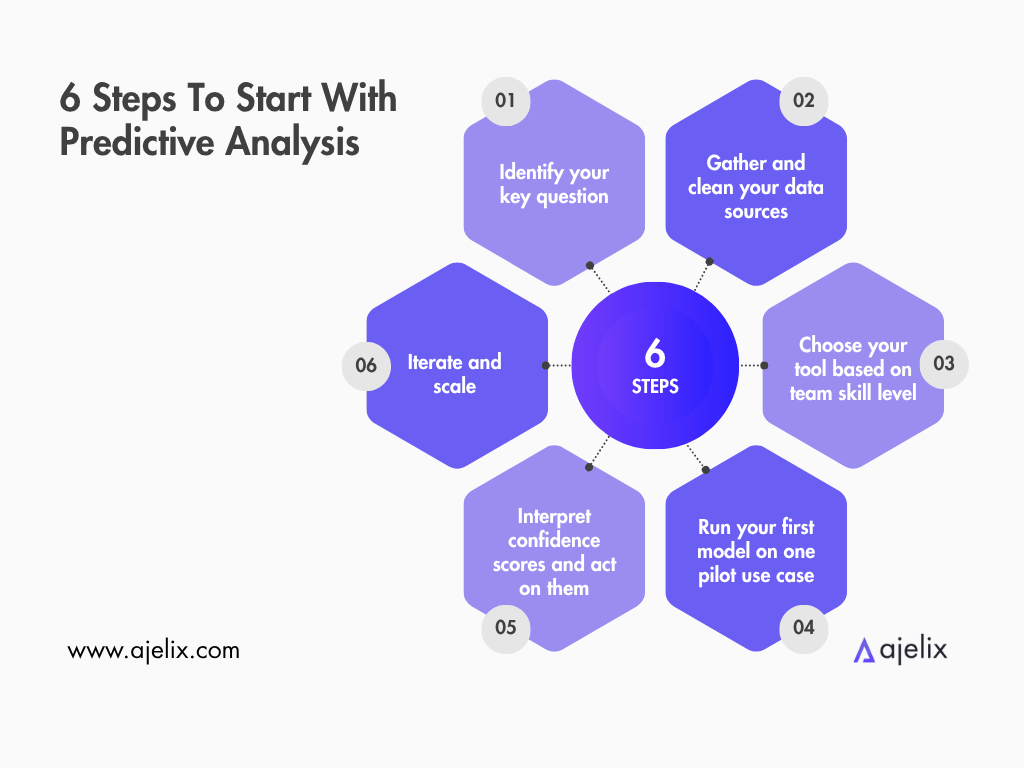
Step 1: Identify your key question
Before starting with data, figure out the problem. Some common first questions are “Which customers are about to leave?” or “Which leads are most likely to convert?”.
Step 2: Gather and clean your data sources
Gather the data that’s relevant to your question(s). Expect to spend some time here, as real-world data is full of errors, duplicates and inconsistencies. It’s likely the AI agent will still understand your data correctly, but you’ll feel more confident if you clean it up.
Step 3: Choose your tool based on team skill level
Using an AI agent like Ajelix requires nearly no technical expertise, just the ability to write a valuable prompt. Other tools might make this process harder.
Step 4: Run your first model on one pilot use case
Lead scoring is a starting point I’d recommend, as it’s low-risk and the output is immediately actionable for sales. Keep your first model simple. Even three datasets you gather can produce useful results.
Step 5: Interpret confidence scores and act on them
Like mentioned, a model output isn’t a certainty as no tool can predict the future with 100% accuracy. This means that a lead with an 82% conversion score would still require a follow-up. Train your team to treat predictions as signals of what to prioritize, not guarantees.
Step 6: Iterate and scale
After your pilot test, review what it got right and wrong. Adjust it accordingly, don’t forget to update it with fresh data and gradually expand what the model can do. The longer you run it with up-to-date data, the more valuable the results will be.
Predictive Analytics In Action Using Ajelix
At this point, you are likely wondering what the process of predictive analytics looks like. To showcase this, I will be using the Ajelix AI agent.
Gather your data
This can be CSV files of:
- Behavioral data – website visits (pages viewed, time on page, scroll depth), social media engagement, email opens (+ clicks, and reply rates), app usage (session length, features used);
- Transactional Data – purchase history (what, when, how often, how much), cart abandonment events, refunds and returns, subscription renewals or cancellations;
- Demographic & Firmographic Data – age, location, gender (for B2C), company size, industry, job title, tech stack (for B2B), loyalty program tier/membership status;
- CRM & Sales Data – lead source and campaign attribution, sales stage progression and deal velocity, customer lifetime so far;
- Customer Service Data – support tickets (volume and topics), NPS or CSAT scores, complaint patterns;
- Intent Data – third-party signals (G2 or Capterra profile views, competitor research), search terms that brought someone to your site, content downloads;
- Contextual / External Data – seasonality and calendar events, economic indicators, competitor pricing changes.
Create an Ajelix account
Ajelix offers a free trial. You don’t need to add a card when registering.
Upload your data to Ajelix and type a prompt
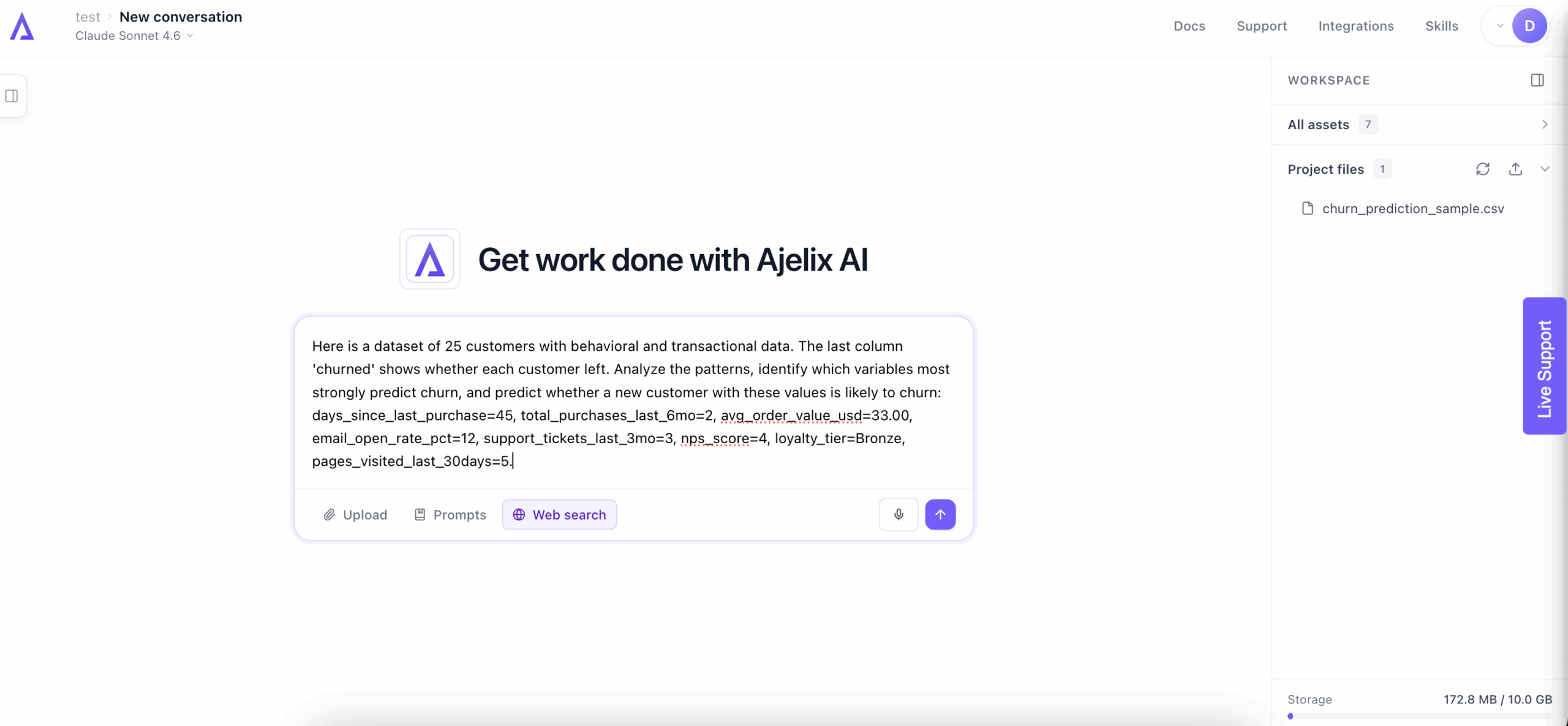
I used an example dataset of customers with behavioral and transaction data. My intention was to predict whether a certain customer is likely to churn.
Prompt I used:
Here is a dataset of 25 customers with behavioral and transactional data. The last column 'churned' shows whether each customer left. Analyze the patterns, identify which variables most strongly predict churn, and predict whether a new customer with these values is likely to churn: days_since_last_purchase=45, total_purchases_last_6mo=2, avg_order_value_usd=33.00, email_open_rate_pct=12, support_tickets_last_3mo=3, nps_score=4, loyalty_tier=Bronze, pages_visited_last_30days=5.
Wait a few minutes and it’s done
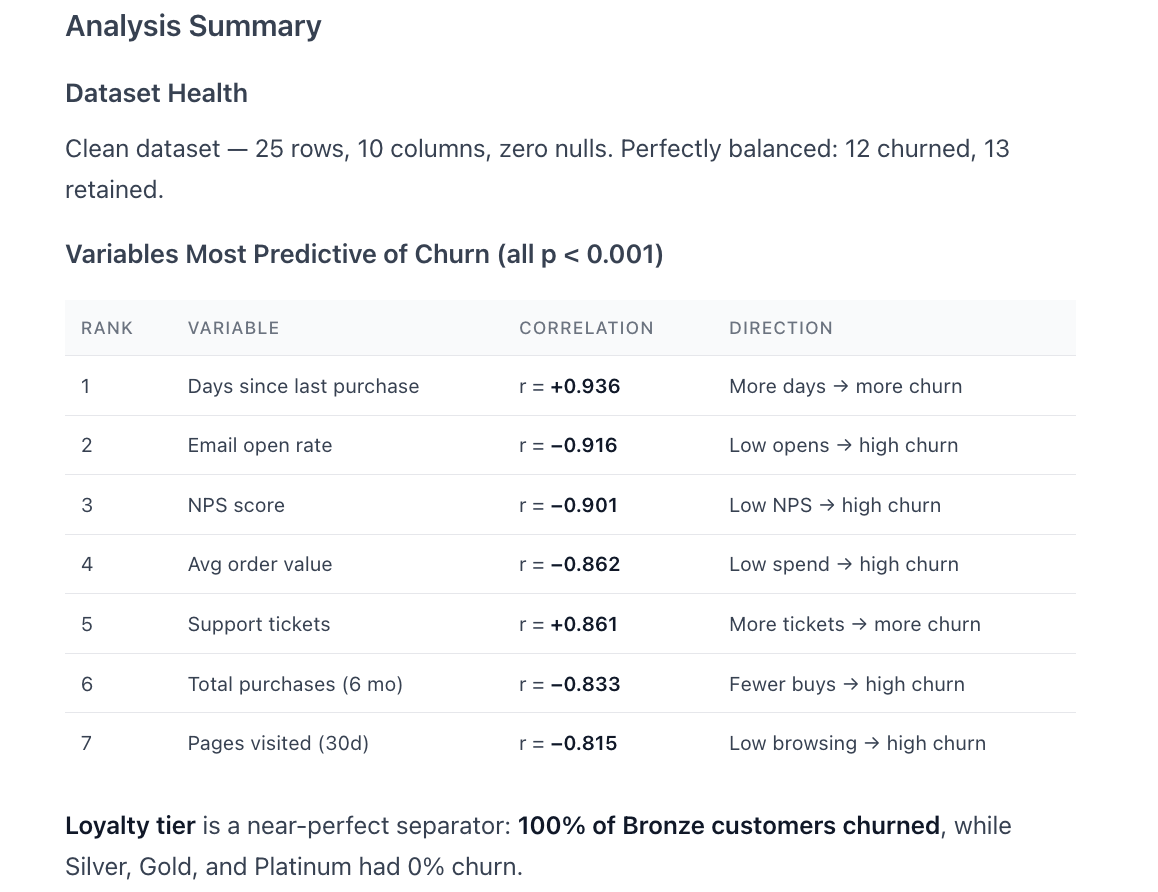
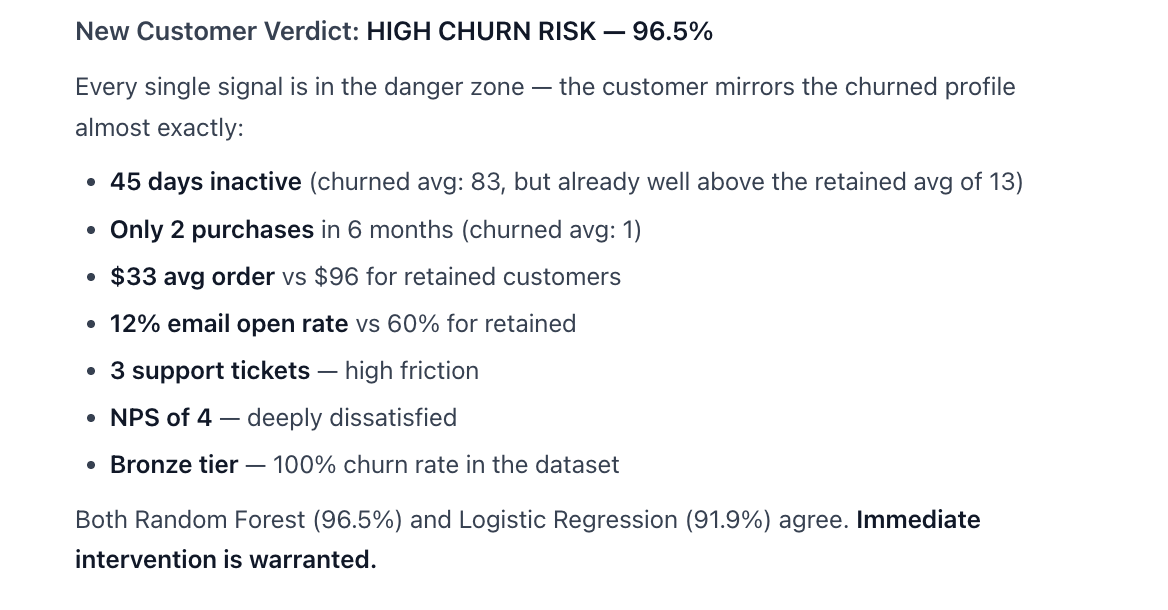
Ajelix does the work for you – it gives you an analysis summary and creates a dashboard for you.
I forgot to mention in my initial prompt to stick to a certain color scheme – white background, various shades of purple (which is what I use for creating dashboards with Ajelix). If design is important to you, you can add your design instructions in the initial prompt. In my case, I sent a follow-up prompt:
Remake the dashboard with white background and various purples as the charts.
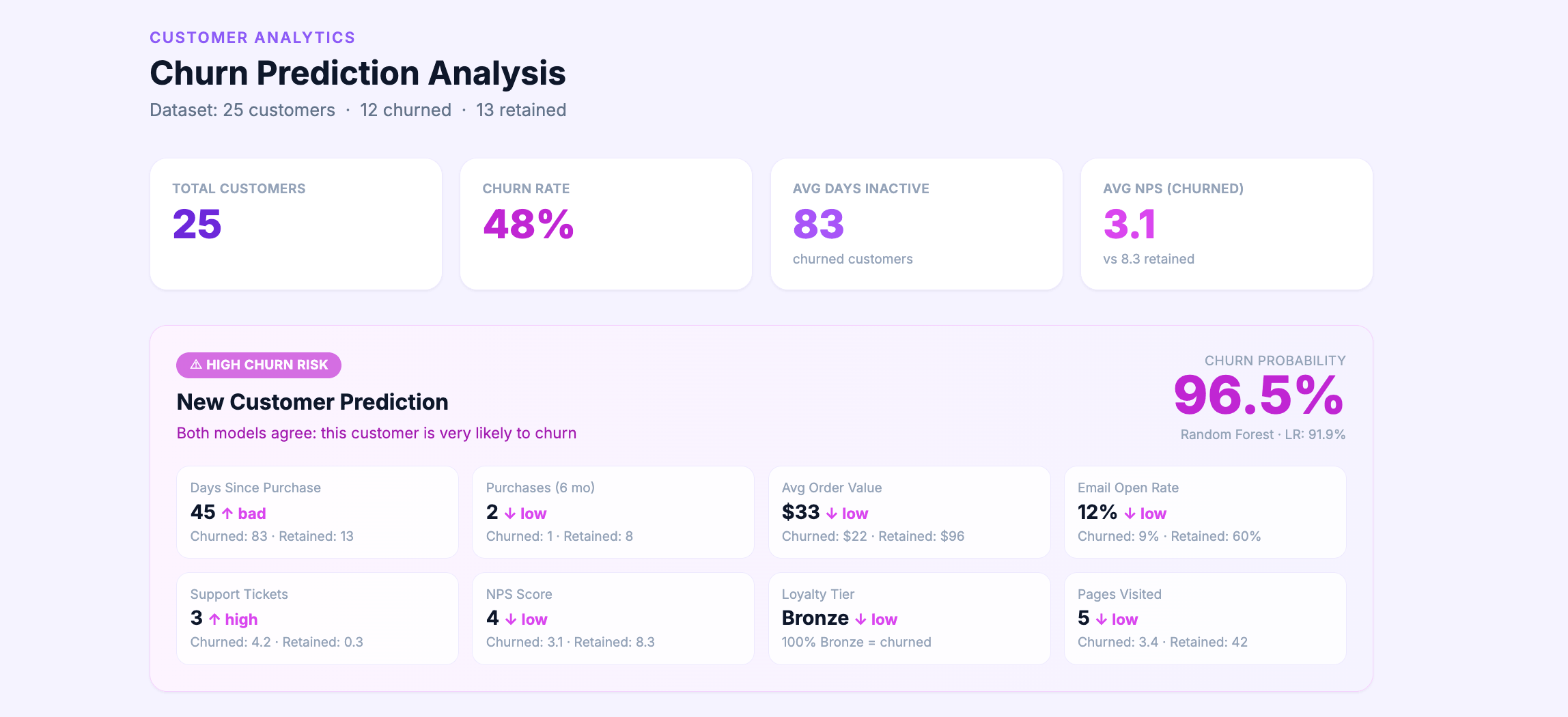
This is just a preview. The full dashboard is available here.
Share the dashboard with your team
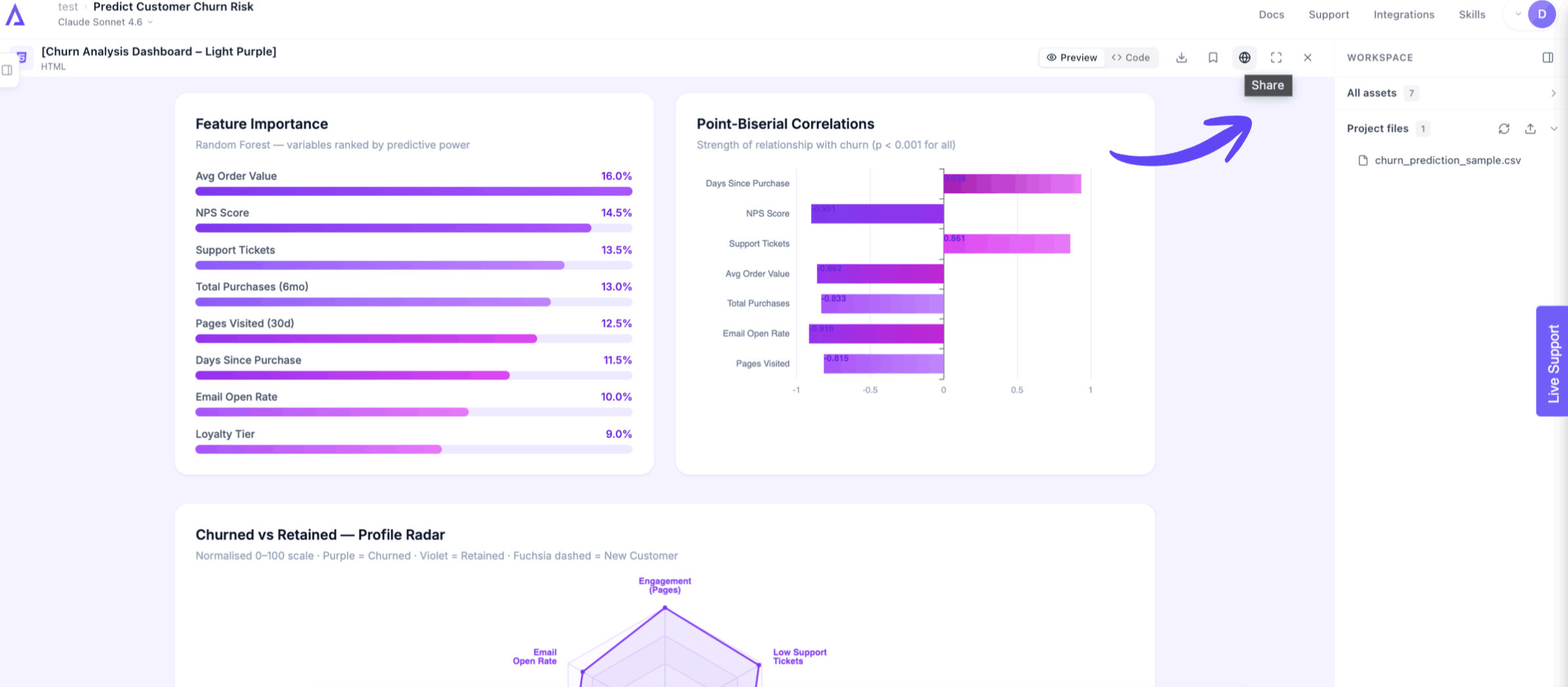
With just one click, you can publish your dashboard and share the link with your team.
The most time-consuming part might be the data collection. Ajelix creates the dashboards and analysis in only a few minutes.
See it in action:
The Benefits (And Limits) of Predictive Analytics in Digital Marketing
Benefits
- Reduced spend on ads. When you know what content is likely to convert, you stop paying to reach people who won’t.
- Better budget allocation. Rather than depending on your gut feeling, your resources go toward channels, campaigns and timing that data predicts will perform.
- Personalization. Your customers can receive individually relevant messaging, offers, and timing without manual segmentation work.
- Competitive edge. Brands acting on predicted behavior outperform those who only use descriptive analytics.
- Faster, more confident decisions. Marketing teams spend less time debating strategy and more time executing on signals that are backed by data.
- Higher customer lifetime value. When you know what to offer your customers next, their engagement is kept longer. This is cheaper than acquiring new customers.
Limitations
- Data quality dependency. Misleading outputs can be produced if the data has duplicates, errors or inconsistencies.
- Model drift. Customer behavior changes over time, so a model trained on old data is likely to lose accuracy, unless it’s regularly updated.
- Upfront time investment. Cleaning data and running a pilot takes considerable time, and that’s before you see any actionable results.
- Risk of over-reliance. If your team makes marketing judgments solely based on the predicted data, they may miss context, nuance and market shifts that the model doesn’t know about.
When used well, predictive analytics can change the future of your company or brand.
If you want to get started with forecasting and haven’t yet decided on what tool to use, I recommend Ajelix.
Try it now → chat.ajelix.com
FAQ
It’s the use of historical data and AI models to forecast future customer behavior, such as who is likely to buy, churn, or respond to a campaign, so marketers can act before the outcome happens.
No. Tools like Ajelix let you run predictive analysis by uploading a CSV and writing a prompt. Technical expertise helps, but it’s not a requirement for a first model.
The most useful starting data includes purchase history, email engagement, website behavior, and CRM records. You don’t need all of it, even a few consistent data points can produce actionable results.
No model predicts the future with 100% accuracy. Outputs are probability scores, not guarantees. Accuracy improves over time as the model is retrained with fresh data.
Lead scoring. It’s low-risk and immediately useful for sales teams. It’s also easy to measure whether the model is working.
Regular (descriptive) analytics tells you what already happened. Predictive analytics tells you what is likely to happen next, and gives your team a window to act on it.
Yes. You don’t need enterprise-level data volume or budget. A small dataset and an AI agent is enough to get meaningful signals, especially for churn prediction or simple audience segmentation.
Agentic AI chat that helps you complete projects
AI for work that ingests, transforms, and delivers the exact deliverables your team needs, while you stay focused on strategy. No more chatting, agents can get the job done.