Best AI Agent For Procurement In 2026: 5 Platforms Compared

Procurement teams have spent the past few decades digitizing the paperwork they deal with on a daily basis. Even with everything available on a computer, completing processes takes significant manual resources.
An AI agent for procurement is a technology that can speed up the mundane processes, and knows how to act even in non-standard situations.
Our AI experts offer you a list of five different platforms capable of automating and assisting with the procurement workload.
What Is A Procurement Agent
A procurement agent is software that takes a goal, such as re-source an expiring contract, onboard a supplier, or validate an invoice against contract terms, and executes the steps on its own. It reads the request, checks policies, retrieves supplier and pricing history, drafts the event, and routes anything outside its authority to a person.
A copilot suggests the next action, while an agent finishes the job, or hands back a completed draft with the reasoning attached.
Gartner expects supply chain management software with agentic AI to reach $53 billion in annual spend by 2030, up from under $2 billion in 2025. The forecast notes, however, that data and workforce readiness move slower than the agent deployment.
The realistic bar for AI for procurement in 2026 is a system that either completes the work or returns something a buyer can approve in one pass.
Agentic AI in procurement adds:
- Decision rights, meaning the agent knows which actions it can take alone, and which it can’t.
- Persistence. The agent runs in the background, monitoring supplier risk and chasing stalled approvals without even being prompted.
We recommend teams to start with simple tasks needing only one agent before expanding into multi-agent workflows. This avoids failures early in the process, and makes the cost more manageable.
The 5 Best AI Agent Platforms For Procurement
Here are our top AI agent platforms for procurement teams:
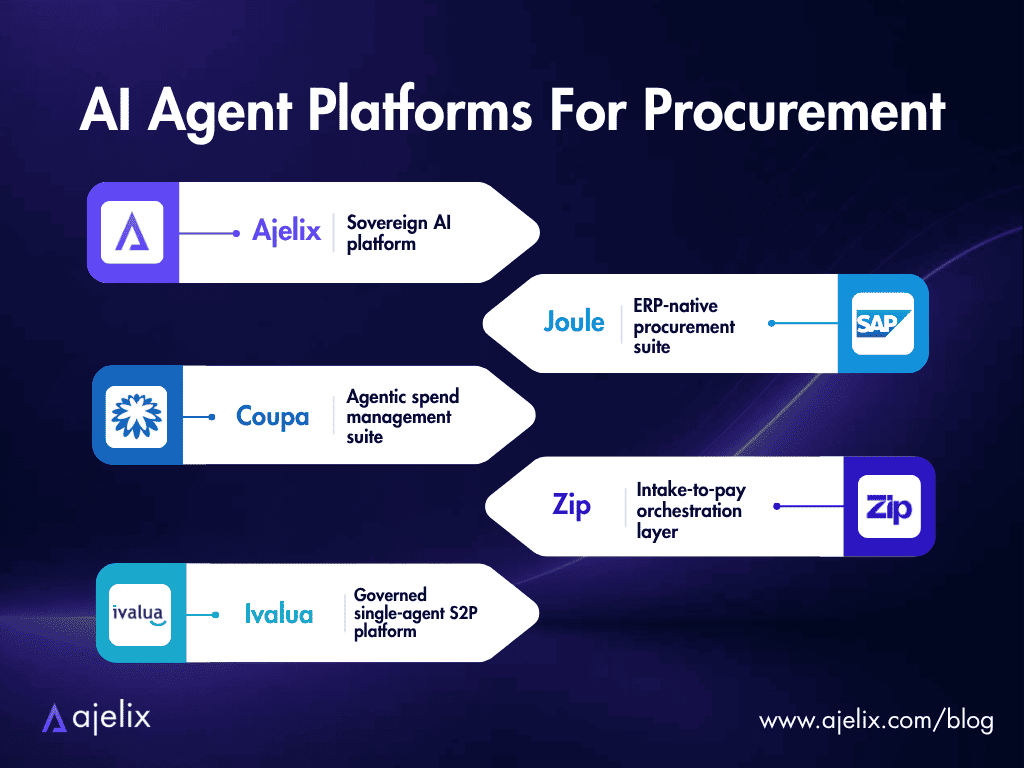
| Platform | What agents are offered | Where it runs | Best for |
|---|---|---|---|
| Ajelix | Multi-step agents over your own files and systems, with approval gates | Ajelix cloud, self-hosted, AWS/Azure/GCP | End-to-end workflow execution and governance without replacing company’s core records |
| Joule (SAP Ariba) | Bid Analysis Agent, contract support, spend analysis assistant | SAP BTP, native to S/4HANA | SAP-centric enterprises |
| Coupa | Autonomous sourcing events, supplier onboarding, payments, custom agents | Coupa cloud | Teams already using Coupa |
| Zip | 50+ agents plus Superagents across procurement, finance, legal, IT, security | Orchestration layer over existing ERP | Intake-to-pay orchestration |
| Ivalua | One agent with reusable skills | Ivalua platform | Governance-heavy, configurable S2P (Source-To-Pay) |
Below, we cover each platform’s pros, cons, and who they are for.
1. Ajelix Enterprise
Who is it for? Procurement and operations teams that want agents reading their own supplier, pricing, and inventory files, working to their rules, with an audit trail and full deployment control.
- Pros: Handles data work, like merging messy supplier, pricing, and inventory files into usable datasets; offers custom connectors through an API key; self-hosted LLM option and flexible deployment; AI is the core product with every answer carrying a source citation, and high-value decisions routing to a human; sovereign platform with its own EU-based infrastructure.
- Cons: Not a platform with a main focus on procurement, however, agents are capable of automating any workflow.
Ajelix Enterprise is an AI agent platform rather than a procurement suite, but you can build agents and workflows suited specifically for your needs. If you’re working as a part of a larger company, Ajelix’s agents can also be used by teams outside the procurement scope.
The procurement work is accomplished through visually built workflows and autonomous agents, featuring a human approval step. The technology powers complete (or near-complete in situations where human judgment is crucial) execution of any needed workflow that procurement teams usually perform manually.
Ajelix offers granular role-based access, hash-chained audit logs, usage quotas, and custom guardrails, plus a RAG system trained on your own documentation so agents follow your standards. Deployment covers its EU-hosted cloud, fully self-hosted, or AWS, Azure, and Google Cloud through accounts you already have.

2. Joule (SAP Ariba)
Who is it for? Enterprises already using SAP Cloud ERP or S/4HANA.
- Pros: Native access to ERP transactions, contracts, and supplier records; bid analysis and contract support; current and next-gen environments can run in parallel.
- Cons: The most useful new capabilities are still only in plans; value depends on how clean your SAP master data already is; heavy implementation scope for organizations not already on next-gen Ariba.
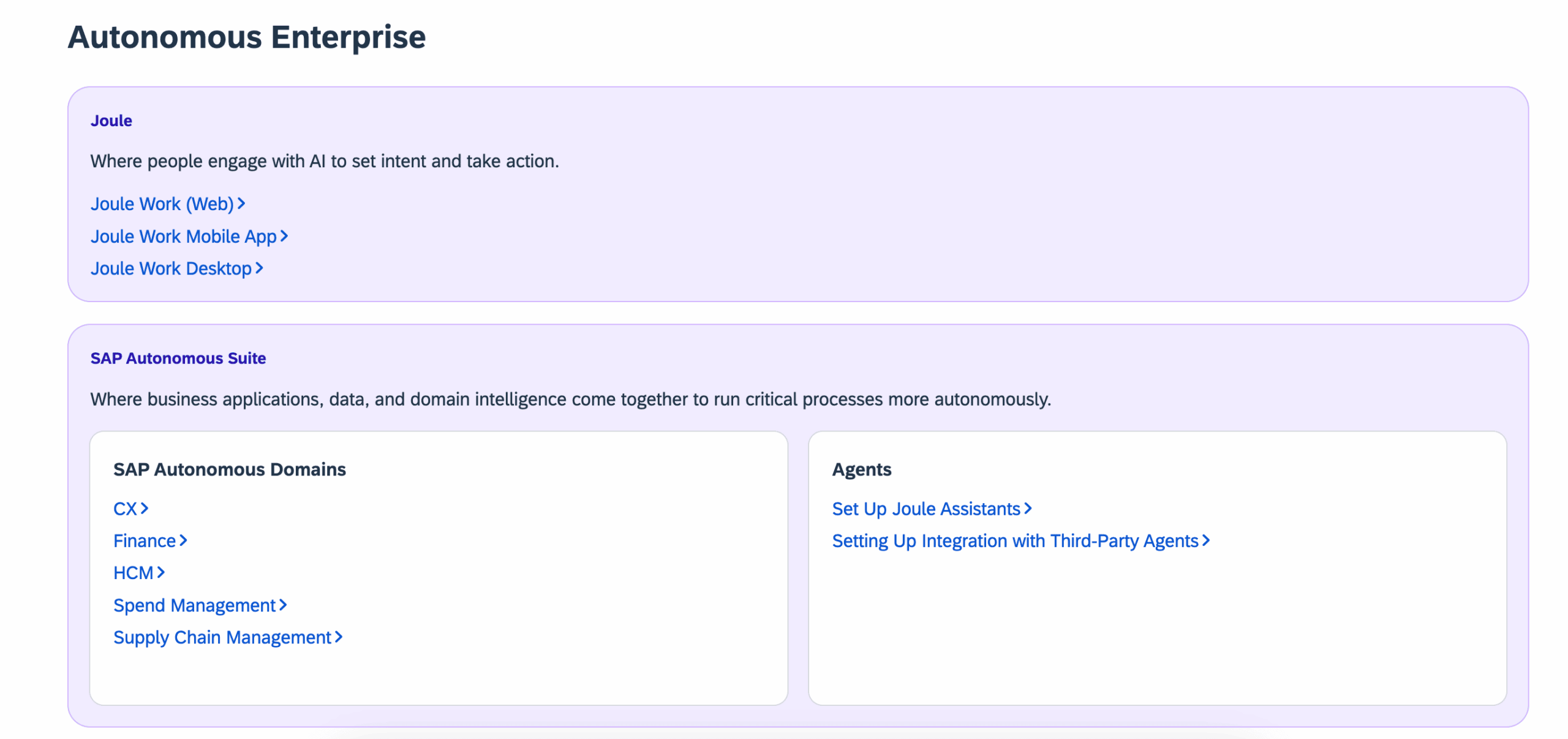
Three names are tangled here, so let’s start with that. SAP is the vendor. SAP Ariba is its procurement suite, the source-to-pay application where sourcing, contracts, and buying happen. Joule is SAP’s AI layer, embedded across SAP’s cloud apps. The agents are capabilities inside Ariba that users reach through Joule.
Next-gen SAP Ariba became available in March 2026, rebuilt on SAP Business Technology Platform with Joule embedded in procurement workflows. Early agent capabilities feature a Bid Analysis Agent that evaluates complex bid scenarios including total cost, and AI-assisted contract support that summarizes contracts and answers routine inquiries.
The AI implementation is still new and developing, but worth a look.
3. Coupa
Who is it for? Existing Coupa customers who want agents across sourcing, onboarding, and payments.
- Pros: Agents that complete and publish sourcing events; an instant risk summary for every completed supplier assessment; stuck approvals and unanswered supplier invites surface on their own; MCP access for external agents with existing permission and audit controls.
- Cons: A good fit only if you’re already using Coupa.
Coupa’s AI, called Coupa Compose, launched as three connected parts:
- Navi Agent Studio is a no-code builder where teams configure custom agents in natural language, monitor what those agents do, and control access by role.
- Smart Intake & Orchestration is a united place where requests arrive, get routed through the relevant agents and systems, and people step in where required.
- Navi Connect carries agent-to-agent communication and real-time updates into SAP, Oracle, and Microsoft Dynamics environments.
Coupa lists 50+ specialized Navi agents, covering sourcing event creation, bid comparison, risk sentinel, sanctions screening, and scenario ranking. Custom agents built in Agent Studio have become the platform’s most-used AI feature.
4. Zip
Who is it for? Mid-market and enterprise companies that already run an ERP but have a messy buying process on top of it.
- Pros: Platform designated for procurement with an orchestration layer over your existing ERP; agents across legal, IT, and security; Superagents are bound by existing policies and approval chains, with every action logged.
- Cons: Weaker at strategic sourcing for complex direct-material categories; still depends on your ERP and finance systems for records and payments.
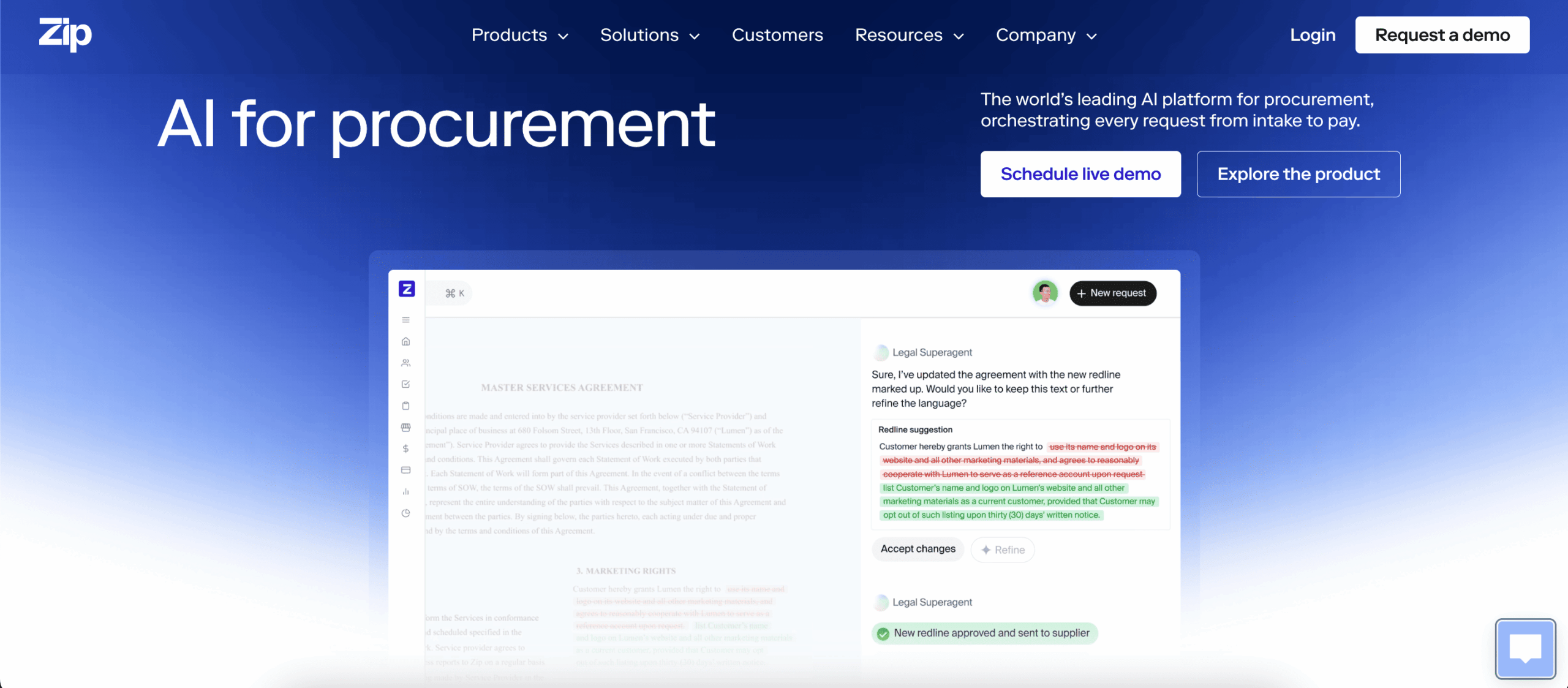
Zip was named a Visionary in Gartner’s 2026 Magic Quadrant for Source-to-Pay Suites. It is the youngest company ever to appear on it, and the only agentic procurement orchestration platform listed.
It offers 50+ purpose-built agents across procurement, finance, legal, IT, and security. It recently added Superagents: a Sourcing Superagent that runs events from request through supplier selection, and a PO Superagen, as well as expanded its AI Risk Orchestration.
5. Ivalua
Who is it for? Procurement organizations who prioritize governance for configuration, monitoring and audit purposes.
- Pros: Permissions enforced, inherited from human users and never exceeded; model-agnostic with MCP support.
- Cons: Single-agent architecture makes you dependent on Ivalua’s skill library rather than building your own agents.
Instead of a catalog of separate agents, IVA Studio powers one agent, IVA, that executes source-to-pay work through reusable skills, and is model-agnostic so customers can bring their own LLM.
There’s nothing to integrate because the Ivalua platform is both a knowledge source and toolset. Skills are how the team’s judgment gets into the agent: each one is a written playbook for a single job, such as how this team sources laptops, how it handles renewal negotiations, or which compliance checks apply. Buyers write them in their own words, and a new hire working with IVA inherits the whole team’s experience instead of starting from scratch.
Choose The Platform For Your Needs
The best AI agent for procurement depends on which part of the buying cycle is broken. This could be sourcing events that take several weeks, suppliers who need four emails to onboard, or invoices that don’t match their contracts.
To help you decide what is the right platform for you, we’ve compared them by use case:
| You need… | Start with |
|---|---|
| Executes procurement workflows from messy supplier, pricing, and inventory files, offers agents that follow your rules with full governance, audit trails and a self-hosted option | Ajelix |
| Agents inside an existing SAP landscape with native access to ERP transactions and contracts | Joule (SAP Ariba) |
| Sourcing events and supplier onboarding that complete themselves inside a platform you already use | Coupa |
| To fix how requests arrive and get approved using orchestration, without replacing your ERP | Zip |
| One governed agent with permissions inherited from users, across a configurable source-to-pay platform | Ivalua |
If deploying AI with control and confidence is your priority, contact the Ajelix team.
FAQ
Software that executes procurement tasks end to end within defined limits. Tasks include but are not limited to: reading a request, checking policy, pulling supplier and pricing data, drafting or publishing a sourcing event, and escalating decisions outside its authority to a person.
Procurement is the middle of the chain, between the demand signal and the payment, which is why an AI agent in supply chain rollout usually starts there. Unilever is building a multi-agent procurement system on Google’s Gemini Enterprise Agent Platform, with specialised agents reviewing supplier data, pricing history, contract terms, and sustainability risk before a coordinator agent presents it to buyers.
Not on anything that matters. The current releases keep humans on awards, approvals, and high-value actions.
No. Ajelix connects through API keys and can run on your own infrastructure. Zip orchestrates over existing systems. Coupa’s Compose combines existing architecture. Ivalua needs no integration because its own platform is the agent’s toolset.
Agentic AI chat that helps you complete projects
AI for work that ingests, transforms, and delivers the exact deliverables your team needs, while you stay focused on strategy. No more chatting, agents can get the job done.