Enterprise AI Adoption In 2026: Stats & Framework

Nearly every large company uses AI now, but most still can’t show what the technology is earning them. Despite budgets growing and new pilots launching continuously, it’s difficult to prove how implementing AI has changed company performance. But we are here to guide you through the enterprise AI adoption statistics and a suggested framework.
Our AI experts break down the state of enterprise AI adoption in 2026, what the latest numbers from the big research houses tell us, the challenges, and a simple framework you can use to move from scattered tools to measurable results.
Let’s dive in.
The Current State Of Enterprise AI Adoption
McKinsey’s annual survey (2026) on the state of AI found that “nearly nine in ten respondents report regular use of AI in at least one business function.”
That number has barely moved since 2025, so let’s instead look at how deep it goes: “44 percent now report that AI is scaling across their enterprise, up from 38 percent a year ago.”
According to this survey, only about 6% of organizations qualify as AI high performers (meaning AI drives at least 5% of their earnings), and just 37% report any positive impact on earnings at all.
It’s best not to look at only one survey, as it doesn’t show the complete picture:
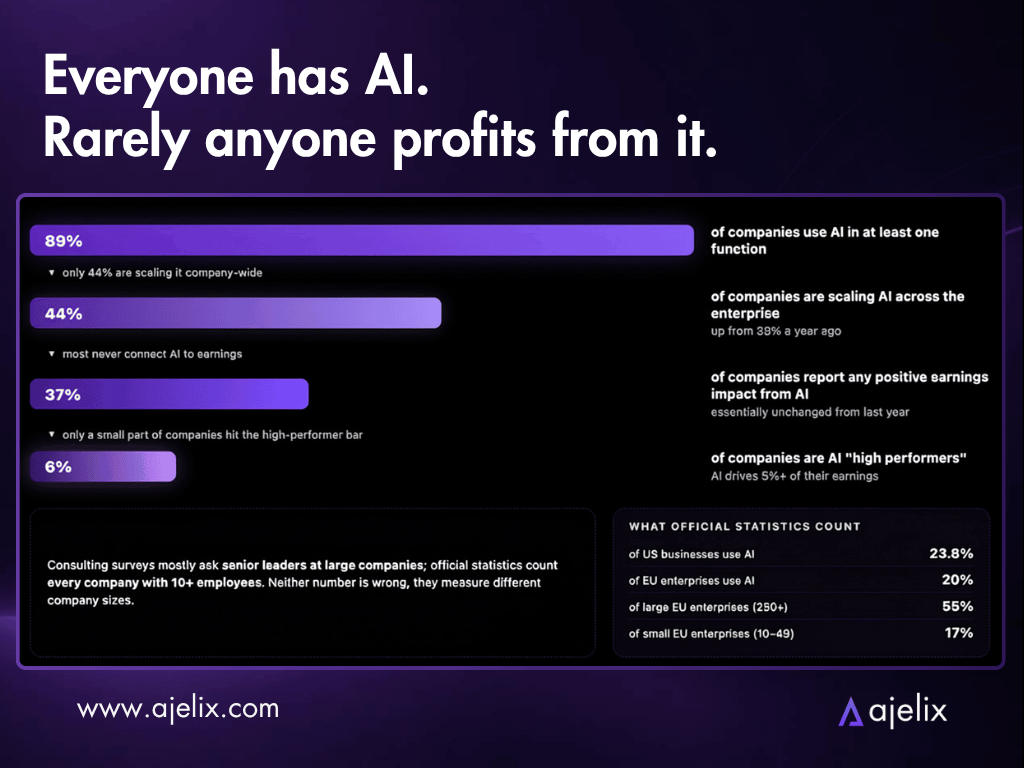
- Eurostat (December 2025): “In 2025, 20% of EU enterprises with 10 or more employees used AI technologies to conduct their business, showing a solid growth of 6.5 percentage points from 13.5% in 2024.” Here, Denmark led at 42%, Finland followed at 37.8%, while Romania was at 5.2%.
- The European Commission’s 2026 State of the Digital Decade report (June 17, 2026) reports that 46.7% of EU enterprises use cloud computing, 39.9% use data analytics, and nearly 20% use AI. The EU’s 2030 target is for at least 75% of businesses to use one of the three.
- The US Census Bureau’s Business Trends and Outlook Survey, sampling about 1.2 million businesses every two weeks, put AI use at 23.8% of US businesses (October 4, 2026).
- Stanford HAI’s 2026 AI Index (April 2026) reports 88% of organizations use AI in at least one business function, but fewer than 10% have fully scaled AI in any single function.
From this, we can tell almost every large surveyed company has used AI, about one in five businesses overall is truly using it, and almost nobody has scaled it properly.
Why Numbers Don’t Match
Consulting surveys like McKinsey’s mostly ask questions to senior leaders at large organizations. Official statistics like Eurostat’s cover every company with 10 or more employees across an entire economy.
If your sample consists mostly of billion-dollar enterprises, 89% AI use is believable. If your sample is the whole economy, 20% is the reality. Neither number is wrong because they measure different things.
- AI adoption tracks company size. Eurostat’s data shows large EU enterprises are far ahead of small ones, and 44% of large EU enterprises used at least two AI technologies in 2025, compared with 10.6% of small enterprises.
- There is still enormous room to grow. Europe is several points behind its 2030 target. If you’re a mid-sized company that hasn’t seriously adopted AI yet, you’re with the majority.
Enterprise Adoption Of Generative AI
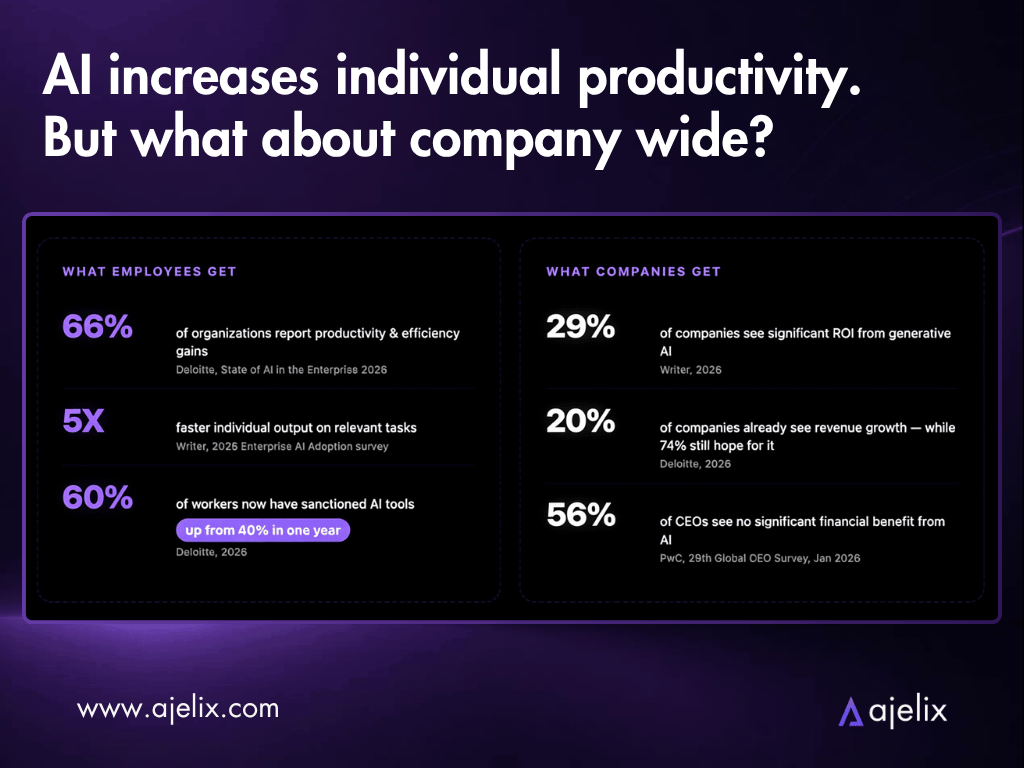
Deloitte’s State of AI in the Enterprise report, based on 3,235 leaders across 24 countries, puts generative AI enterprise adoption like this: “Improving productivity and efficiency lead the list of benefits achieved from enterprise AI adoption so far, with two-thirds (66%) of organizations reporting gains.”
However, “revenue growth largely remains an aspiration, with 74% of organizations hoping to grow revenue through their AI initiatives in the future compared to just 20% that are already doing so.”
Companies “broadened workforce access to AI by 50% in just one year, growing from fewer than 40% to around 60% of workers now equipped with sanctioned AI tools.”
The Writer 2026 enterprise AI adoption survey of 2,400 executives and employees captures the same issue: “Only 29% see significant ROI from generative AI, despite individual productivity gains of 5X.”
Personal speed doesn’t become company profit because employees finish their part of the work faster, then hand it to the same slow approval chains and processes that existed before AI.
Deloitte splits organizations into three groups: about a third are using AI to deeply transform processes, about a third are redesigning key processes around AI, and the last third use AI “at a more surface level, with little or no change to existing processes.” The gains come mostly from the first two groups.
PwC’s 29th Global CEO Survey reports that 56% of CEOs say they’ve seen no significant financial benefit from AI so far.
Agentic AI Enterprise Adoption
Agentic AI is AI that executes multi-step tasks instead of simply answering questions, and it’s starting to become more relevant than chatbots.
About two in ten organizations are scaling AI agents across the enterprise. Among organizations above $1 billion in revenue, 40% report scaling agents in at least one function, up from 27% a year earlier, while smaller organizations stayed at 22% (per the McKinsey survey). AI agents are currently a story only relevant to big companies.
Deloitte’s 2026 report shows where this is heading: “85% of companies expect to customize agents to fit the unique needs of their business.”
However, Gartner’s September 2026 forecast puts worldwide AI spending at $2.7 trillion in 2026, and its June 2025 prediction says more than 40% of agentic AI projects will be canceled by the end of 2027, due to escalating costs, unclear business value or inadequate risk controls.
Agentic AI enterprise adoption is expanding, but comes with risks. Agents within governed, measured workflows survive, while agents deployed as experiments might get canceled.
The Challenges
Enterprise AI adoption challenges are consistent across research houses, and they’re rarely about the quality of the models.
- Results aren’t apparent. Results aren’t reaching the P&L (see the McKinsey and PwC figures above). The issue here is that productivity gains aren’t connected to redesigned workflows and measured outcomes.
- Internal conflict over ownership. 54% of C-suite respondents in the Writer survey say AI adoption is tearing their company apart internally. This includes fights over budget, and who decides which model powers which workflow.
- Costs are high. In McKinsey’s survey, 20% of respondents said AI operating costs, including tokens, have constrained their AI rollouts.
- Governance can’t keep up with deployment. Deloitte and Stanford both warn that oversight and validation are not catching up with the AI usage. Additionally, the EU AI Act brings hard requirements for transparency, human oversight and documentation into this.
- Shadow AI. 67% of executives in the same survey believe their company has already suffered a data breach connected to unapproved AI use.
- Skills and data. The European Commission names SME barriers as “data, skills, integration and resources” because ICT specialists make up only 5% of EU employment.
The pattern here is that adoption is easy to start and hard to finish. Companies that get stuck with AI typically lack a redesigned workflow, someone accountable for the result, and governance that was included from day one, instead of added only after the first incident.
Enterprise AI Adoption 2026 Statistics At A Glance
The main enterprise AI adoption trends 2026 research has captured so far:
| Statistic | Source | When published |
|---|---|---|
| ~89% of organizations regularly use AI in at least one function | McKinsey State of AI 2026 (1,719 respondents, 97 countries) | August 2026 |
| 44% of organizations scaling AI across the enterprise (up from 38%) | McKinsey State of AI 2026 | August 2026 |
| 37% report any EBIT impact from AI; only 6% are AI high performers | McKinsey State of AI 2026 | August 2026 |
| 66% of organizations report productivity gains from AI | Deloitte State of AI in the Enterprise 2026 (3,235 leaders, 24 countries) | January 2026 |
| 74% hope for revenue growth from AI; only 20% already see it | Deloitte State of AI in the Enterprise 2026 | January 2026 |
| 56% of CEOs see no significant financial benefit from AI | PwC 29th Global CEO Survey (4,454 CEOs) | January 2026 |
| 29% see significant ROI from generative AI; 59% spend $1M+ a year | Writer Enterprise AI Adoption survey (2,400 respondents) | April 2026 |
| 20.0% of EU enterprises (10+ employees) used AI in 2025, up from 13.5% | Eurostat | December 2025 |
| 63% of EU businesses use AI, cloud or big data – 12 pp below the 2030 target | European Commission, State of the Digital Decade 2026 | June 2026 |
| 23.8% of US businesses used AI (19.8% in May 2026) | US Census Bureau BTOS | October 2026 |
| 88% use AI in at least one function; under 10% fully scaled in any function | Stanford HAI AI Index 2026 | April 2026 |
| 40% of $1B+ organizations scaling AI agents (up from 27%) | McKinsey State of AI 2026 | August 2026 |
| More than 40% of agentic AI projects will be canceled by end of 2027 | Gartner | June 2025 |
A Simple Enterprise AI Adoption Strategy Framework
Here’s a five-step enterprise AI adoption strategy framework that turns the 2026 research findings into actions your company can take:
Step 1: Pick one painful, measurable process
One, not multiple. The companies that succeed pick a process where the result can be measured. This can be invoice processing, report generation, customer support triage, or data cleaning.
Write down the current cost and time of the process before anything changes. If you can’t measure it, you can’t prove its value.
Step 2: Run a pilot with governance from the first day
Give it to one team only, give them a time limit, and set up access controls, audit trails and data rules before the first prompt can be sent.
Prevent shadow AI by giving people an approved place to use AI.
Step 3: Redesign the workflow
If an employee finishes a report in an hour instead of five because of AI’s help, but it is still queued for the same week-long approval chain, you haven’t gained anything. Change the process of approval alongside changing the way the task is executed.
Step 4: Make one person accountable, and keep measuring results against what you know works
Fewer than a quarter of organizations assign a single executive direct accountability for AI outcomes, per 2026 industry surveys. Unclear ownership is one of the main reasons organizations don’t see returns.
Compare results against Step 1 monthly, and get rid of everything that doesn’t work.
Step 5: Scale only what works
Once a process is measured and governed, extend it. That’s where agentic AI belongs, and what the 40% of large enterprises scaling agents are focusing on.
Scale on a platform with role-based access, spend controls and human escalation built in, so that the deployment costs are under your control and don’t get too expensive.
How Ajelix Can Help You
Ajelix Enterprise is a sovereign agentic AI platform built for organizations that want to use AI but need it to be governed, measurable and scaleable.
How it correlates to the framework:
- Start with a simple process. Ajelix agents produce excellent work with spreadsheets, documents, and reports, which are formats most enterprise processes use. That makes Step 1 easy, as you can pick the reporting, finance, or data-cleaning process your team already does manually, and let the agent take it over.
- Governance from day one. Ajelix offers Role-based access control (RBAC), policy enforcement on every input and output, banned-topic and keyword blocking, and PII detection that catches sensitive data before it leaves.
- Audit trails for every action. Every prompt, agent decision, and output is logged and traceable. This is the evidence you need for GDPR, the EU AI Act, and the Step 4 monthly reviews.
- Human escalation is built in. Agents escalate high-value decisions to a person instead of acting alone, which keeps the redesigned workflow under human control (Step 3). This is also relevant for reducing costs after you start scaling.
- Spend controls. Manage and limit AI usage across teams and projects, so that there are never any unpleasant surprises in your bill.
- Scale without losing control. When a pilot proves itself, extend it into multi-step agents on the same governed platform. Ajelix offers flexible deployment on Ajelix’s own EU-hosted cloud, on AWS, Azure, Google Cloud, or the opportunity to go fully self-hosted.
Every 2026 success story features a measured process, a governed platform, and someone accountable for the result. Ajelix Enterprise gives you the platform part, so your team can focus on picking the right process.
Contact the Ajelix team to see how it would work on your workflows.

FAQ
AI adoption in the enterprise is the process of an organization moving AI from experiments into regular, governed use in its daily operations, ideally scaled across multiple business functions and connected to measurable business results.
It depends on who you ask and who they survey. McKinsey found nearly nine in ten large surveyed organizations use AI in at least one function, while official statistics show 20% of EU enterprises and 23.8% of US businesses use AI. Company size is the strongest predictor of adoption.
Unmeasurable returns, rising operating costs, conflicts over budget and tool ownership, shadow AI, lack of governance, and shortages of skills and clean data.
For measured, governed workflows – yes, and 40% of large enterprises are already scaling agents. Gartner expects more than 40% of agentic AI projects to be canceled by the end of 2027, but mostly because they were launched as experiments without clear value or governance.
Pick one painful, measurable process and write down its current cost and time. Then run a contained, governed pilot on it. Trying to adopt AI everywhere at once is the most common reason companies end up with no returns.
Agentic AI chat that helps you complete projects
AI for work that ingests, transforms, and delivers the exact deliverables your team needs, while you stay focused on strategy. No more chatting, agents can get the job done.