Sovereign AI: The 2026 Guide For Enterprises

If your AI vendor can change the model overnight, cut you off with one policy decision, or hand over your data under a foreign court order, you don’t control your AI – someone else does. Fixing that is the whole point of sovereign AI.
In this guide, our AI experts explain what sovereign AI is, the infrastructure and companies behind the movement, and how enterprises can build sovereign AI capabilities.
Let’s dive in.
Table of Contents:
- What Is Sovereign AI
- Why It’s Important
- The Layers Of Sovereign AI
- Infrastructure And Data Centers
- Companies Building Sovereign AI In 2026
- Sovereign AI Servers
- Ajelix Enterprise: The Best Sovereign AI Platform
- Sovereign AI vs Data Residency vs On-Premise AI
- How Enterprises Can Adopt Sovereign AI
- FAQ
What Is Sovereign AI
The widely accepted sovereign AI definition is: AI systems that remain under the full control and legal jurisdiction of the organization or nation using them. This ensures nothing essential can be switched off, accessed, or repurposed by a foreign provider.
You can check if you’re using sovereign AI by asking the following questions:
- Where does the computing happen? Everyday AI use should run on hardware that you own, or rent inside your country of residence.
- Where does the data end up? Every question, document, answer, and log should stay inside that country as well.
- Who can demand access to the data? If a company in another country can, the setup isn’t sovereign.
Sovereign AI technology includes:
- AI accelerators and servers;
- Large Language Models and their weights,
- The inference and orchestration layer;
- The governance controls around all of it.
You don’t need to own every component (it’s nearly impossible to), but you need to know exactly where your dependencies are.
Why It’s Important
Sovereign AI has become a procurement requirement due to three main forces:
- Gartner has predicted that by 2027, 35% of countries will be locked into region-specific AI platforms. NVIDIA’s sovereign AI has expanded to national programs in countries like Canada, France, the Netherlands, Singapore and the UK.
- The three main AI and Cloud Acts. The EU AI Act imposes transparency and data governance requirements on high-risk and general-purpose AI systems. The European Commission’s Cloud and AI Development Act has proposed requirements for sovereign cloud providers. The US CLOUD Act and export controls have made it clear that access to AI can be turned off by a decision made elsewhere.
- Companies are tired of depending on others. Europe hosts around 5% of the global AI compute, while the US hosts close to 75%. One foreign policy decision can stop a national AI program.
If you’re responsible for an enterprise and your AI vendor can change the model overnight, hand over your data under a foreign court order, or raise prices once you’re dependent, you don’t control your own operations.
The Layers Of Sovereign AI
Frameworks break sovereignty into these four layers:
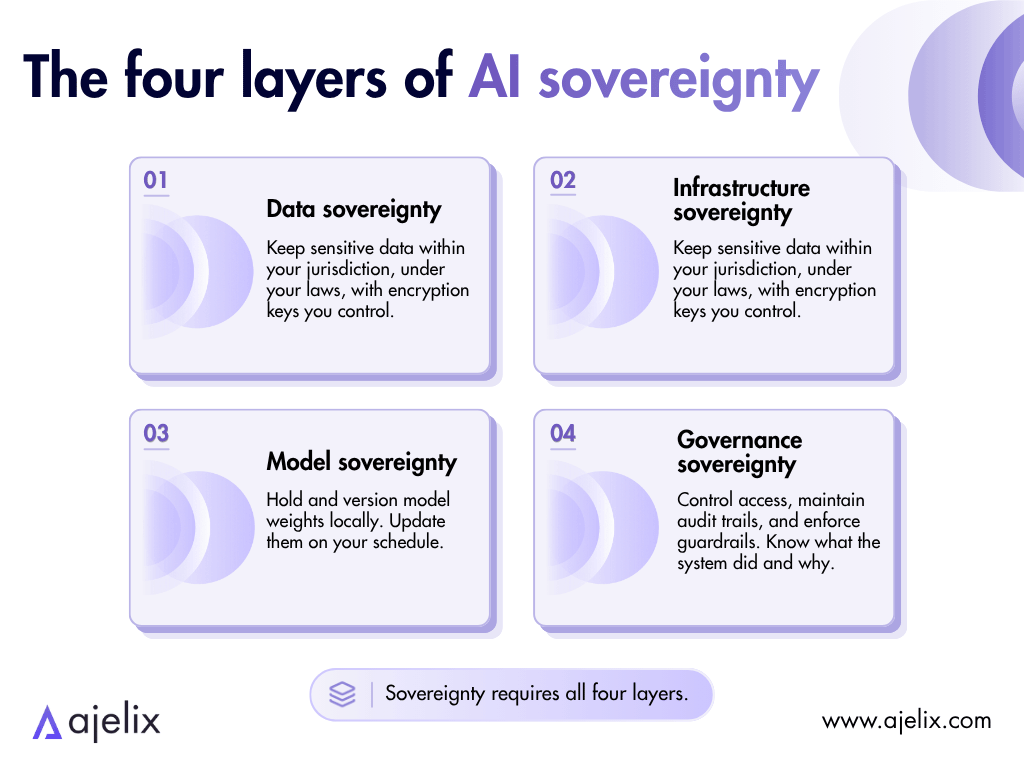
- Data sovereignty. So that sensitive data stays inside your jurisdiction, is processed under your laws, with you controlling the encryption keys.
- Infrastructure sovereignty. The compute (GPUs, servers, data centers, networking) is owned, leased, or contracted under your jurisdiction, and the control plane isn’t operated from abroad.
- Model sovereignty. Model weights are held and versioned locally, and updated on your schedule.
- Governance sovereignty. Role-based access, audit trails, guardrails, and the ability to prove exactly what the system did and why.
All four layers together give you full sovereignty, while two or three is only partial sovereignty.
Infrastructure And Data Centers
A sovereign AI data center is a large-scale computing facility built to train, fine-tune, and run AI models under the control of the jurisdiction it serves. It functions with domestic or contracted hardware, local energy, and no dependency on a foreign provider.
The latest news on sovereign AI infrastructure is the European Commission announcement of an open call to build up to seven AI gigafactories across the EU. Each facility is expected to host at least 100,000 advanced AI processors, complementing the EU’s existing network of 19 smaller AI factories.
The Commission signed letters of intent with NVIDIA, AMD, and Qualcomm, meaning “sovereign” data centers will be filled with American-designed processors. Europe is building jurisdictional sovereignty faster than hardware sovereignty.
Several European AI infrastructure projects are already in motion:
- Stargate Norway, a 100,000-GPU facility backed by OpenAI, Nscale, and Aker, is under construction with first GPUs expected online by end of 2026;
- NVIDIA and Deutsche Telekom have unveiled a 10,000-GPU industrial AI cloud in Germany;
- Microsoft committed to a multibillion-dollar partnership bringing Mistral’s models into its sovereign cloud portfolio.
Outside Europe, Saudi Arabia is spending billions on AI data centers and infrastructure, the UAE is building a massive 1-gigawatt cluster with OpenAI, and India has assembled a national pool of more than 34,000 GPUs, aiming for 100,000 by the end of 2026.
Companies Building Sovereign AI In 2026
Here’s what the most notable companies building sovereign AI have produced so far:
| Company / Program | Country | What they’re building |
|---|---|---|
| Mistral AI | France | Secured $830 million in debt financing in March 2026 for its data center near Paris, on top of a €1.2 billion Sweden expansion announced in February. |
| NVIDIA | US | Sells AI computing systems to government AI programs. |
| G42 & TII | UAE | G42 is building a 1-gigawatt AI cluster with OpenAI, Oracle, and NVIDIA. TII develops the Falcon open-weight AI models. |
| HUMAIN | Saudi Arabia | Building AI data centers, cloud platforms, and Arabic-language AI models. |
| IndiaAI Mission | India | Runs a national pool of more than 34,000 GPUs and supports startups like Sarvam AI building AI models for Indian languages. |
| Naver | South Korea | Building AI infrastructure and AI models for the South Korean market. |
These sovereign AI examples share a pattern: control of compute, open or locally controlled models, and alignment with local law and language.
Sovereign AI Servers
What makes a server sovereign is where it runs and who controls it. If you’re evaluating the best sovereign AI server for a private deployment, the market offers this list:
- NVIDIA DGX B200 / DGX SuperPOD;
- HPE ProLiant Compute XD685;
- Lenovo ThinkSystem GB300 NVL72;
- Supermicro AI Factory SuperCluster.
For most enterprises, a platform you can self-host delivers sovereignty benefits without buying a space in a data center.
Ajelix Enterprise: The Best Sovereign AI Platform
Ajelix Enterprise is an agentic AI platform built for organizations that need AI to operate inside their own compliance and security requirements.
- Flexible deployment. Run on Ajelix’s EU-hosted cloud, deploy on AWS, Azure, or Google Cloud, or go fully self-hosted, meaning the entire platform and all data run inside your own infrastructure, with nothing leaving your environment. Self-hosting is the strongest sovereignty option of the three.
- Own AI infrastructure. Ajelix runs on infrastructure the company invested in and operates itself, so your data isn’t passed through a chain of external services.
- Guardrails on every message. Policy is enforced on every input and output, banned topics and keywords are blocked, and sensitive data like PII (Personal Identifiable Information) is caught before it leaks.
- Role-based access control (RBAC). Define exactly which employees, teams, and projects can reach which agents, data sources, and outputs.
- Complete audit trails. Every prompt, agent decision, and output is logged and traceable. This is the evidence you will need for GDPR, the EU AI Act, and internal compliance reviews.
- Spend controls. Manage and limit AI usage across projects and teams, preventing unexpected costs and unauthorized deployments.
- Human escalation built in. Agents are designed to escalate high-value decisions to a person instead of acting alone.
For enterprises, Ajelix’s combination of deployment choice, infrastructure, governance, and auditability is what turns simply using AI into owning it.
You won’t need to add on extra sovereign AI tools for hosting or governance, because Ajelix gives you the choice of models and handles the model serving. Ajelix handles the operational layer hosting, model serving, and governance tooling, but the controls stay with you: model and ecosystem choice, exportable data, exit paths, and audit evidence remain yours.
Contact the team for a quote.

Sovereign AI vs Data Residency vs On-Premise AI
While vendors may use these terms interchangeably, they aren’t the same.
| Property | Data Residency | On-Premise AI | Sovereign AI |
|---|---|---|---|
| Data physically stays in-country | Yes | Yes | Yes |
| Operator controls the hardware | No | Yes | Yes |
| Operator controls the model version | No | Usually | Yes |
| No cross-jurisdiction legal reach | No | Sometimes | Yes |
| Works air-gapped | No | Sometimes | Yes |
The last two rows matter the most, because even if the servers are in your own building, the vendor can still reach the system from abroad, through remote updates, support access, or the law of the country it’s based in. This is called being ‘residency-compliant’, not truly sovereign.
How Enterprises Can Adopt Sovereign AI
The good part is that you don’t always need to invest in your own physical AI infrastructure to move toward sovereignty. Here are tips for how you can progress:
- Classify your data. Identify what can and cannot leave your jurisdiction or legal control.
- Map your dependencies. For each AI tool you use, figure out where inference happens, where data is stored, who can control the access, and whether the vendor can change something without notice.
- Choose models you can control. Open-weight models let you hold, version, and fine-tune weights on your own schedule.
- Pick the right deployment model. An EU-hosted cloud operated under EU jurisdiction (if your company is based in the EU), a private cloud you contract, or a fully self-hosted deployment where nothing leaves your environment. Ajelix Enterprise supports all three.
- Remember that governance is a must. A sovereign AI platform must have RBAC, policy enforcement on every input and output, model pinning, exit rights, and auditable logs.
- Avoid new ways of being locked to one provider. Choose open standards, exportable data, and documented exit paths.
The goal is to make sure every critical dependency is one you’ve chosen and can leave.
Want to learn more about how Ajelix can help your enterprise? Contact us.
FAQ
The sovereign AI meaning is simple: AI that runs entirely under your own control (your infrastructure, your data, your models, and your country’s laws) with no foreign provider able to access, change, or shut it down.
A large-scale computing facility where AI training and inference happen entirely under the control of the country or organization it serves, with local energy, domestically governed hardware, and no operational dependency on a foreign provider.
The biggest sovereign AI Europe story is the European Commission’s July 2026 call to build up to seven AI gigafactories, unlocking more than €30 billion in total investment, up to €10 billion in public funding from the EU and member states, with at least €20 billion expected from private capital.
Mistral AI in Europe, Sarvam AI in India, Reflection AI (partnering with Saudi Arabia’s HUMAIN), Nscale (behind Stargate Norway and Stargate UK), and TII’s Falcon program in the UAE.
Almost no organization is 100% AI sovereign, as everyone depends on chip supply chains that cross borders. The realistic goal is controlled sovereignty, such as knowing every dependency, keeping sensitive data and model control inside your jurisdiction, and staying operational if any vendor relationship changes.
No. It started as a nation-state concept, but in 2026 it’s a practical procurement requirement for enterprises in finance, healthcare, defense, and any organization operating under GDPR or the EU AI Act.
A practical sovereign stack combines open-weight models you can host yourself, an AI platform with EU-hosted or self-hosted deployment (such as Ajelix Enterprise), governance features like RBAC and audit trails, and jurisdiction-controlled hosting.
Agentic AI chat that helps you complete projects
AI for work that ingests, transforms, and delivers the exact deliverables your team needs, while you stay focused on strategy. No more chatting, agents can get the job done.