Agentic AI vs Generative AI: Key Differences & Examples

Generative AI answers your questions. Agentic AI completes your work.
That one sentence captures the core difference – but what separates the two runs much deeper than most people realize. Different goals, outputs, and levels of autonomy.
If you’ve ever wondered what sets tools like ChatGPT apart from a fully autonomous AI agent, this is the article for you.
Table of Contents
- What Is Generative AI vs Agentic AI?
- Agentic AI vs Generative AI: Key Differences at a Glance
- Agentic AI vs Generative AI vs Traditional AI: Where Does Each Fit?
- Agentic AI vs Generative AI: Examples with Walkthroughs
- Can Generative AI and Agentic AI Work Together?
- How to Choose: When to Use Generative AI vs Agentic AI
- How to Get Started with Agentic AI Today
- FAQ
What Is Generative AI vs Agentic AI?
Generative AI is AI that creates new content – text, images, audio, code – in response to a user’s prompt. It works by learning patterns from large datasets and generating outputs based on those learned patterns. You ask, it produces. ChatGPT’s chatbot mode is the most widely known example: you type a prompt, you get a response.
Agentic AI plans, decides, and acts to complete a goal with minimal human input at each step. Rather than responding to a single prompt with a single output, it runs a continuous loop: it perceives context, reasons through a plan, executes actions using tools, checks its results, and adapts.
Agentic AI is the capability that makes a system autonomous – not a product itself, but a quality built into products like AI agents.
Author’s Note. An AI agent is not to be confused with Agentic AI as a whole. An AI agent is a system itself, whereas Agentic AI is the capability and autonomy.
The clearest way to see the difference between Generative and Agentic AI is through what each one hands you at the end of a task.
With Generative AI, you describe what you need and receive instructions, a draft, or a suggestion. The work is still yours to finish.
With Agentic AI, you describe the goal and receive a finished output. The Ajelix agent, for example, can take a single prompt and go from web research to a finished investor pitch deck. Or turn a raw sales file into a formatted Excel financial model, a visual dashboard, and an executive summary, all in one go.
In short: Generative AI lowers the cost of creation. Agentic AI lowers the cost of action.

Agentic AI vs Generative AI: Key Differences at a Glance
Generative AI creates content on demand – you prompt it, it responds, and it stops. Agentic AI pursues a goal autonomously – it plans, uses tools, self-corrects, and delivers a finished result with minimal input from you. The core distinction is not capability, but control: one waits for instructions at every step, the other only needs them once.
Here are the six key differences in more detail.
| Dimension | Generative AI | Agentic AI |
|---|---|---|
| Primary function | Creates content (text, images, code, audio) | Executes tasks and completes goals |
| Interaction mode | Reactive – responds to each prompt | Proactive – pursues a goal autonomously |
| Task scope | Single-turn: one prompt, one output | Multi-step: plans, executes, checks, adapts |
| Human involvement | Required at every step to move forward | Minimal – set a goal, review the output |
| Output | A response, draft, or suggestion | A finished, usable deliverable |
| Tool use | Works within its training data | Connects to external tools, APIs, files |
Human Involvement
Generative AI keeps you in the loop at every step – you prompt, review, adjust, repeat.
With Agentic AI, you set the goal up front and review the result at the end. The agent handles everything in between – the planning, execution, and self-correction. This is the progression from AI as an assistant to AI as a colleague.
Tool Use
Generative AI works within the boundaries of its training data. It can’t browse the web, access your files, run code, or call external services – unless those capabilities have been explicitly added on top.
Agentic AI is built around tool use. A core property of any AI agent is its ability to connect to external systems – search engines, APIs, databases, code execution environments – and use them to carry out a plan.
Each step can use a different tool and build on the last. That lets Agentic systems chain together actions no single prompt could handle, and catch errors mid-task instead of delivering a flawed output at the end.
Agentic AI does introduce limitations worth knowing:
- Early errors: Because steps execute sequentially and each builds on the last, an early error can compound – a wrong assumption in step two affects everything after it.
- External tools: Actions taken through external tools can also be harder to audit or reverse than a piece of generated text.
The more autonomy you give an agent, the more important it is to define the goal precisely and review the output before acting on it.
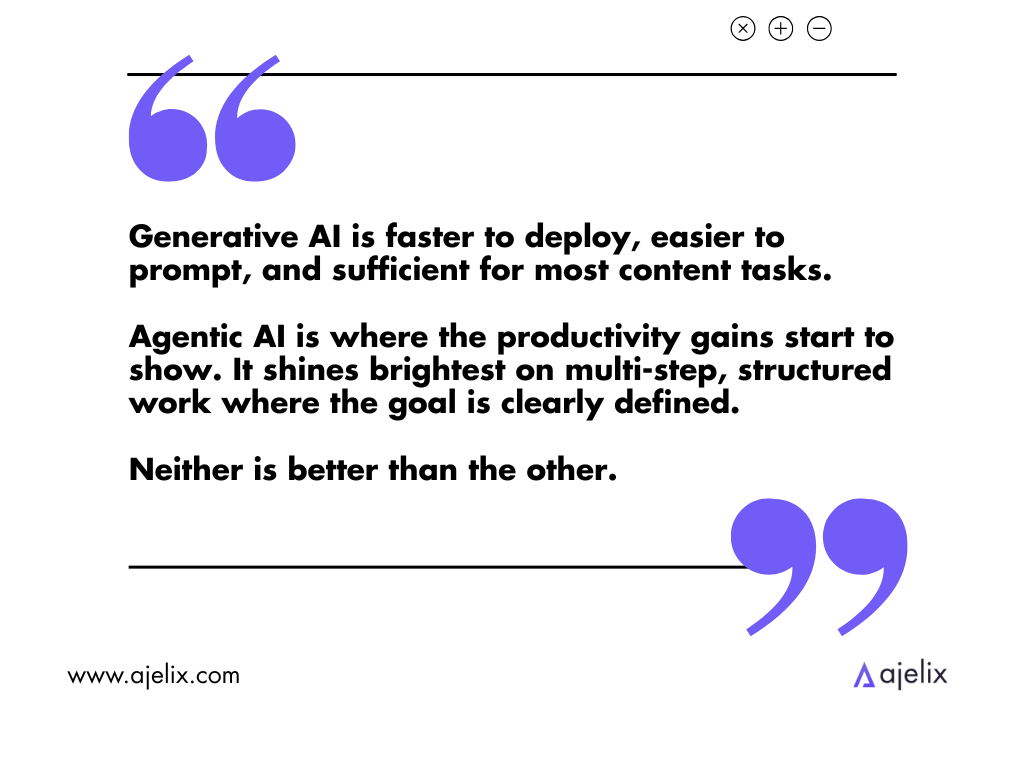
Author’s Note. Generative AI is faster to deploy, easier to prompt, and sufficient for most content tasks. Agentic AI is where the productivity gains start to show. It shines brightest on multi-step, structured work where the goal is clearly defined. Neither is better than the other in every situation.
Agentic AI vs Generative AI vs Traditional AI: Where Does Each Fit?
Each AI type solves a different problem: traditional AI follows rules, generative AI learns from data and creates, and agentic AI takes a goal and sees it through. Understanding where each fits tells you which one to reach for.
Traditional AI: The Rule-Follower
Traditional AI – also called narrow or rule-based AI – operates on explicit, hard-coded logic. It doesn’t learn; it executes. Feed it an input that matches a defined rule, and it returns the expected output.
This makes it exceptionally reliable for structured, predictable tasks – fraud detection, purchase-based recommendations, compliance rule enforcement. Consistent inputs, consistent outputs.
The limitation is its rigidity. Change the conditions, and the system breaks or simply does nothing. It cannot adapt, improvise, or handle anything outside its predefined scope.
Where it fits: High-volume, well-defined tasks where consistency and auditability matter more than flexibility.
Generative AI adds adaptability: it learns from data rather than rules, and produces new content in response to whatever you ask.
Agentic AI adds initiative: it doesn’t wait to be asked but takes a goal and sees it through.
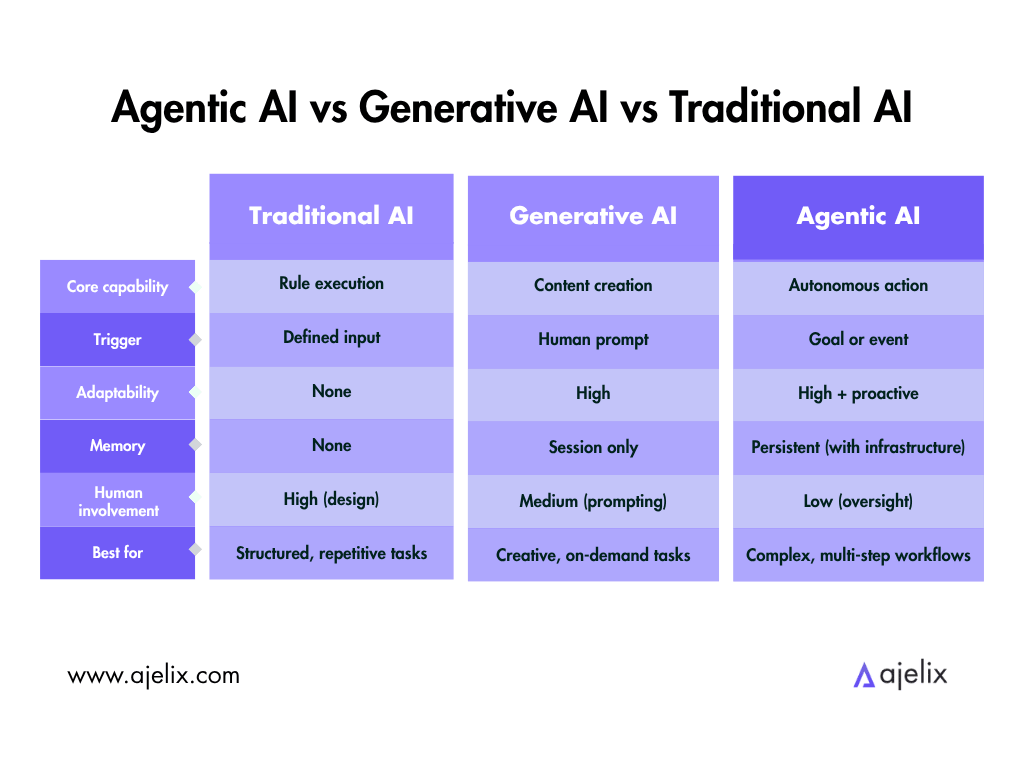
These types of AI aren’t competing – most enterprise deployments will use all three. Traditional AI handles the rules-based work. Generative AI handles language and creativity. Agentic AI handles execution.
Understanding where each fits is what separates organizations that experiment with AI from those that put it to work.
Agentic AI vs Generative AI: Examples with Walkthroughs
To showcase the differences between Agentic AI and Generative AI, I will prompt a free version of the ChatGPT chatbot, and my paid version of Ajelix’s AI agent as a team member.
While that may not sound fair, the choice is deliberate. Free ChatGPT is a clean example of a Generative AI model – no tools or autonomous steps, just prompt in, response out. That makes it the right representative for this exercise. Upgrading to a paid plan unlocks Agentic capabilities, which would make it a different kind of comparison entirely.
The goal here isn’t to compare products at different price points, but to show what pure Generative AI looks like next to a purpose-built Agentic system, using the most accessible version of each.
I’m choosing a task where ChatGPT can do something genuinely useful, while Ajelix takes it a step further.
Prompt for ChatGPT (Generative AI, standard chat):
Give me a competitive analysis of Notion vs. Ajelix. Cover what each tool does, who it's for, its main strengths and weaknesses, and how they differ. Format it clearly.
Prompt for Ajelix (Agentic AI):
Research Notion and Ajelix as competing productivity tools. Search for up-to-date information on both, then produce a competitive analysis that includes: a summary of each tool, a side-by-side comparison table of features, and a recommendation on which suits a small business vs. an enterprise team. Save the final output as a formatted document.
ChatGPT (Free Version) Walkthrough
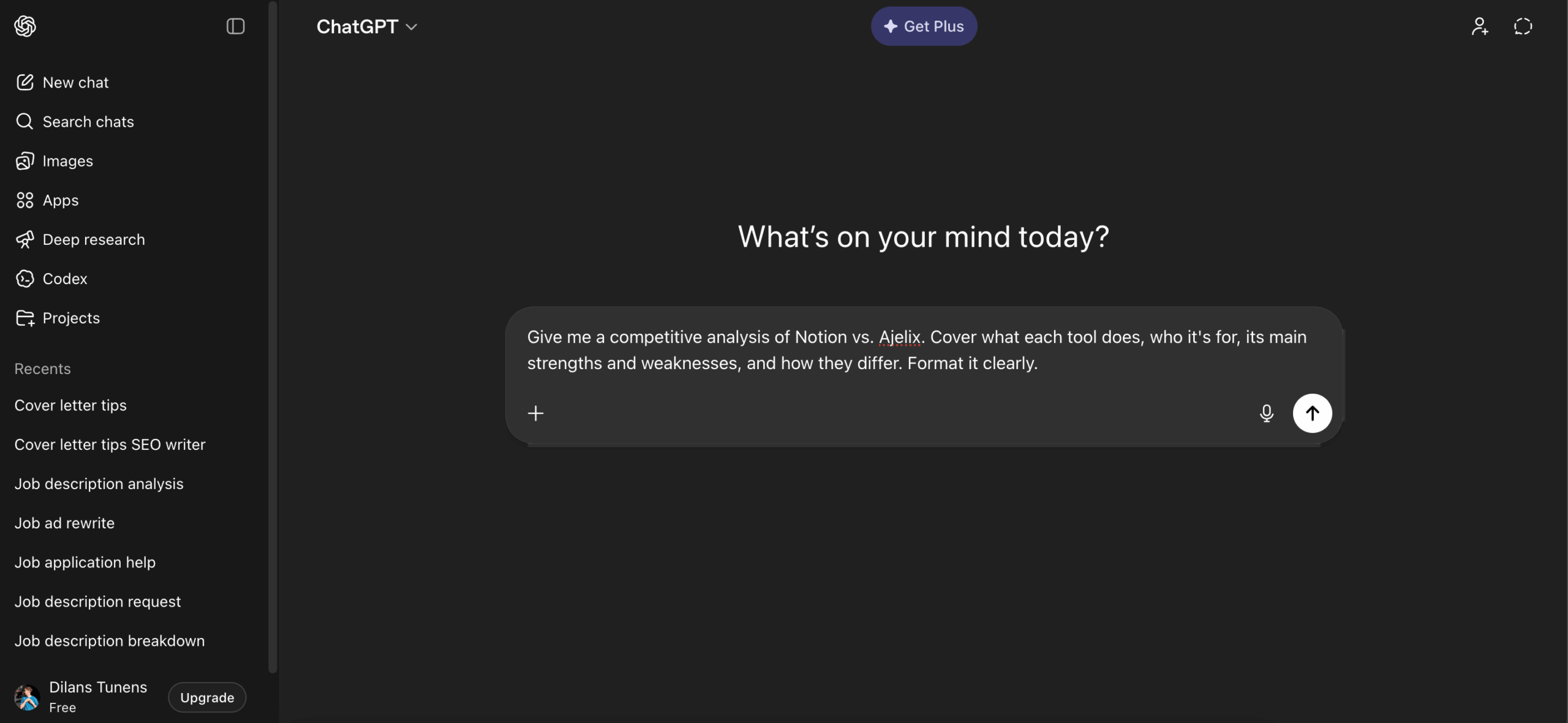
After logging in with a free account, I entered the prompt.
ChatGPT ended up summarizing the contents and then going on a long explanation about the two tools in the prompt.
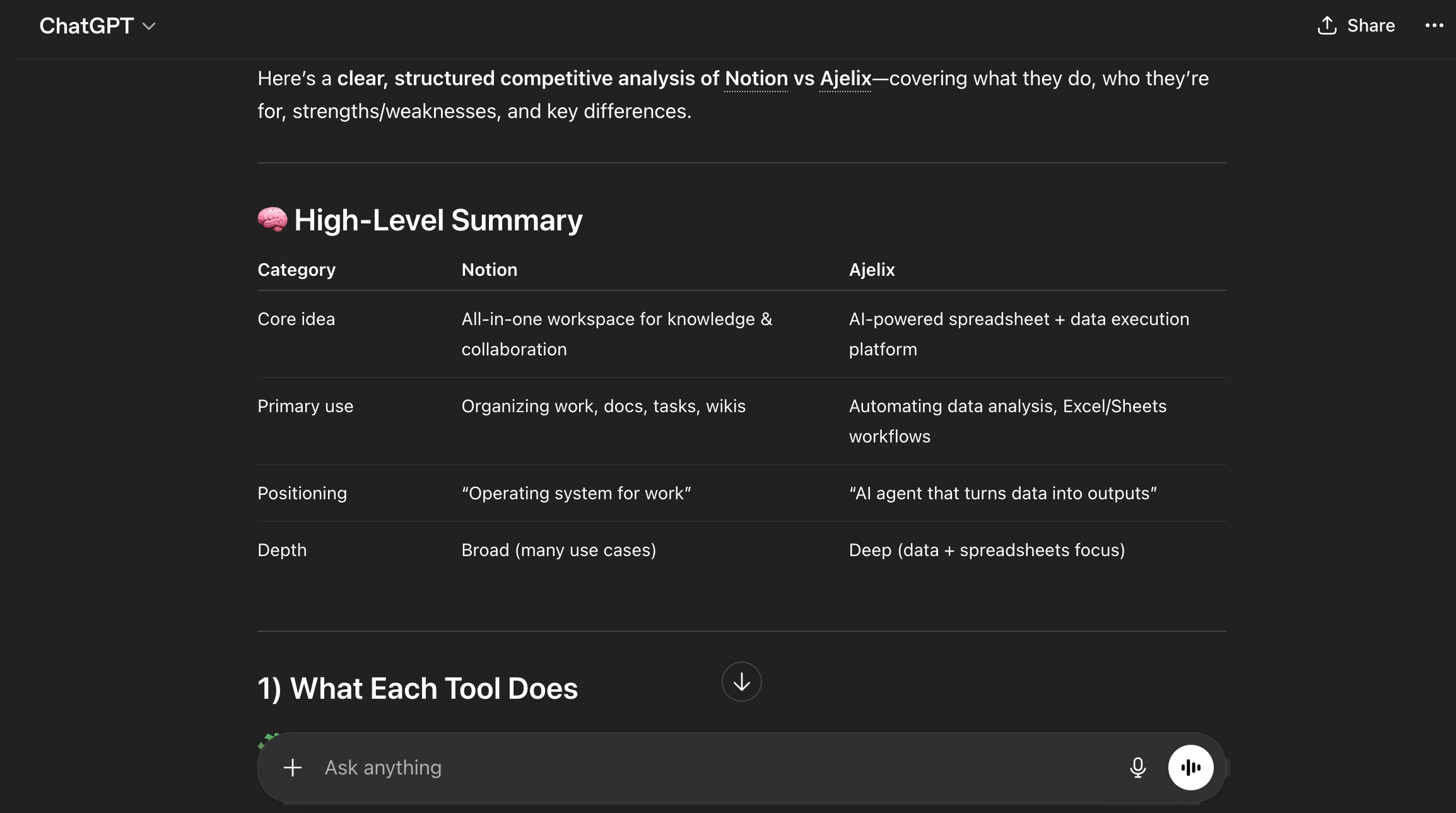
To keep the screenshots manageable for the article, I asked ChatGPT to create a .doc file of its response.
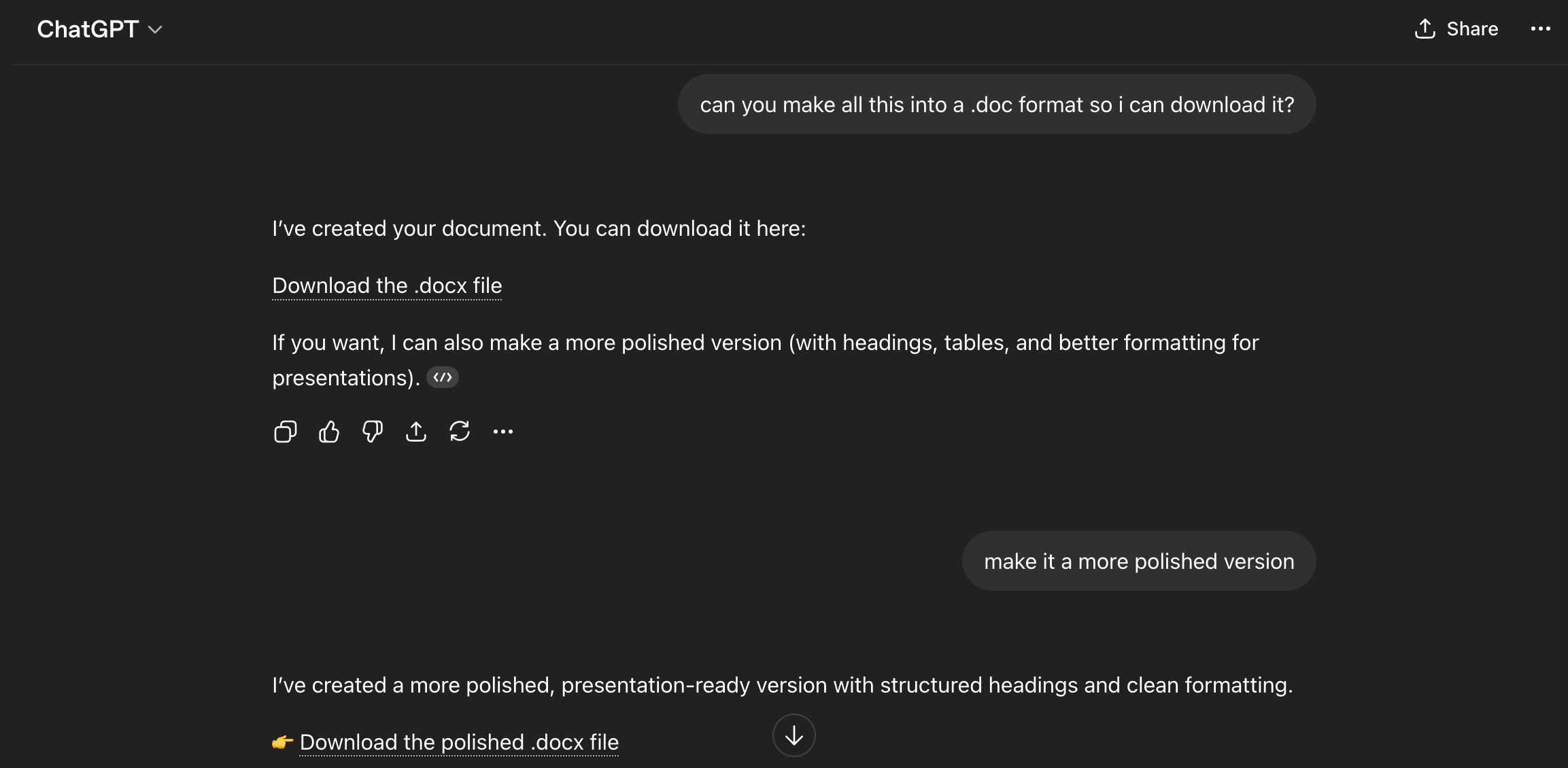
I went back and forth with ChatGPT several times until I was satisfied with the formatting.
All my attempts:
By the final version (basic → polished → advanced), most detail had been stripped out and replaced with a narrow summary.
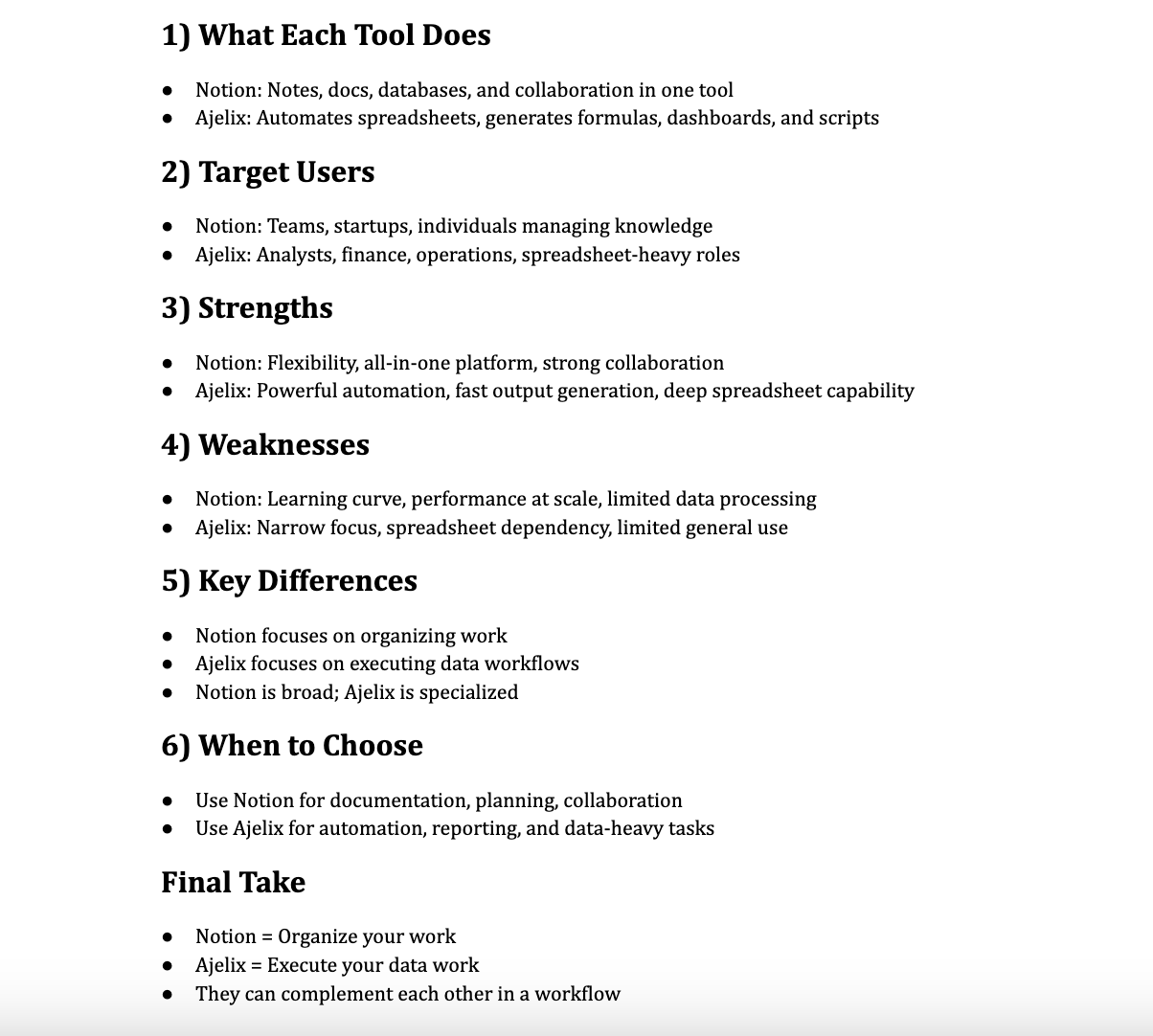
For a free Generative AI chatbot, I was relatively satisfied with its capabilities. My main takeaway after working with Ajelix’s AI agents for a while was the aspect of continuous back-and-forth.
Ajelix (Paid Version) Walkthrough
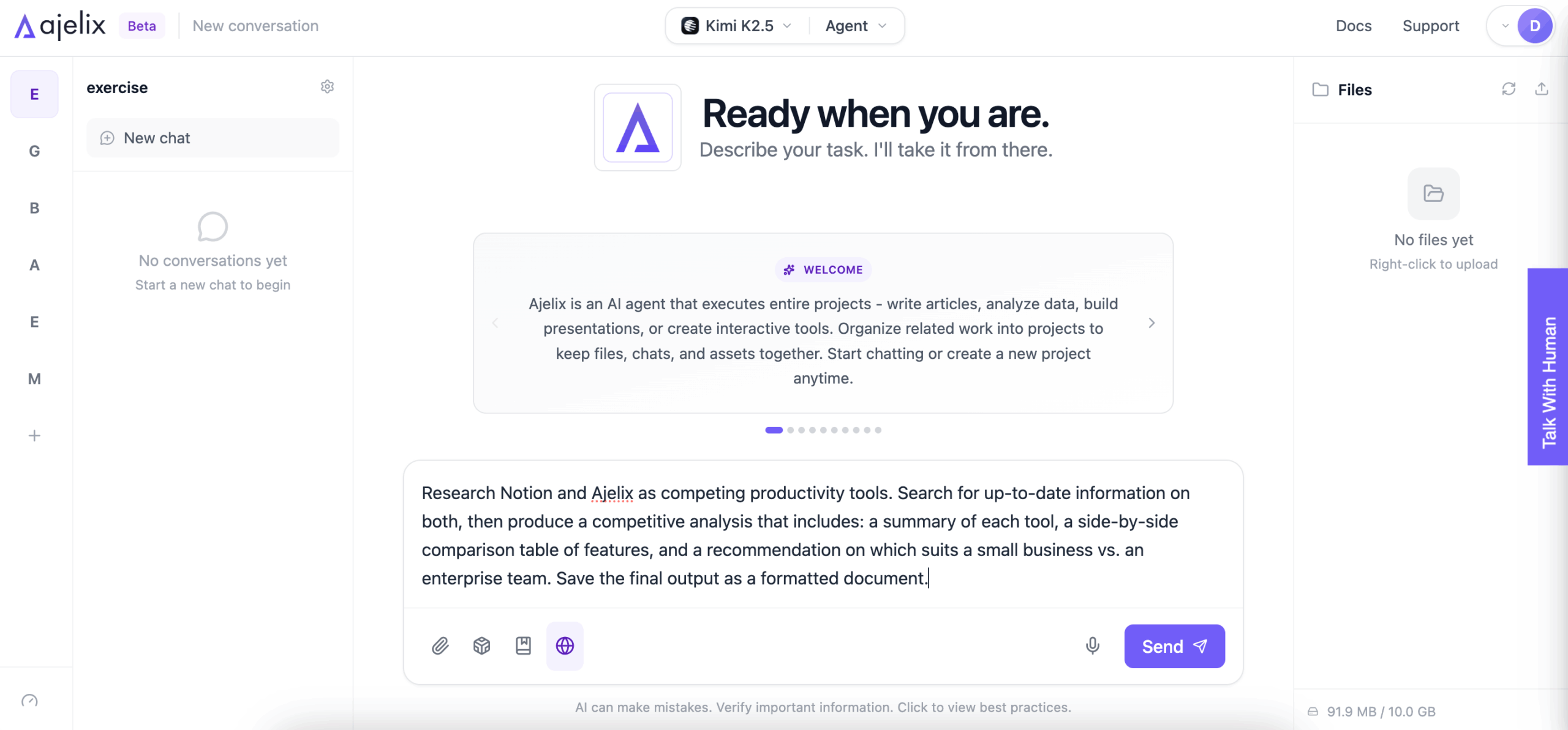
Using my work account, I entered the prompt in Agent mode on chat.ajelix.com and enabled Web Search.
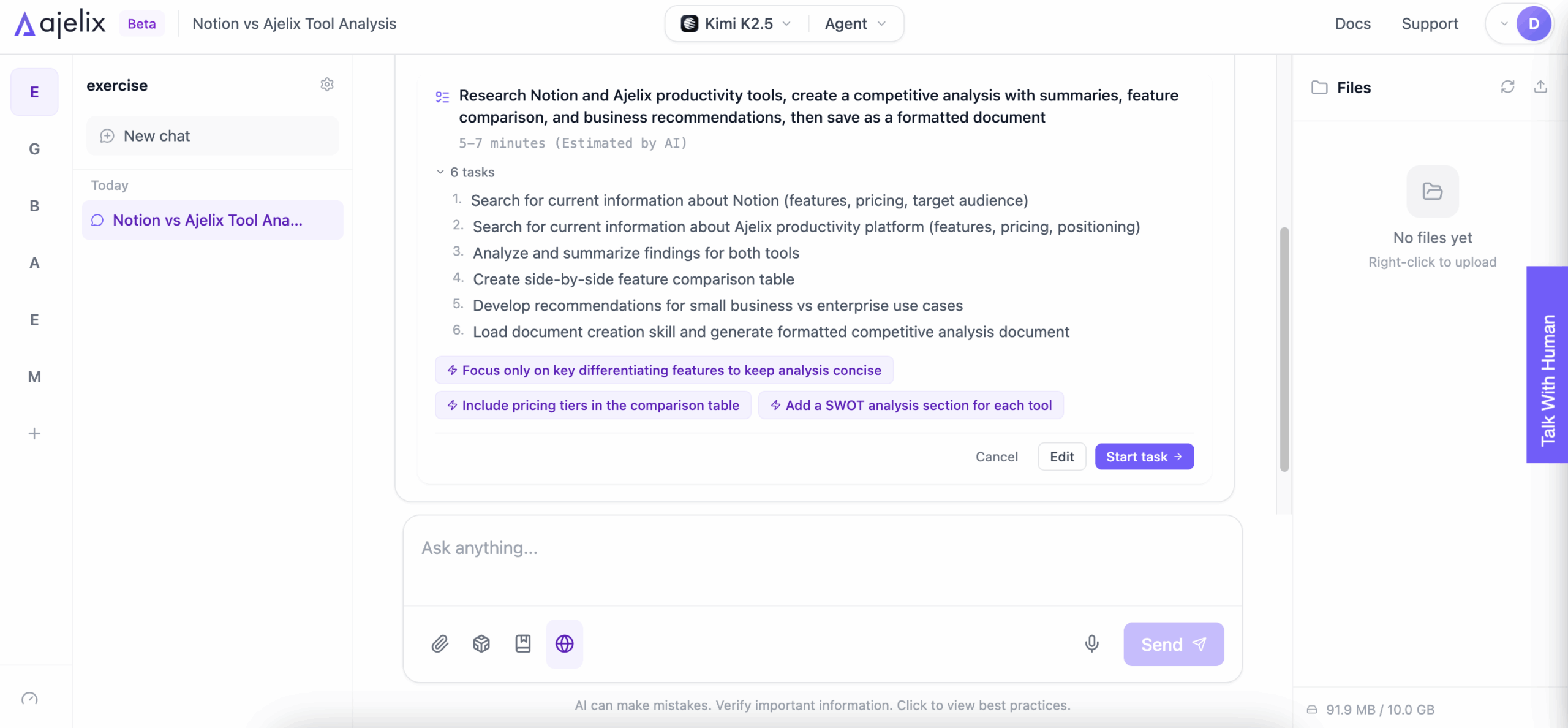
In seconds, the Agentic capabilities are displayed – Ajelix offered a work plan that I could edit if I wanted to. This is when you can judge whether the AI has understood your prompt correctly. In my case, everything seemed good, so I clicked on Start task.
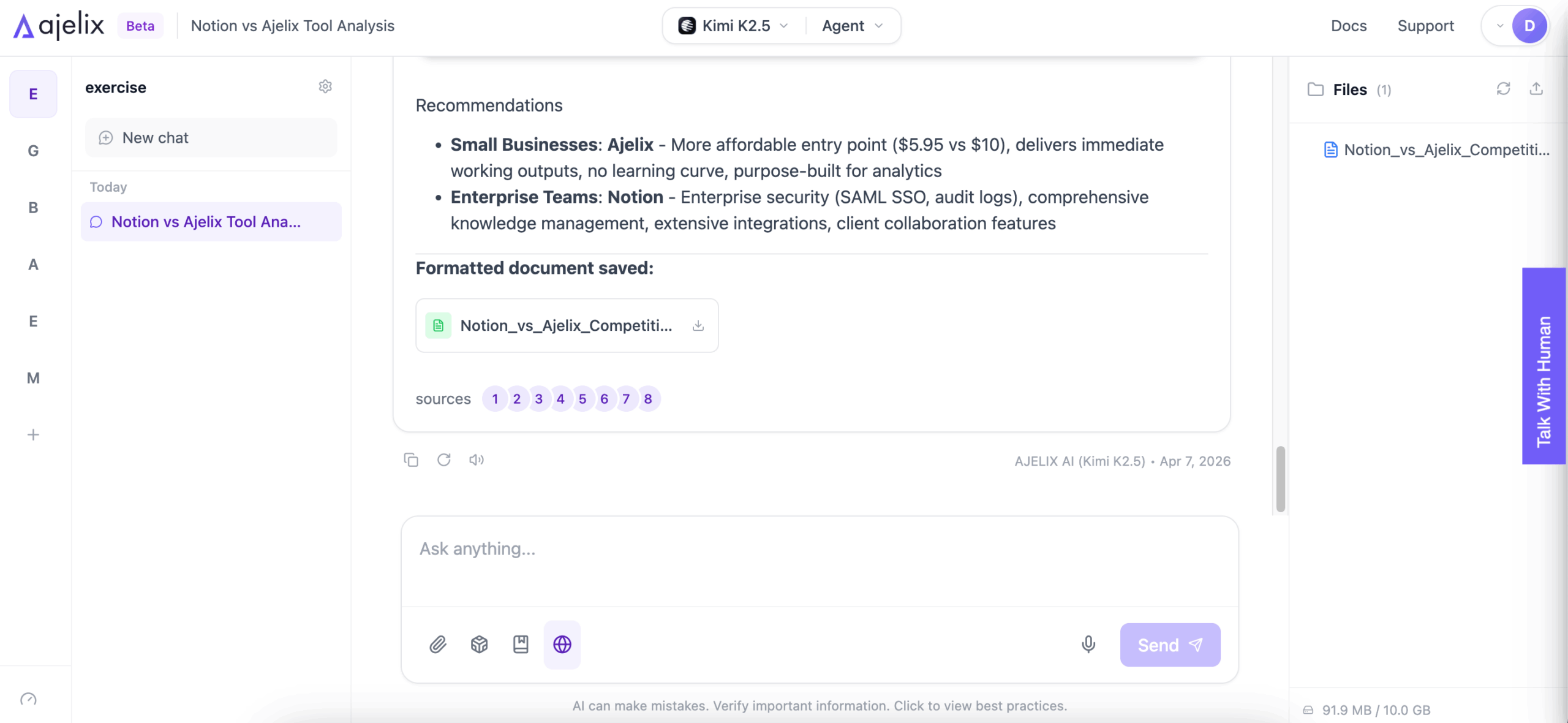
After a few minutes, Ajelix’s agent delivered the result along with a summary of the document’s contents. It took the agent 2 actions and it used 8 sources, linked at the end of the response.
Full Competitive Analysis:
The document was fully formatted right away, along with headings, headers and footers. It included an Executive Summary, Overviews of both tools, and a side-by-side Feature Comparison:
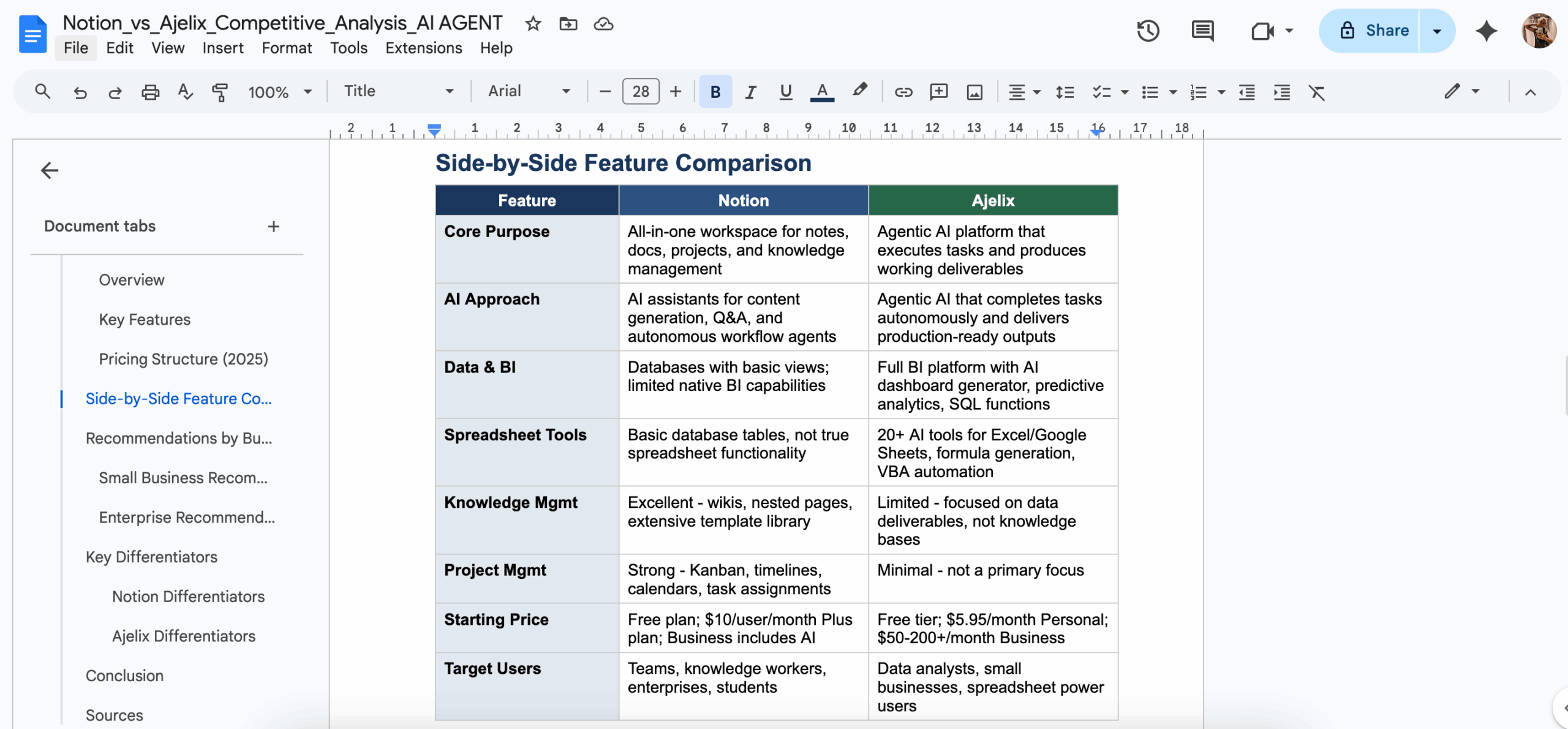
Ajelix’s AI agent delivered a fully polished output that I can immediately use, after entering only one prompt, without the need for follow-ups. And that is exactly the difference between Generative AI and Agentic AI that I wanted to show you.
What’s less obvious is that you don’t have to pick a side. Generative AI and Agentic AI aren’t mutually exclusive. Knowing how they work together is where the true productivity gains are.
Can Generative AI and Agentic AI Work Together?
Yes – and in practice, they already do. Generative AI and Agentic AI are the layers of the same system.
Agentic AI builds on Generative AI, not against it. The LLM is still there, reading input, reasoning through options, and generating language. What changes is what happens after the generation.
Think of it this way: Generative AI is the brain. Agentic AI is the brain with hands. The generation and the action happen together, in the same workflow.
Generative AI is strong for open-ended tasks – brainstorming, drafting, and explaining ideas. Agentic AI is the right layer when thinking needs to become a deliverable.
Used together, they cover the full arc from idea to output.
How to Choose: When to Use Generative AI vs Agentic AI
The simplest way to decide: ask yourself what you need at the end.
If you need to think something through – explore ideas, draft a message, get a quick explanation – Generative AI handles that well. It’s fast, flexible, and requires minimal setup. You write a prompt, it writes back.
If you need something you can use – a file, a report, a dashboard, a presentation, a landing page – that’s when Agentic AI earns its place. The output isn’t text about the thing, but the thing itself.
Here’s a practical breakdown:
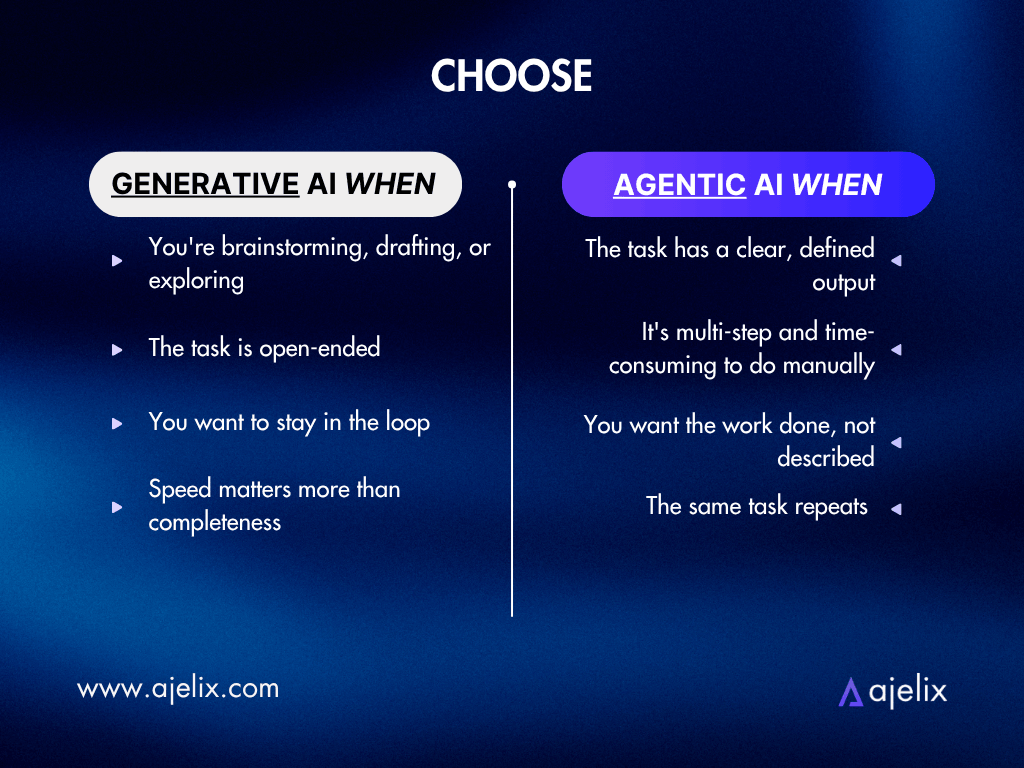
Choose Generative AI when:
- You’re brainstorming, drafting, or exploring options
- The task is open-ended and benefits from iteration
- You want to stay in the loop at every step
- Speed matters more than completeness
Choose Agentic AI when:
- The task has a clear, defined output (a report, a model, a slide deck)
- It’s multi-step and time-consuming to do manually
- You want the work done, not described
- The same task repeats week after week
With Generative AI, you guide it step by step. With Agentic AI, you describe the outcome upfront and let the system figure out the steps. Instead of “help me analyze this sales data,” you prompt it with “analyze this sales file and build a dashboard showing monthly trends, top regions, and yearly growth.”
For tasks where you want full control over each decision – legal review, sensitive communications, strategic choices – Generative AI keeps you in the driver’s seat. Agentic AI is best suited to structured, repeatable work where the goal is clear and the value is in execution speed, not deliberation.
Most professionals will use both – Generative AI for the thinking, Agentic AI for the doing.
How to Get Started with Agentic AI Today
The barrier to getting started is lower than most people expect – you don’t need technical skills, a new workflow, or a background in AI. You need a clear description of what you want done.
That’s the single biggest progression from Generative AI: instead of guiding the AI through each step, you describe the end result. The agent figures out how to get there.
Here’s a practical way to start:
1. Pick a task you do every week that takes longer than it should.
Think about reports you build manually, spreadsheets you reconstruct from scratch, or presentations you assemble from raw data. These are the high-value targets. Agentic AI handles multi-step, structured work best. Those repetitive tasks are where the time savings are most visible.
2. Write a prompt that describes the output, not the steps.
Instead of “help me with my presentation,” try: “Create a professional PowerPoint pitch deck for a SaaS product targeting HR teams. Include slides for the problem, solution, market opportunity, pricing, and a call to action. Use a clean, modern design.”
The more specific you are about what you want at the end, the better the result.
Author’s Note. Keep it reasonably detailed. Packing too many requirements into a single prompt can work against you – the agent may lose focus, produce rigid outputs that overfit your specifics, or miss the broader goal entirely.
A good rule of thumb: be specific about the output and the context, but leave the how to the agent. If your prompt is starting to look like a project brief, that’s usually a sign to trim it down or split the task into steps.
3. Let the agent work, then review.
Agentic AI delivers a finished or near-finished output. Your job changes from building to reviewing. Think of it as getting 90% of the work done and spending your time on the 10% that needs your judgment.
The use cases that tend to produce the strongest reaction in people trying this for the first time:
- Building a financial model from a short prompt,
- Turning raw spreadsheet data into an investor-ready PowerPoint,
- Running a full competitor analysis that comes back as a structured document with sourced data.
If you want to see what this looks like on a real-life task, Ajelix is a good place to start. It’s built specifically for this kind of work – reports, dashboards, Excel models, presentations, landing pages, content creation, research. A free trial lets you try it without any setup.
Agentic AI is genuinely different from what most people have tried. The best way to understand it is to give it a task you’d normally spend an hour on, and see what comes back.
FAQ
Generative AI produces content in response to a prompt – a draft, an answer, an image. Agentic AI completes a full task with minimal guidance at each step. The core distinction is output: one gives you a starting point, the other delivers a finished, usable result.
Neither is better – they serve different purposes. Generative AI is faster and more flexible for open-ended tasks like drafting or brainstorming. Agentic AI delivers more value when the goal is a structured, multi-step output that needs to be acted on, not just reviewed.
Yes – and in practice they already do. Agentic AI is built on top of Generative AI, not separate from it. The language model handles reasoning and generation; the agentic layer adds planning, tool use, and execution. They operate as layers of the same system.
You give it one prompt asking for a competitive analysis. It searches the web, synthesizes the findings, and returns a fully formatted document without any follow-up from you. Tools like Ajelix are built for exactly this kind of multi-step, output-driven work.
No. The main shift is in how you write your prompt – describe the end result rather than each step. Instead of “help me with this,” say “build me a dashboard showing monthly sales trends and top regions from this file.”
Use Generative AI when you want to stay in control of every step, the task is open-ended, or you need a quick answer rather than a finished deliverable. It’s also the right choice for sensitive decisions – legal review, strategic calls – where human judgment at each stage matters.
Traditional AI follows fixed, hardcoded rules and cannot adapt to new inputs. Generative AI adds adaptability – it learns from data and produces new content. Agentic AI adds initiative – it pursues a goal autonomously rather than waiting to be asked at every step.
Agentic AI chat that helps you complete projects
AI for work that ingests, transforms, and delivers the exact deliverables your team needs, while you stay focused on strategy. No more chatting, agents can get the job done.