Zero Data Retention: What It Is And AI Tools That Offer It

Zero data retention is the shortest privacy promise an AI vendor can make: they process your prompt, return the answer, and keep no record of either. OpenAI and Anthropic both publish retention terms, attach conditions, and changed those conditions at least once this year.
A vendor that stores no customer data doesn’t have an archive that can be subpoenaed, a log that can be breached, or a reviewer reading a flagged customer complaint. A vendor that keeps prompts for 30 days or longer produces a copy you can’t delete.
In this guide, our AI experts explain what zero data retention is, which AI tools offer it, and how to verify the claim before you sign.
What Is Zero Data Retention
Zero data retention (ZDR) is a processing commitment from an AI provider. The provider holds your input in memory just long enough to generate a response, then immediately discards it. Nothing is sent to a log, database or training set, and no employee can retrieve it later.
It’s important not to confuse ZDR with other AI provider promises, such as:
- No training on your data. The provider may still keep your prompts for a period of time specified in its privacy policy.
- Deletion upon request. Your data is kept until someone deletes it, which means it still may exist somewhere, even if you ask for it to be removed.
- Zero retention. This is when nothing is kept after the response is returned, apart from safety signals and what the law forces the vendor to keep.
Zero data retention AI is mostly an API-level arrangement, not a setting you can adjust in an AI chatbot. You need to dig deep into a vendor’s documentation before you can safely say the AI has ZDR.
GDPR Article 5(1)(e) requires personal data to be kept no longer than necessary for its purpose, so a vendor holding prompts for a month has to justify why it’s doing it. A vendor holding nothing has nothing to justify, which is the easier position to document under the EU AI Act.
Why ZDR Became Important
In 2026, three events took place that made major AI providers compete for their stance on data retention.
Anthropic raised retention, then received a pushback from customers. In June 2026, Claude Fable 5 and Mythos 5 were shipped as “Covered Models” with a mandatory 30-day retention rule that overrode existing zero data retention agreements. In turn, many regulated customers declined the adoption.
OpenAI used it as a differentiator. In August 2026, OpenAI reaffirmed zero data retention for eligible API customers on frontier models and previewed Private Safety Processing, which spots misuse across interactions while sending staff only a signal about activity type and severity. It was seen as a contrast to Anthropic’s 30-day retention rule.
Anthropic relocated the data instead of deleting it. A few weeks later, Anthropic announced Enterprise Frontier Safeguards, which meant monitoring data would move into the customer’s own cloud storage (S3, Azure Blob or Google Cloud) under the customer’s keys, with alerts going to the customer’s security team.
By October, Fortune was describing zero data retention as the ground the frontier labs compete on.
For buyers of the AI technology, this showed that a vendor can override its own policy in a matter of a few weeks. You should control retention through where the system runs, not only through what the contract promises.
What It Doesn’t Cover
Every provider’s documentation has an exceptions list, and most of them follow the same pattern:
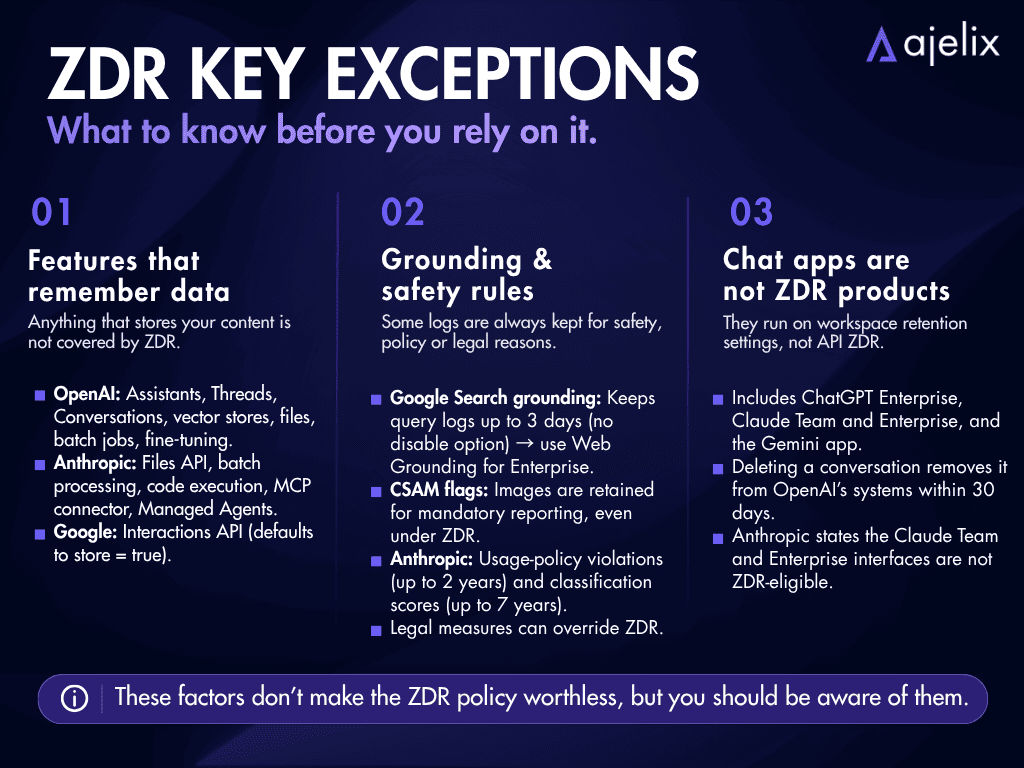
- Any feature that has to remember something breaks the agreement. Keeping the memory of a saved thread, an uploaded file, a knowledge base, and an agent that recalls earlier tasks, means storing your content. On OpenAI that includes Assistants, Threads, Conversations, vector stores, files, batch jobs and fine-tuning. Anthropic excludes the Files API, batch processing, code execution, the MCP connector and Managed Agents. On Google, the Interactions API defaults to store = true.
- Grounding and safety rules keep logs you cannot switch off. Grounding with Google Search stores query logs up to three days with no disable option, so Google points ZDR customers to Web Grounding for Enterprise. Images flagged as potential child sexual abuse material are retained for mandatory reporting even under ZDR. Anthropic keeps usage-policy violations up to two years and classification scores up to seven. Legal measures can override anything.
- Chat apps are not ZDR products. ChatGPT Enterprise, Claude Team and Enterprise, and the Gemini app run on workspace retention settings. Deleting a conversation removes it from OpenAI’s systems within 30 days. Anthropic states the Claude Team and Enterprise interfaces are not ZDR-eligible.
These factors don’t mean the ZDR policy is worthless, but you should be aware of them.
AI With Zero Data Retention: Top 5 Tools
Here is how the zero data retention AI options compare as of November 2026, starting with Ajelix, whose on-premises deployment can run fully disconnected from the vendor:
| Tool | How zero retention is achieved | What still gets stored | Best for |
|---|---|---|---|
| Ajelix Enterprise | On-premises or disconnected deployment: Ajelix never holds your data. Hosted deployments: zero retention on request | With ZDR, nothing gets stored. Audit logs, however, may be kept in the system for some time | Regulated teams and teams whose policy forbids copies made by the vendor |
| OpenAI API | ZDR for approved organizations, with Private Safety Processing in preview | Abuse logs without ZDR; features that keep memory; flagged CSAM images | Frontier models with an approval step |
| Anthropic Claude API | ZDR by agreement per organization, with Enterprise Frontier Safeguards | Covered Models at 30 days by default; flagged content up to 2 years | Monitoring data in your own cloud |
| Google Gemini Enterprise Agent Platform | Disable caches, request an abuse-monitoring exception, set store = false | Prompt logs under default terms; Search grounding logs | Teams already on Google Cloud |
| Microsoft Foundry (Azure OpenAI) | Modified abuse monitoring, approved through Limited Access | Flagged content in your geography until approval | Microsoft-centric estates |
Ajelix Enterprise
The deployment you choose decides whether Ajelix holds your data at all. Ajelix offers three types of deployment – on-premises, on Ajelix Cloud, and on other cloud providers.
In the case of an on-premises deployment, Ajelix stores none of your data, as it runs on your own servers. If you choose to host any part of the platform with Ajelix, you can agree on how that data will be processed.
In the Ajelix EU cloud, inference runs on GPU servers Ajelix owns in Riga, Latvia. For this, Ajelix offers zero retention on request for hosted deployments. The one exception is an infrastructure outage, where Ajelix may fall back to a vetted provider that is barred from training on your content and held to the same DPA terms, same as Ajelix.
Ajelix Enterprise offers governance that makes either route auditable: role-based access control per team and workspace, guardrails enforced on every message, spend limits, and an audit trail with reasoning logs you can export for your own monitoring needs.

OpenAI API
Zero data retention is available to eligible API organizations on frontier models, subject to prior approval and additional requirements. Under ZDR, prompts and responses are not retained after processing, staff cannot access them for review, and content does not train models unless you opt in. Without ZDR, abuse-monitoring logs run up to 30 days.
Anthropic Claude API
ZDR is requested through Anthropic’s sales team and enabled per organization, covering the Messages API and Claude Code with a commercial API key. The Covered Models mentioned previously (Claude Fable 5, Fable 5.1, Fable 5.2, Mythos 5, Mythos 5.1 and Mythos 5.2) carry 30-day retention unless Anthropic expressly authorizes otherwise. With Enterprise Frontier Safeguards, eligible customers can run Fable 5 and 5.1 under ZDR.
Google Gemini Enterprise Agent Platform
Google has no single ZDR switch. You can separately request an exception to prompt logging for abuse monitoring, disable context caching and session resumption, and set store = false on every Interactions API call. Google warns ZDR may not be possible on some Advanced AI models. The paid Gemini Developer API retains prompts 55 days by default.
Microsoft Foundry (Azure OpenAI)
Microsoft uses modified abuse monitoring, approved through the Limited Access process. Flagged prompts and completions are stored by Microsoft in your region for human review. Approval stops that storage, automated review still runs while the request is processed, and you can check the result yourself: the resource’s ContentLogging capability in that case starts reading as false.
How To Verify An AI Vendor’s Claim
Ask these six questions and get the answers approved before implementation:
- Which products, models and regions are covered? ZDR applies product by product and model by model, never to a vendor as a whole.
- What stays outside the agreement? Most providers keep something – abuse logs, flagged content, classifier scores, or grounding logs. This includes legal measures that can override any agreement.
- Do your features need to remember anything? Saved threads, knowledge bases, uploaded files, and agent memory are all stored by design. If your workflow depends on them, you don’t have ZDR.
- Who can read what remains? Human review of flagged content is a standard feature. Ask who reviews it, and under what approval.
- Does the agreement take into account future models? Anthropic’s June rule overrode existing ZDR contracts on launch day. Ask how a new model may change your terms.
- Can you check it yourself, without asking the vendor? Look for an audit log you can export or a deployment you can run yourself. If the only proof is the vendor’s word, the claim is unverified.
Write the answers into your data processing agreement.
Choose The Tool For Your Needs
Depending on your data retention requirements, we suggest the relevant tool/platform for you:
| Your requirement | The pick | Why |
|---|---|---|
| “Our policy says zero retention, with no exceptions” | Ajelix Enterprise, on-premises, fully disconnected | Ajelix never holds your data, so no vendor copy exists |
| “Data must stay in the EU and never reach another vendor’s model” | Ajelix Enterprise, EU cloud, with zero retention requested | Ajelix-owned GPUs, no external model provider |
| “We need frontier models and can handle an approval step” | OpenAI API or Anthropic Claude API | Documented ZDR programs, with limits by model and feature |
| “We want monitoring data in our own cloud account” | Anthropic EFS, or Ajelix on-premises | Whatever is kept can be only accessed by your keys |
| “We already use Google Cloud or Azure” | Gemini Enterprise Agent Platform or Microsoft Foundry | ZDR becomes configuration plus approval |
| “Our agents depend on threads, files and memory” | Self-hosted deployment with your own storage | Features that keep memory outside every vendor’s ZDR |
Keep in mind that agent security does not end with retention: an agent that cannot store context cannot do multi-step work, so the goal is retention you control, not retention you outsourced.
If keeping sensitive data on your own infrastructure is your priority, contact the Ajelix team.
FAQ
Zero data retention means the AI provider processes your prompt, returns the answer, and keeps no record of either. Nothing is logged, used for training, or available for staff review once the request completes, apart from narrow safety signals and content the law requires the vendor to keep.
No. A no-training clause limits one use of your data and says nothing about storage. Most business API terms already exclude training while retaining prompts for 30 days to screen for abuse.
Ajelix Enterprise on-premises, where your data never reaches Ajelix at all, or zero retention on request in Ajelix hosted deployments. Then OpenAI’s API for approved organizations, Anthropic’s Claude API by agreement with Enterprise Frontier Safeguards, Google’s Gemini Enterprise Agent Platform through configuration, and Microsoft Foundry through modified abuse monitoring.
Not for consumer or standard business plans. ChatGPT Enterprise lets admins set retention periods and removes deleted conversations within 30 days, which is a deletion control rather than zero retention.
Yes, and it happened in 2026. Anthropic’s 30-day rule for Covered Models applied from launch day, overriding existing agreements. Ask how new models affect your terms, and prefer controls you can enforce yourself.
Agentic AI chat that helps you complete projects
AI for work that ingests, transforms, and delivers the exact deliverables your team needs, while you stay focused on strategy. No more chatting, agents can get the job done.