Autonomous AI Agents: A Practical 2026 Guide

The simplest way to tell whether autonomous AI is truly autonomous is by giving it a task, walking away, and seeing if you come back to the task being fully executed on its own.
Last year AI drafted emails, while this year it can send them. The move from answering to acting is what autonomous AI means in practice, and it is why questions like what it can use and who approves it, are beginning to matter more than what model the AI is using.
Our expert guide covers what autonomous AI is, how autonomous AI systems are built, in which situations deployments break, and how to build autonomous AI agents.
What Autonomous AI Is
Autonomous AI is software that you give a goal. It decides on its own what to do next, what systems to use to execute the task, checks its results, and keeps going until you either stop it or the job is finished.
Three questions separate autonomous AI from AI that you go back-and-forth with:
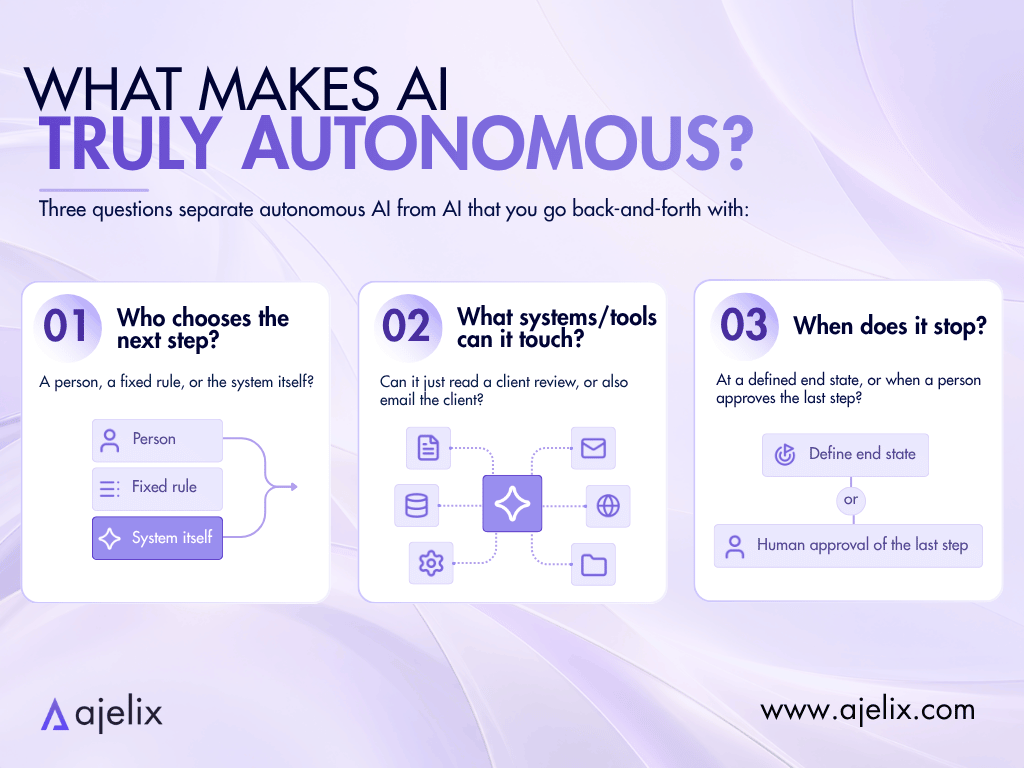
- Who chooses the next step? A person, a fixed rule, or the system itself?
- What systems/tools can it touch? Can it just read a client review, or also email the client?
- When does it stop? At a defined end state, or when a person approves the last step?
Teams running several AI autonomous agents have a coordination layer, which describes autonomous agentic AI, with shared memory, tool access, and a planner deciding which agent handles what.
Why Is It Relevant Now
The main reason is the capability of the technology, which has progressed monumentally in the past few years. METR’s time horizon measures how long a job, in expert human hours, an agent finishes successfully half the time. Since 2023 that horizon has doubled roughly every four months. (They stopped measuring it as of September 2026).
Another significant reason is the progression of AI deployment in team and enterprise environments. Gartner’s 2026 CIO survey found that 17% of organizations have deployed an AI agent to date. Caylent’s August 2026 survey of 200 US and Canadian leaders all already working with agentic AI, reported that 59.5% were running agents autonomously. In this survey, 23.5% had agents deployed broadly.
When it comes to regulations, the EU AI Act transparency duties have applied since August 2026: chatbots must say they are AI, and generated content needs machine-readable marking. This means the agent answering your queries is a regulated interface now. It has to say it is AI, and name the business it acts for.
How The System Works
Any autonomous AI system uses the same loop:
- Read. It gathers the request, the records, the documents, and the results of what it has already done.
- Plan. A language model turns that into ordered steps and picks the tool each one needs.
- Act. It calls the tools it needs to execute the task.
- Check. It compares the result against the goal, retries in case something’s failed, and may stop to ask when the result looks wrong.
Whether the loop is successful depends on the AI’s memory, tool access, and pre-written guardrails.
If you’re into math, you can look at it this way: an agent that is right 95% of the time per step is right about 36% across 20 steps (0.9520=0.36). Push each step to 99% and the same task lands at 82% accuracy. Working deployments use small steps and checkpoints.
Autonomous AI Agents vs Chatbots vs Automation
| Chatbot | Scripted automation | Autonomous AI agent | Agentic system | |
| Who picks the next step | Person | Fixed rule | The agent | A planning layer over agents |
| Scope | One conversation | One defined path | One job, many paths | A workflow with branches |
| How it handles surprises | Poorly | Stops or errors | Adapts or escalates | Replans across agents |
| What you give it | A question | Instructions | A goal and limits | An objective |
If the work needs judgment about what comes next, and that judgment changes depending on each case, you are in need of an agent. If the path is fixed and follows the same rules each time, automation is enough and costs less.
However, most teams will need both automation and autonomous AI for different processes. Ajelix Enterprise combines automation and agentic qualities into one governed, sovereign platform.

Autonomous AI Chat
Autonomous AI chat gets less attention than it deserves, given how many people using consumer chatbots have already felt the difference.
OpenAI’s own description: “ChatGPT now thinks and acts, proactively choosing from a toolbox of agentic skills to complete tasks for you using its own computer.” Google’s Gemini Spark runs in the background against Gmail and Calendar instead of waiting for a prompt. Microsoft’s Copilot Tasks works the same way with its own computer and browser.
The same interface that used to only be capable of drafting an email can now send it, and the assistant reading a spreadsheet can now write an updated one from scratch.
Ajelix’s agentic chat is the default interface of the tool. All you need to do is describe the job, attach the files and data you want the agent to access, and the agent executes the full workflow. It returns a file or an asset, such as an Excel workbook with formulas, a dashboard, a slide deck, a landing page.
In Ajelix Enterprise, the same chat interface is available, except it’s connected to all your company’s systems, data, documentation, and it’s auditable and governable. Ajelix runs on its own EU-based AI infrastructure, offers flexible deployment, and within the platform, you can build your own workflows and agents visually.
The Autonomous AI Workforce
The autonomous AI workforce is the phrase vendors use for agents treated as a company headcount.
Salesforce’s Agentic Enterprise Index found the average activated agent count in its production cohort rose from 5 in February 2025 to 13 by April 2026. Saleforce’s February 2026 survey of 1,050 IT leaders put the average at 12 agents, projected to climb 67% by 2027.
This has also affected human workers. Salesforce’s own support organization went from roughly 9,000 people to 5,000, according to the CEO, with agents handling about half of customer service interactions.
Agents multiplied faster than the people accountable for them, and only 21.9% of organizations give an agent its own identity, so the audit log cannot even tell you whether a person or a program made the change.
When It Breaks Or Fails
Production is where the honest failures of autonomous AI show up. They are rarely about the power of the model and technology.
- Integration. Most enterprises run on half-documented APIs and old systems. Before you connect an agent, the data needs to be cleaned and connections – secured.
- Permissions. Agents on a person’s login or a shared service key act with more access than the job requires, which nobody notices until something goes wrong.
- Drifting from the goal. During long runs, agents tend to wander. A simple task to “reconcile this account” can become “clean up this whole file.” Limits must be set.
- The gap in auditing. When an agent makes a decision a regulator asks about, someone has to produce the trail. If nobody owns the agent, nobody owns the answer.
In Ajelix Enterprise, audit trails are provided for every step and action the AI or human (in cases of escalations) takes.
How To Build Autonomous AI Agents
Building an autonomous AI agent comes down to six steps:
- Writing the job description. Inputs, outputs, what it may change, what it must never touch, when it stops.
- Starting read-only. Let it research, prepare, and recommend. Watch what it would have done before it does anything.
- Adding one write action before adding another. A write action has to change something, like sending the email, updating the record, and moving the money. Give it only one, watch what it does for a while, then add the next. The agent gets its own login with only the permissions that job needs, and the limit is enforced in your code.
- Setting budgets. Step, time, spend, and retry limits.
- Building a review path. Decide who is responsible for escalations, what evidence travels with them, and what the log records. Approve the last step whenever money or a client is involved.
- Measuring per-task success. Count correct completions on one task, before widening access.
Where you’re building it depends on the language your team writes in, and whether the agent has to pause for a person to approve an action before it runs.
| Framework/Platform | Best when |
| LangGraph | You need durable state, branching, and human approval inside the graph (Python, TypeScript) |
| OpenAI Agents SDK | You are OpenAI-native and want the smallest surface area |
| Google ADK 2.0 | You are Gemini-first, or writing Go, Java, or Kotlin |
| Microsoft Agent Framework 1.0 | You are a .NET or Azure shop; GA since 3 April 2026, with AutoGen folded in |
| CrewAI | You want a multi-agent prototype running this week |
Most teams do not want to operate agent infrastructure, as it takes a lot of IT resources. With Ajelix Enterprise, you can build and use pre-made agents (and workflows) visually. It includes role-based access, audit trails, and spend controls for projects/teams, and runs on EU infrastructure, private cloud, or on-premises when data cannot leave your environment.
If your priority is a secure, sovereign, autonomous AI platform, contact the Ajelix team.
FAQ
Software you give a goal to instead of instructions. It works out the steps itself, uses your tools to act, checks its own results, and stops when the job is done or it hits a limit you set.
With limits, yes. The failures that matter come from permissions, missing approval gates, and nobody owning the agent, not from the model being clever.
Surveys say 12 to 100 depending on what counts as an agent. Salesforce’s 2026 benchmark found an average of 12; Gravitee’s April 2026 sample found a median of 76 to 100. It’s not an exact science, as it depends on your company’s AI needs.
Agentic AI chat that helps you complete projects
AI for work that ingests, transforms, and delivers the exact deliverables your team needs, while you stay focused on strategy. No more chatting, agents can get the job done.