Shadow AI Risks Every Business Must Know in 2026

Shadow AI is a business risk that every team must evaluate. When dedicated AI isn’t officially implemented into an enterprise’s processes, employees will secretly use unapproved tools instead. This results in sensitive data getting leaked and used to train AI models.
In this guide, our AI experts explain what shadow AI is, where the term comes from, what shadow AI risks your organization faces, and what shadow AI governance and prevention practices you can pursue today.
Let’s dive in.
What Is Shadow AI
The shadow AI meaning is simple – it stands for using AI tools, models, chatbots or agents for work-related tasks without the approval or oversight from your company’s IT, security or compliance teams.
Examples of shadow AI include:
- A personal ChatGPT account drafting reports;
- A free transcription app recording client calls;
- A browser extension that summarizes webpages;
- A data analyst running an AI script on a laptop nobody approved.
Shadow AI descends directly from shadow IT, which stands for employees using unauthorized software at work. Shadow IT became widespread when specific departments in a company started buying SaaS subscriptions without an approval from the IT team.
While a shadow SaaS app stores your data in a vendor’s cloud, a shadow AI tool absorbs it, learning from it and reproducing it in someone else’s answer at a later point.
Why Employees Use Unapproved AI Tools
Shadow AI becomes a problem when a company doesn’t provide its employees with the up-to-date tools they need to work.
Let’s say an employee has a tedious task to do, such as summarizing a 50-page contract. They know that an AI tool is capable of doing this in a few minutes. The employee checks whether the company provides a tool, and there either isn’t one, or the approved one is difficult to navigate without training.
So, what the employee does is open a free chatbot that does the task for them.
From this, we can conclude that if your organization doesn’t invest in AI, your employees will start using it secretly, on their own accounts, on their own time, and on their own devices. They won’t be doing this out of malice, but simply with the intention of trying to do their jobs better and more quickly.
Arturs Jaunosans, co-founder of Ajelix, saw this firsthand after talking with AI users across industries:
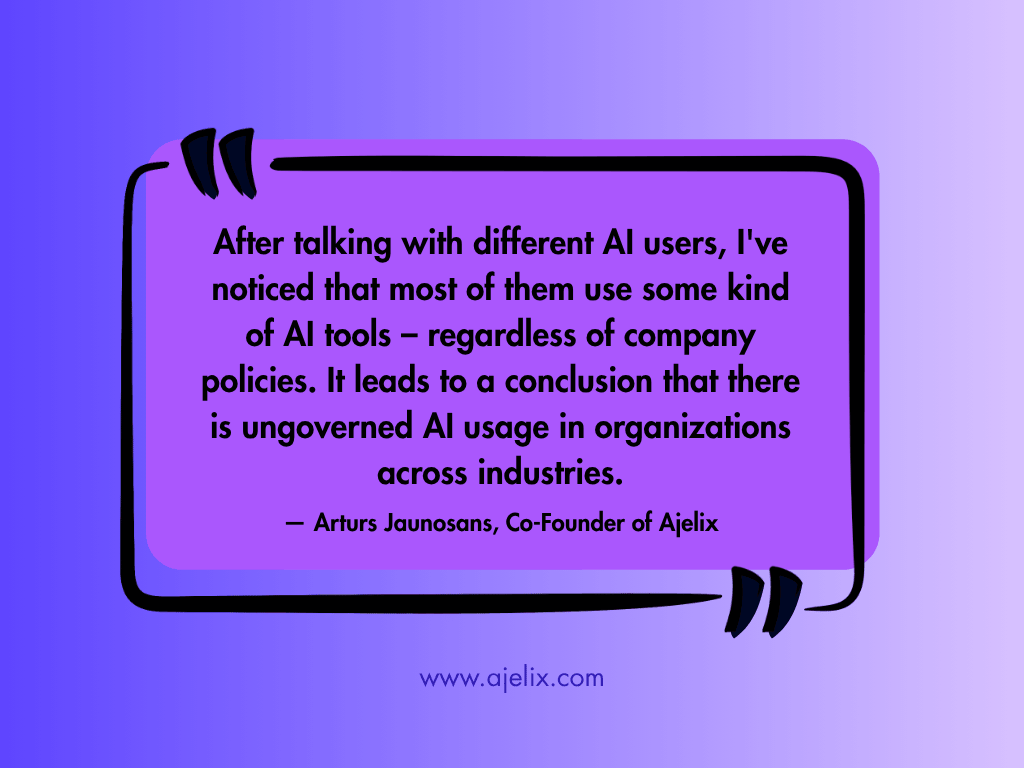
“After talking with different AI users, I’ve noticed that most of them use some kind of AI tools – regardless of company policies. It leads to a conclusion that there is ungoverned AI usage in organizations across industries.”
Read that again: regardless of company policies. While policies might exist on paper, employees are prone to go against them to make their work tasks easier. It’s only natural, when they know that tools to achieve that are readily available to them.
What Research Says About Shadow AI
Depending on the study, between 55% and 78% of employees use AI tools their employer didn’t approve:
| Finding | Figure | Source |
|---|---|---|
| Breached organizations with a shadow AI incident | 43% | IBM Cost of a Data Breach Report 2026 |
| Office professionals who used AI believing it wasn’t permitted | 66% | PagerDuty / Wakefield Research, 2026 |
| UK employees using unapproved consumer AI at work | 71% | Microsoft UK / Censuswide, 2025 |
| Workers using personal GenAI accounts for work | 57% | Gartner Top Cybersecurity Trends, 2026 |
| Employees sharing work information with public AI tools | 88% | PagerDuty, 2026 |
| Organizations suspecting forbidden public AI tool use | 69% | Gartner, 2025 |
Conclusions that can be drawn from this data:
- 66% of employees used AI tools believing it wasn’t permitted by their company, but used them anyway.
- Executives and senior leaders are doing the same, sometimes even being the biggest offenders. In a Cybernews study, 93% of executives and senior managers admitted to using unapproved AI tools at work.
- Roughly half of employees say they wouldn’t tell their manager they used AI to complete a task.
What Are The Risks Of Shadow AI
The following shadow AI risks can affect your company:
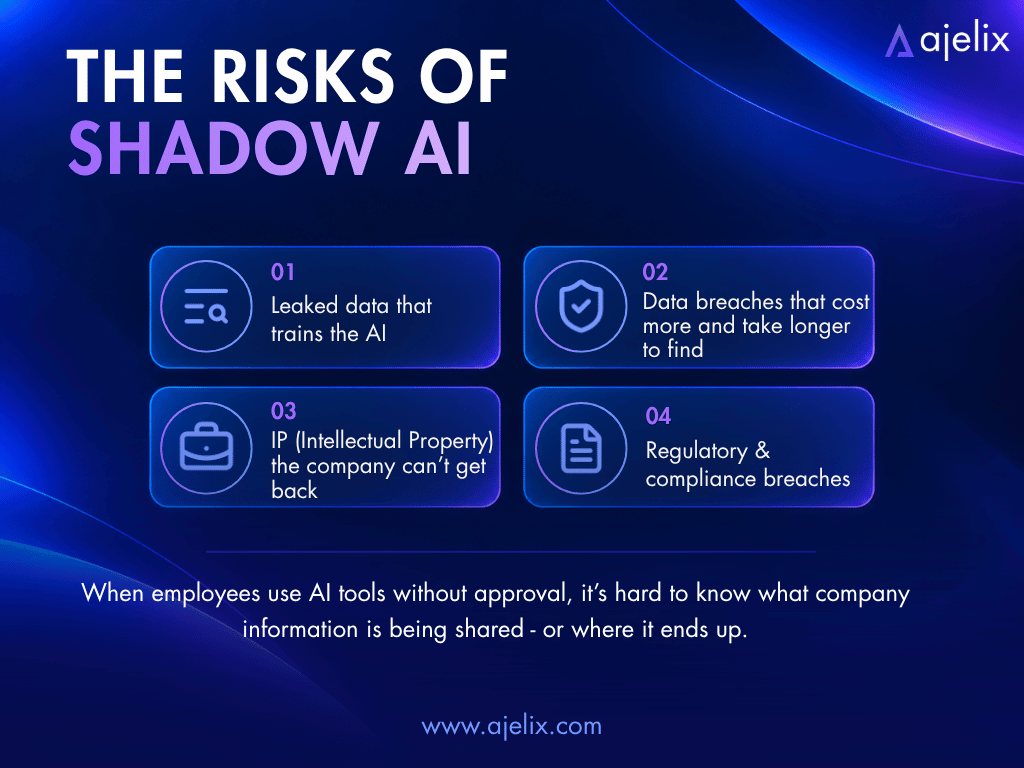
Leaked data that trains the AI
When an employee pastes any company data into a public AI tool, they’re leaking sensitive information. Your confidential data may become part of someone else’s product, if you don’t pick an AI provider that is committed to security.
Major tech companies face lawsuits over the alleged use of data they had no right to train on, including copyrighted books and scraped personal content. It’s not far-fetched that an employee’s pasted data could end up in a model.
Gartner found 33% of workers have entered sensitive data into unapproved GenAI tools. The Cybernews study shared earlier put it even higher, with 75% of employees using unapproved AI admitting to sharing potentially sensitive information through them.
Data breaches that cost more and take longer to find
Dealing with an enterprise data breach is expensive, poses a huge reputation risk, and happens fast, especially with shadow AI.
IBM’s 2026 Cost of a Data Breach Report found shadow AI in 43% of breached organizations, with the average shadow AI-linked breach costing $5.39 million.
Detection takes around 247 days, because security teams are looking in the wrong places. Customer PII was exposed in 65% of shadow AI breaches, versus 52% of breaches overall.
IP (Intellectual Property) the company can’t get back
When governance is absent, things like source code, pricing strategy, product roadmaps, and legal agreement drafts get entered into third-party chatbots that store and process them outside the company’s control. Once that is done, there is no way to undo it.
Regulatory & compliance breaches
Common situations include:
- Unsanctioned processing violates frameworks like GDPR, HIPAA, and the EU AI Act;
- Lack of data lineage triggers audit failures and heavy fines;
- Cross-border data transfers happen without legal vetting.
The Problem With Free Plans
Free AI plans don’t include security and governance, as they are consumer tools built for individuals, not companies.
Free accounts have:
- No data protection guarantees, meaning inputs may be retained for model training;
- No encryption requirements or data residency controls that enterprises need;
- No access controls, such as SSO, role management or audit logs;
- No compliance certifications like GDPR, SOC 2, or the EU AI Act;
- No support, meaning no SLAs, guaranteed uptime, or help when something breaks
Enterprise AI platforms exist to fight this, featuring data isolation, admin controls, audit trails, and contractual guarantees that your data won’t train anyone else’s model.
Shadow AI Governance And Best Practices For Management
The main aspect of shadow AI management is implementing a specific AI tool in your company, with clear guidelines that employees may only use the dedicated tool.
Practical shadow AI management looks like this:
- Find out what’s in use right now. Audit browser extensions, cloud apps, and network traffic.
- Give people a tool worth using. When the sanctioned option is capable and convenient, people will stop looking elsewhere.
- Enforce controls on that platform. Introduce shadow AI security basics like SSO and identity management, role-based access, admin oversight, audit logs, and data isolation.
- Write a policy people can follow. It can be a simple page explaining what’s approved and what data can go into it.
- Explain the fact about consumer AI using data for model training. Most workers have never had formal AI security training, so tell them that pasting customer data into a free chatbot can feed model training.
- Review quarterly. New shadow AI tools appear all the time, so keep an eye out for any new AI usage.
Shadow AI prevention isn’t about having zero AI, but about having AI you can see, control, and account for.
Ajelix Enterprise As An Alternative
The way out of shadow AI is giving employees capable technology they want to use, with all the controls enterprises need included. This is what Ajelix Enterprise was built for.
Ajelix Enterprise is designed around privacy and security, with these key capabilities in place:
- Role-based access control (RBAC): define exactly which employees, teams, and projects have access to which agents, data sources, and outputs.
- Guardrails on every message: Ajelix enforces policy on every input and output, catching sensitive data before it leaves, with keyword and topic blocking.
- Complete audit trails: every agent action is logged and traceable, protecting you in compliance reviews and incident investigations.
- Flexible deployment: run on Ajelix’s EU-hosted cloud, deploy on AWS, Azure, Google Cloud, or go fully self-hosted.
- Human escalation built in: agents are designed to escalate to a human for high-value decisions.
- Ajelix’s own AI infrastructure: Ajelix runs on its own GPU infrastructure, so AI workloads stay on hardware the company controls end to end, without depending on external services to process your data.
When the sanctioned tool is the convenient tool, shadow AI stops being a problem.
If you want truly secure AI technology, contact Ajelix for more information.

FAQ
Shadow AI is the use of AI tools, models, or agents for work without approval or oversight from an organization’s IT, security, or compliance teams. Prevent shadow AI by discovering which AI tools employees use, providing a sanctioned enterprise AI platform people want to use, enforcing access controls and audit logging, writing a clear usage policy, and training employees on the risks.
The main shadow AI risks are data leakage into tools that may train models on your inputs, more expensive and slower-to-detect breaches, compliance exposure, and permanent loss of intellectual property.
Because AI makes their work faster and companies often fail to provide an approved alternative that’s just as capable. High shadow AI usage is a signal of unmet demand.
In one key way, yes. A shadow SaaS app stores your data, while a shadow AI tool can retain it, learn from it, and reproduce it elsewhere. The adoption speed and data sensitivity involved make shadow AI a larger, faster-moving risk.
Ajelix Enterprise is an AI platform built for organizations that need AI to operate within their security and compliance requirements. It includes role-based access control, guardrails on every message, complete audit trails, and flexible deployment.
Agentic AI chat that helps you complete projects
AI for work that ingests, transforms, and delivers the exact deliverables your team needs, while you stay focused on strategy. No more chatting, agents can get the job done.