AI Agent Security: Everything Your Enterprise Must Know

AI agent security is a business risk that every enterprise implementing AI in their processes needs to evaluate. Enterprise-grade AI accesses your and your client’s data in order to work with it, which makes security non-negotiable.
In this guide, our AI experts explain what AI agent security consists of, what AI agent security risks your organization faces, which AI agent security frameworks you should know about, and what AI agent security best practices you can pursue today.
Let’s dive in.
What Is AI Agent Security And Why Does It Matter
AI agent security is the set of policies, controls, and monitoring systems that ensure an AI agent operates within defined boundaries, can’t be manipulated, and doesn’t misuse the data and systems it has access to.
Because AI agents act autonomously, rarely needing manual human approval, security is especially crucial. Security ensures agents stay on course, stick to their guardrails, and only take actions they are built for.
AI Agent Security Risks
When looking at the latest AI agent security news, six main risk categories are relevant:
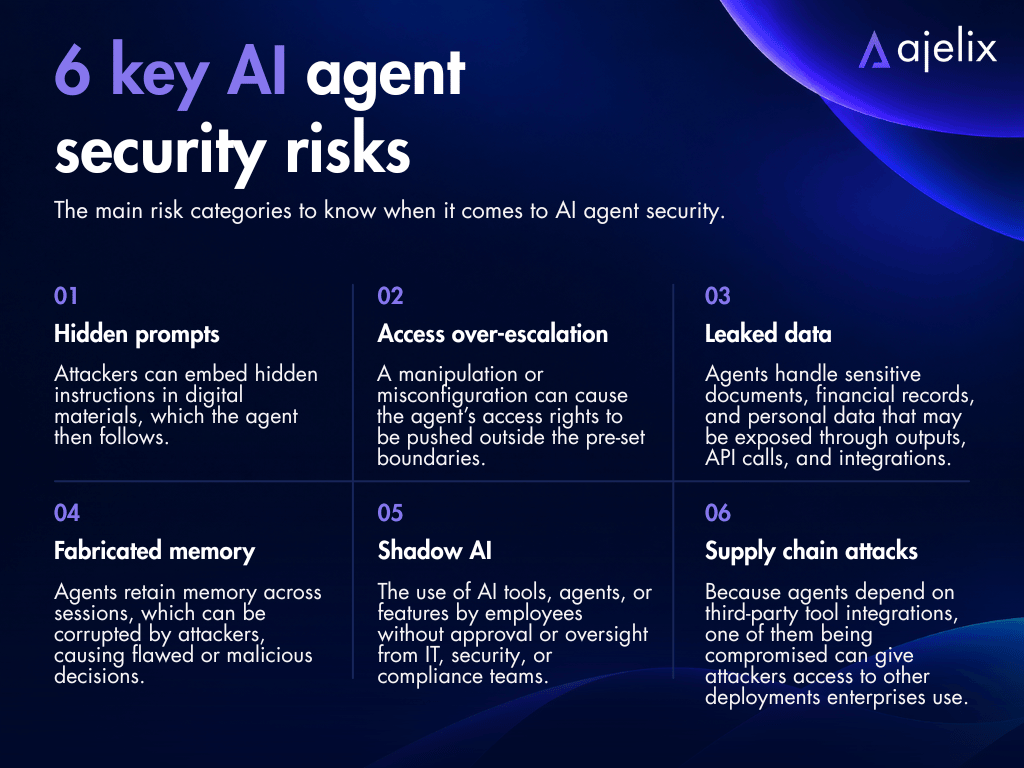
- Hidden prompts. An attacker can embed hidden instructions for the AI in digital materials, such as a document, which the agent then follows. The AI is not able to tell apart prompts from a real employee and fabricated ones from an attacker.
- Access over-escalation. A manipulation or misconfiguration can cause AI agent access rights to be pushed outside the pre-set boundaries. This is especially dangerous when the agent is pushed to access critical sources.
- Leaked data. Agents handle sensitive documents, financial records, and personal data that may be exposed through outputs, API calls, and integrations. Amazon Bedrock Guardrails, for example, help detect sensitive information, such as personally identifiable information (PII), in input prompts or model responses using sensitive information filters. Ajelix enterprise also uses PII guardrails.
- Fabricated memory. Agents, especially agents that execute multi-step tasks, retain memory across sessions. This memory can be corrupted by attackers, causing the agent to make flawed or malicious decisions.
- Shadow AI. This is the use of AI tools, agents, or features by employees without approval or oversight from IT, security, or compliance teams.
- Supply chain attacks. Because agents depend on third-party tool integrations, one of them being compromised can give attackers access to other deployments enterprises use. If your company is EU-based, GDPR applies here too, meaning you’re accountable for how third parties handle your data, so it’s important to evaluate whether each integration is really needed. Ajelix minimizes this risk by running on its own infrastructure, keeping your data secure without depending on external services.
Dealing with an enterprise data breach is expensive*, a huge reputation risk, and can happen fast, especially with AI involved. It’s crucial to have the needed security protocols in place.
The average cost of an enterprise data breach is currently at $4.99 million, according to IBM’s 2026 Cost of a Data Breach Report.
The Security Frameworks
An AI agent security framework gives your enterprise an opportunity to assess, manage, and demonstrate control over the risk of AI agents. The following frameworks are used by enterprises currently, depending on their needs:
- OWASP Top 10 for Agentic Applications 2026: the first security framework built specifically for autonomous AI systems, identifying the ten highest-impact threats facing agents.
- NIST AI Risk Management Framework (AI RMF): covers the full AI system lifecycle (Govern, Map, Measure, Manage) and is widely recognized as a crucial part of the governance for enterprise AI deployments.
- ISO 27001: the international management system standard for AI, which handles external verification of your AI governance practices.
- CSA Agentic Trust Framework: this framework addresses the Zero Trust principles specific to multi-agent architectures, including how agents should authenticate, delegate authority, and be revoked.
- EU AI Act: requires organizations operating high-risk AI systems to coordinate their deployments to a recognized governance framework. If your organization operates in Europe or serves European customers, this is a compliance requirement.
Most enterprises will end up using multiple frameworks to cover all necessary grounds.
Secret And Password Management
To do their work, AI agents need API keys, tokens, and passwords that connect them to your tools and data. Secrets management is the discipline of keeping those credentials confidential by storing them in one central place, controlling who and what can access them, and keeping them up to date.
Some of the foundations of good secrets management include:
- Centralized identity management (IAM): Handle authentication through only one system, so every user and agent is verified in one place.
- Encryption of credentials: Stored secrets should be unreadable without a decryption key. Keys should be rotated on a regular schedule.
- Role-based access control (RBAC): Grant access based on the employee role, so that agents can only access what their role allows.
- Certificate management: The certificates that secure network communication need regular renewal.
- Zero trust: Treat every access request as untrusted by default and grant only the minimum access needed.
AI agents specifically should be using vault-stored credentials to access anything. Such is the case in Ajelix Enterprise.
Best Practices And Guardrails
Guardrails are the controls that define what an AI agent is allowed to do, verify it, and record each step it executed. They consist of:
- Input controls: what goes into the agent;
- Action controls: what the agent does;
- Output controls: what the agent sends out.
When it comes to the AI agent security best practices, it all comes down to the same principle: treat AI agents like any other system that has access to your and your client’s sensitive data.
Remember that this includes every external system the agent connects to. Your security is only as strong as the third-party tools, APIs, and integrations the agent relies on.
- Apply as few privileges as possible. Give each agent only the data and tools it needs for a specific task. Avoid granting broad permissions, though it may seem more convenient.
- Require human approval for high-value actions. Human-in-the-loop approvals stop an action before it becomes irreversible. Make sure to keep manual steps performed by humans where important.
- Monitor continuously. Real-time monitoring is crucial for logging agent actions and flagging anomalies.
- Maintain audit trails. Every prompt, agent decision and output must be logged and traceable. This protects you when it comes to compliance reviews and incident investigations.
- Block sensitive data from leaving. Enforce your policies in every message to prevent agents from exposing sensitive data through their outputs.
- Manage secrets and passwords separately. In an enterprise environment, good secrets management means keeping all your secrets in one central vault, connecting that vault to your automation tools.
- Establish a “kill switch”. Make sure to build a mechanism that pauses or shuts an agent down immediately if unwanted behavior is detected.
- Keep maintaining the AI. Schedule regular reviews of agent permissions, integrations, and behavior, and treat security as ongoing operation.
Ajelix Enterprise includes these controls as built-in governance features:
- Role-based access,
- Complete audit trails,
- Guardrails that catch sensitive data before it leaves,
- Keyword and topic blocking,
- Policy enforcement on every message in and out.
For organizations that need maximum control, Ajelix also supports self-hosted deployment, meaning the platform runs entirely within your own infrastructure.

Knowledge Management & Training
Educate your teams on what they can and cannot do with AI, such as, which tools are approved, what data they may enter, and what should never be sent to third-party systems.
A few basics every employee who uses company AI should know:
- Which tools are approved? If your organization provides an AI platform, make that the default and only platform to use for all employees.
- What data can and cannot be shared? Customer records, financial documents, passwords, and internal strategy should never be pasted into public AI tools. Specify exactly what can’t be shared.
- What happens if the rules are unclear? Give your employees an internal guide, or the possibility to request an approval.
Short onboarding sessions and a one-page reference guide significantly reduce unauthorized tool use, because employees who understand the risks feel accountable for following them.
AI Agent Security: Whose Responsibility Is It
This responsibility belongs to multiple teams:
- IT & Security own the technical controls, such as access management, monitoring, guardrails, and incident response. They’re responsible for setting the policies and ensuring the technology is behaving as intended.
- Legal & Compliance are responsible for understanding what each agent can access, documenting those controls, and demonstrating that the AI is operating within approved boundaries.
- Business owners are responsible for any decision related to the deployment, such as what the agents should and should not be allowed to do. They pass these decisions to the technical team for implementation.
- Executives use their leadership to ensure all new AI deployments are registered and documented.
The Most Secure Enterprise AI Agent
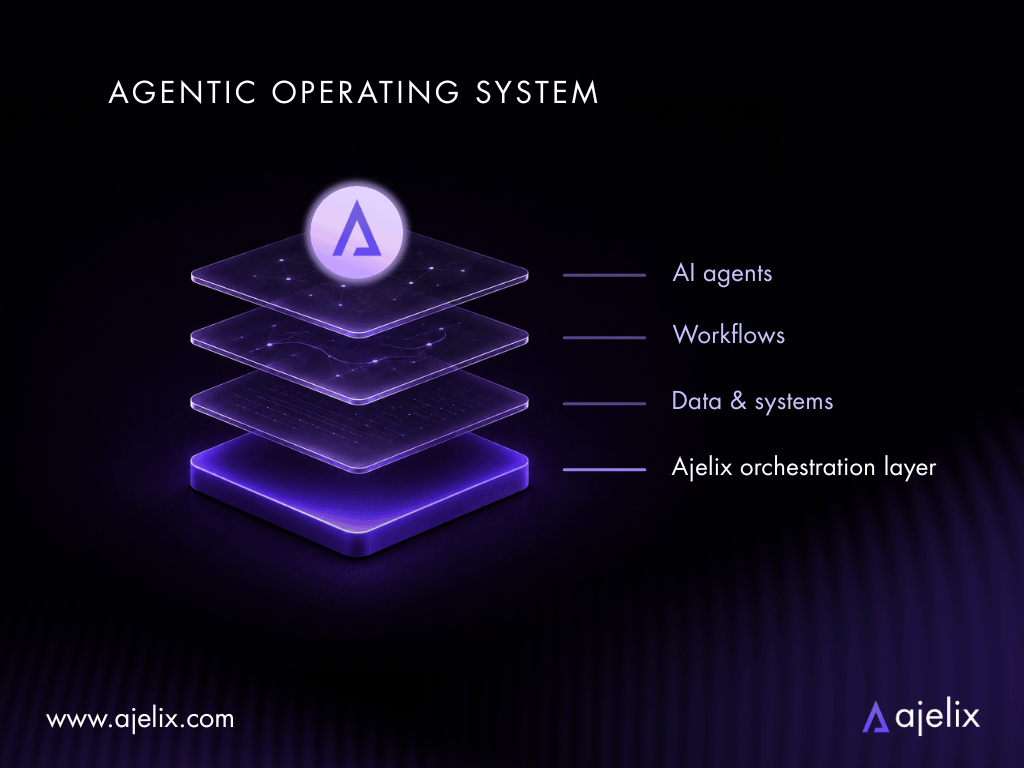
Ajelix Enterprise was built specifically for organizations that need AI to operate within their compliance and security requirements, with these key security and governance capabilities in place:
- Role-based access control (RBAC): Define exactly which employees, teams, and projects have access to which agents, data sources, and outputs.
- Guardrails on every message: Ajelix enforces policy on every input and output, blocking banned topics, keywords, and catching sensitive data before it leaks.
- Complete audit trails: Every agent action is logged and traceable.
- Spend controls: Manage and limit AI usage across projects and teams to prevent unexpected costs or unauthorized deployments.
- Flexible deployment: Run on Ajelix’s EU-hosted cloud, deploy on AWS, Azure, Google Cloud, or go fully self-hosted.
- Human escalation built in: Ajelix agents are designed to escalate to a human when it comes to high-value decisions.
- Source-cited answers: Every response is linked to its source document, giving your teams verifiable outputs.
For enterprises in regulated industries, Ajelix’s governance architecture is designed to make AI adoption accountable from day one.
Contact the team for a quote.
FAQ
AI agent security is the set of controls, policies, and monitoring practices that ensure autonomous AI agents operate within defined boundaries, cannot be manipulated, and do not expose or misuse data and systems they have access to.
The main risks are prompt injection (attackers hijacking agent instructions), access over-escalation (agents acting beyond their scope), leaked data, fabricated memory, shadow AI (unmonitored agent deployments), and supply chain attacks on the tools agents depend on.
There is no single framework that covers everything – most enterprises combine OWASP Top 10 for Agentic Applications 2026 (engineering baseline), NIST AI RMF (governance lifecycle), and ISO 42001 (external verification). Organizations subject to the EU AI Act must also map deployments to a recognized governance framework.
It is a shared responsibility. IT and security are responsible for the technical implementation, legal and compliance – for regulatory exposure, business unit owners define what agents are permitted to do, and executives set the organizational policies that prevent shadow AI.
Shadow AI is the use of AI tools, agents, or features by employees without approval or oversight from IT, security, or compliance teams.
Yes. Platforms like Ajelix Enterprise support fully self-hosted deployment, meaning the entire platform and all data run within your own infrastructure, with nothing leaving your environment.
Agentic AI chat that helps you complete projects
AI for work that ingests, transforms, and delivers the exact deliverables your team needs, while you stay focused on strategy. No more chatting, agents can get the job done.