AI Agents vs RPA: The Ultimate Business Automation Guide

AI agents vs RPA: these terms are often seen in material about business automation, but not many founders and managers fully understand their differences. Not to mention what and how much they should be implementing in their own business.
Using business automation is no longer about standing out, but keeping up with every other company. For that reason, I’ve compiled an ultimate guide on AI agents and RPA, explaining what’s best for the specific needs of your business.
What Is RPA And What Does It Do
Gartner defines Robotic Process Automation (RPA) as software that automates tasks within business and IT processes. It uses software scripts that replicate human interaction with the application interface.
That means, RPA watches what a person does on their computer, then repeats those exact actions automatically. It clicks, types, and moves through applications just like a human would.
RPA’s scripts are programmed by humans, but operate through bots. The human creates a sequence that the bot carries out, such as “open this file” or “click submit”. If the process stays consistent, the RPA bot works flawlessly.
RPA fails as soon as something in the scripted process changes. For example, if a website is redesigned and now has a different layout.
Three types of RPA bots exist:
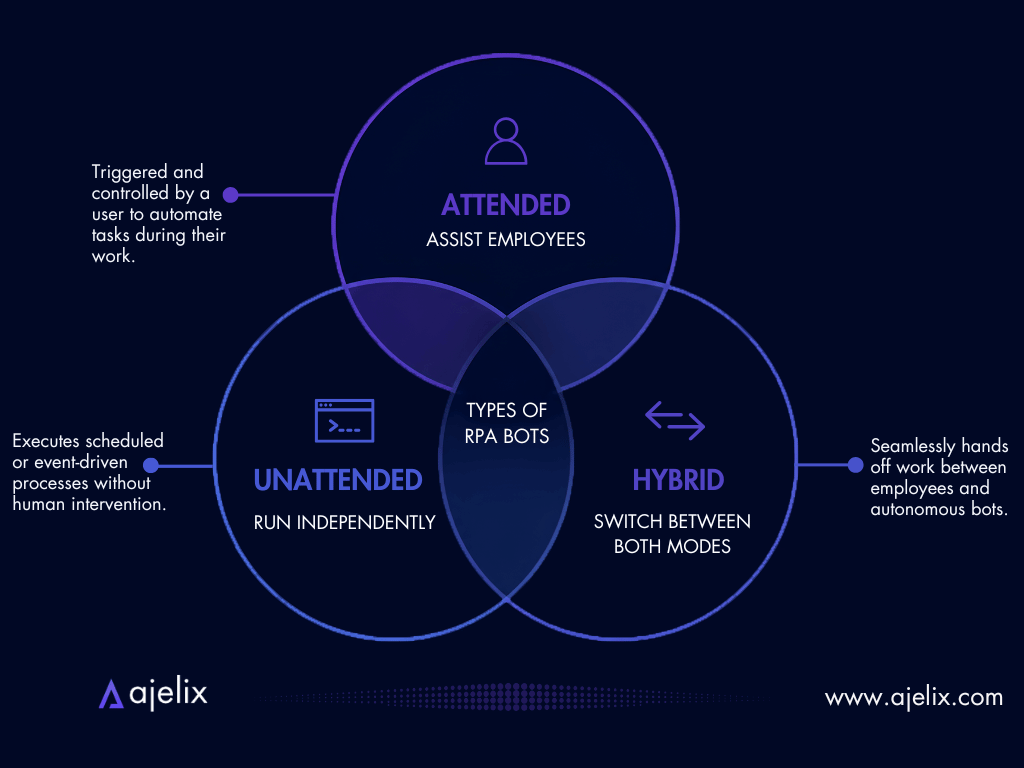
Attended bots should be used when human oversight is of importance. Unattended bots work best for the mundane, repetitive parts of the job.
- Attended bots operate on an employee’s computer, triggered by specific human actions. They assist employees by automating repetitive tasks, completing them in the background.
- Unattended bots run independently, in the background at all times. They perform tasks without any human involvement.
- Hybrid bots use both modes – either be triggered by a specific human action or run in the background 24/7.
AI Agents vs RPA Bots: The Key Differences
RPA bots follow prewritten scripts, record human actions and replicate them automatically. AI agents, on the other hand, don’t typically follow a fixed sequence. They are, depending on the agent, different levels of autonomous.
AI agents still automate processes, but they understand objectives and figure out how to achieve them.
Here are the main differences between AI agents and RPA bots:
| Aspect | RPA Bots | AI Agents |
|---|---|---|
| Operation | Replicates human UI interactions | Reasons through tasks autonomously |
| Input handling | Structured, predictable data | Unstructured data, natural language, ambiguity |
| Adaptability | Fails when processes change | Adjusts dynamically to new conditions |
| Decision-making | Rule-based, scripted | Goal-oriented, self-directed |
| Failure response | Stops or requires manual fix | Recovers and continues |
| Human interaction | Background automation | Conversational, collaborative dialogue |
Let’s take a situation from the world of business: extracting data from a vendor invoice.
An RPA bot would need all invoices to be in the same format, using the same template, to extract the needed information. An AI agent would adapt regardless of the template used, understanding and extracting what is needed.
How An AI Agent Performs A Task vs How An RPA Bot Would
To showcase their differences with real examples, I will be assigning a task to the Ajelix AI agent.
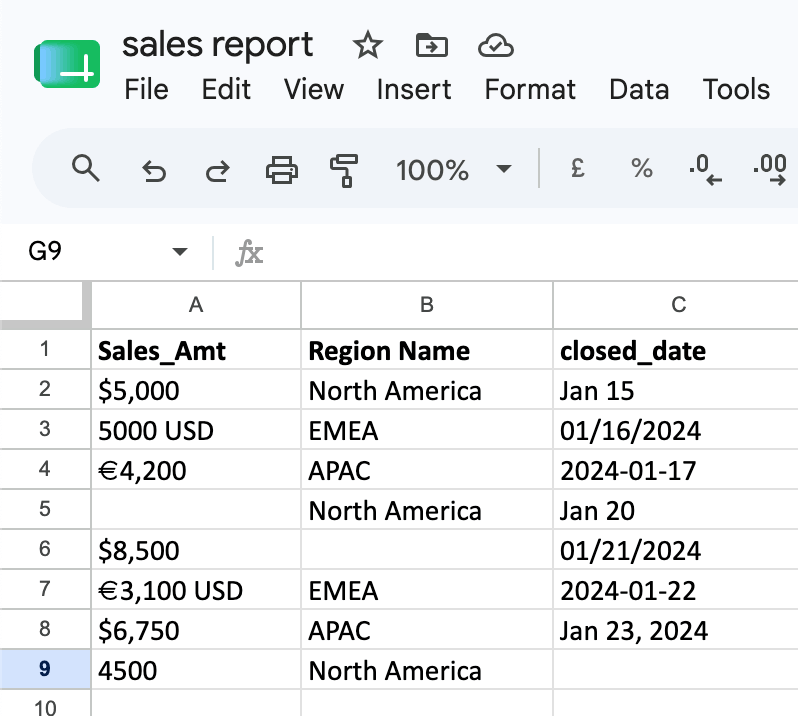
I have a messy data report with sales in different currencies, inconsistent formatting and missing values:
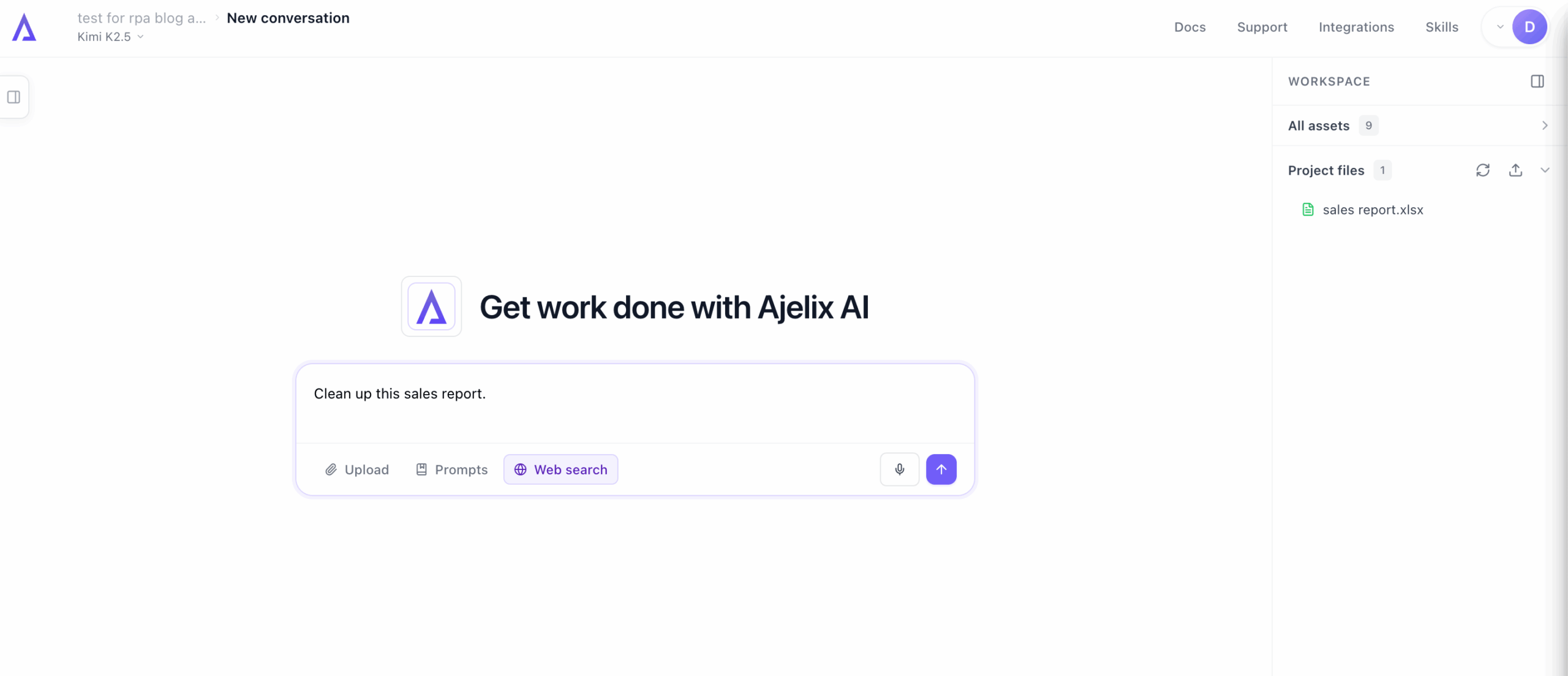
I asked Ajelix to clean up the dataset, prompting it very simply:
Clean up this sales report.
In less than a minute, Ajelix responded with the issues it identified and the cleaned file:
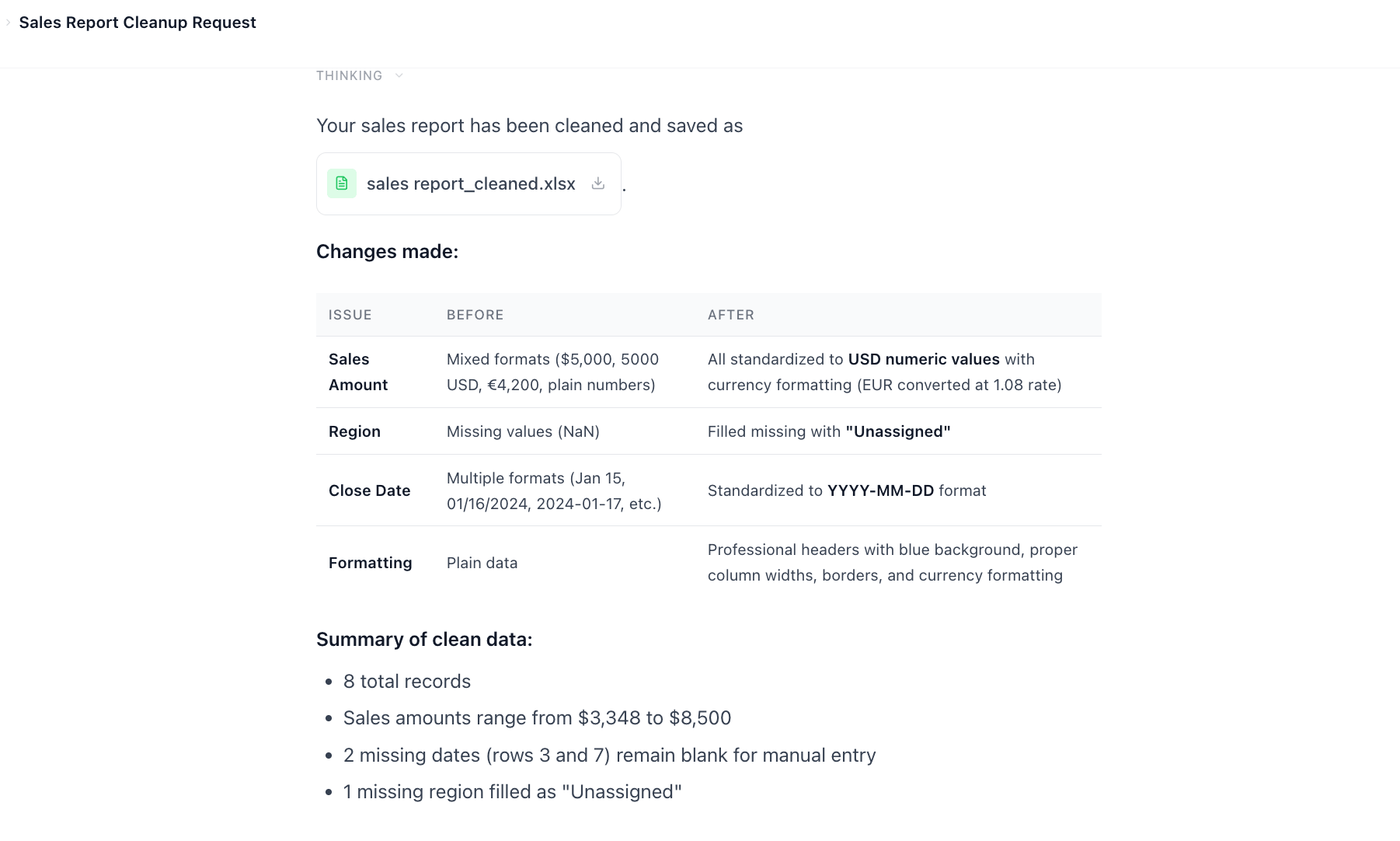
It noted that it kept some values blank for manual entry. It’s a good thing it caught that, as we wouldn’t want the AI to hallucinate non-existent data.
Here is the cleaned file Ajelix created:
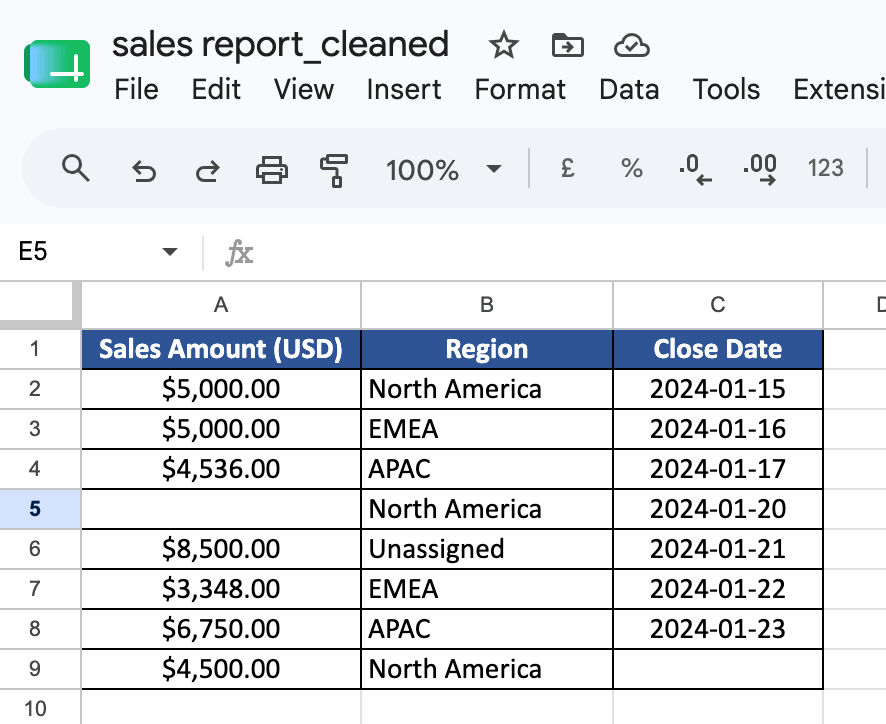
Ajelix did an excellent job at standardizing the formats, columns, and currency.
You can watch how an Ajelix team member does a similar task in this short video:

But what about an RPA bot? Would it be able to perform the task the same way as Ajelix?
The short answer is no. As RPA bots follow strict pre-defined rules or templates, they wouldn’t be able to clean the data. They are better at moving it.
An RPA bot would copy data from one cell to another and export to a formatted template. But it would not:
- Recognize that “$5,000” and “5000 USD” mean the same thing;
- Decide whether to exclude a row;
- Know what to do with missing values;
- Understand that “Jan 15” and “2024-01-17” both represent dates.
This makes RPA suitable for high-volume, perfectly consistent data transfers, but not so much for messy, real-world data, where human judgment and an AI agent would normally be required.
Ajelix’s Enterprise platform features both agentic AI and RPA automation processes, and a mix of both. It is available for the subscribed users of the Enterprise/Custom plan, and upon request.
Here is a preview of Ajelix’s workflow engine:
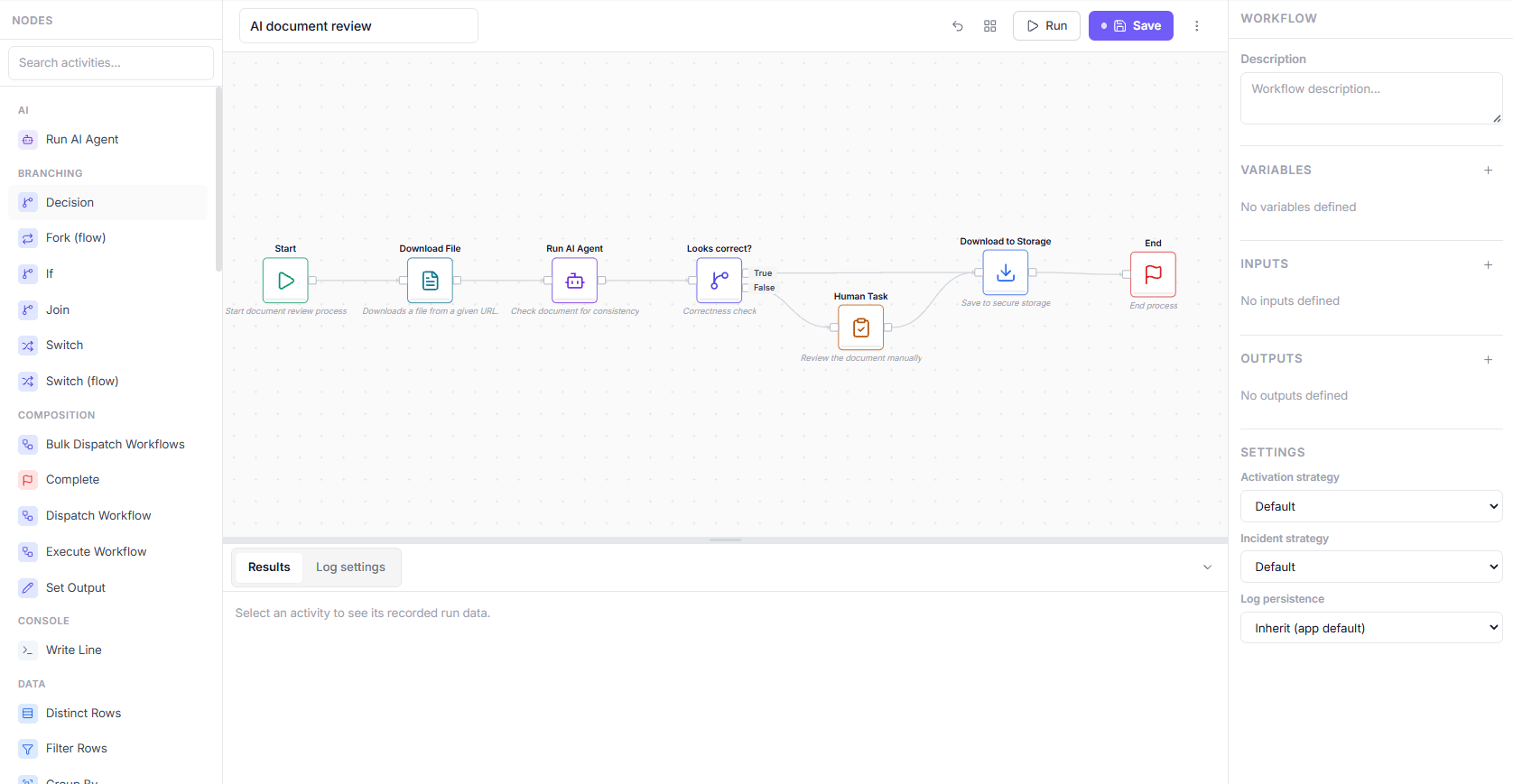
This shows a workflow titled “AI document review”, built in Ajelix’s visual workflow designer. It’s a good example of agentic AI and rules-based automation working in the same flow:
- Start: Kicks off the document review process.
- Download File: A classic automation step that takes a document from a given URL.
- Run AI Agent: Here an AI agent checks the document for consistency; this is the agentic step where the model reads and evaluates content.
- Looks correct? (+Decision): The AI agent’s output is routed into a conditional branch, so a human only gets involved when the AI is uncertain or flags a problem.
- Human Task: If the AI’s check fails, the document is sent for manual review.
- Download to Storage: Once approved (either by the AI or by a human), the file is saved to secure storage.
- End: Process is completed.
This is a hybrid agentic AI and RPA bot process, accompanied by manual human review. RPA (download, store) handles the predictable work, the AI agent handles the judgment call, and a decision node ties them together so humans are only involved in exceptional cases.
The left sidebar also shows separate node categories for AI, Branching, Composition, Data, and more, so workflows can mix automation, logic, and agentic steps freely.
Which Business Automation Should You Choose
This depends on what you’re trying to solve – so make sure to figure that out before implementing anything. AI agents and RPA solve different problems, and neither is “better” than the other. If you’re still unsure which solution best fits your business, platforms like Flaex AI can help you clarify your automation needs and build the right AI stack. You can also browse its AI Agent Directory to compare solutions and identify the type of AI agent your workflows may require.
Choose RPA Bots When
- Your process never changes: If you’re processing thousands of identical invoices with the same fields in the same locations, RPA handles this without flaw.
- Your data is structured: As we learned, RPA is good at moving data between sheets, and the same applies to systems.
- Audit trails are required: Because RPA follows exact scripts, every action is logged precisely. For industries with strict regulatory requirements, the ability to trace that is valuable.
- You have legacy systems without APIs: RPA bots interact through the user interface, making them great for connecting old systems that lack modern integration capabilities.
Choose AI Agents (Like Ajelix) When
- Your inputs vary: If you receive data in different formats, from different sources, with inconsistencies, an AI agent adapts to them.
- The task requires judgment: Scripted automation cannot provide reasoning. An AI agent lets you decide and input your human reasoning.
- You want conversational interactions: AI agents provide an interface people want to use because it’s like talking to a coworker. (If your coworker was machinery).
- The processes change frequently: If your workflows evolve all the time, an AI agent adapts. You don’t need to rewrite the scripts all the time, like you would with RPA.
Businesses either have high-volume, repetitive data transfers that are best for RPA, or messy, unpredictable work that requires the flexibility of an AI agent.
But this doesn’t mean you must pick a side and stick with it forever.
Can RPA And AI Agents Work Together
Yes, and they already do. When Google-searching “RPA bots”, several RPA software are already advertising their AI implementation. They are both needed for the best possible business automation, each handling the tasks they are respectively better at.
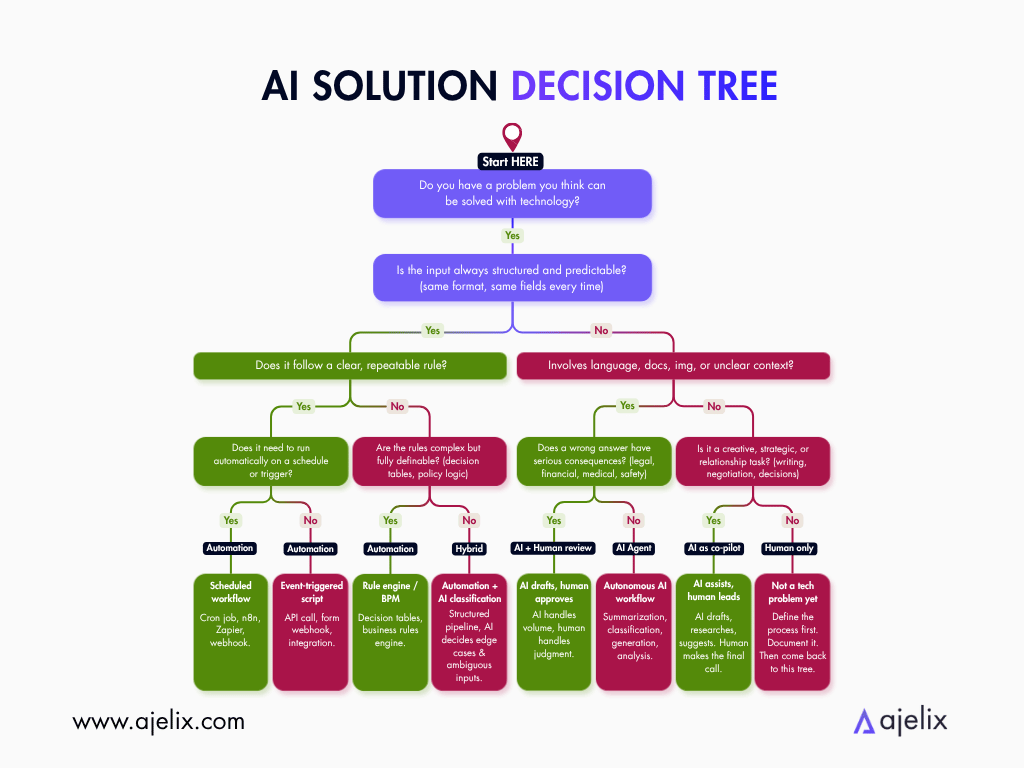
If you’re still uncertain about whether AI and automation is the right fit for you, follow the questions in Ajelix’s co-founder Agnese’s decision flow:
Limitations: What Neither Can Do (Yet)
While an AI agent can make suggestions and an RPA bot can execute decisions that were programmed into it, neither can navigate complex ethical dilemmas or read subtle social cues.
For example, neither technology can:
- Negotiate a contract with nuanced terms;
- Handle a customer complaint needing empathy and discretion;
- Decide when to make an exception when it comes to a client case.
When it comes to changes in the company, an RPA bot’s scripts will need to be rewritten, and an AI agent will require some guidance to get accustomed to new types of tasks.
RPA needs predefined rules and AI agents need data to work with. Without that, the RPA will fail and the AI is likely to hallucinate.
What this all leads to is that humans will always remain part of the automation process. Current technology can’t replace human strategy, relationships or needed scope of emotions for a certain job. There is no magic tool that can do absolutely everything for you – and, in my opinion, there shouldn’t be.
If you want to get started with an AI agent and haven’t yet decided on which one to use, I recommend Ajelix.
Try it now → chat.ajelix.com
FAQ
RPA bots follow prewritten scripts and replicate human actions exactly. AI agents understand objectives and figure out how to achieve them autonomously.
No. RPA remains better for high volume, repetitive tasks with structured data that never changes. AI agents handle variable, judgment-based work.
AI agents like Ajelix typically require less upfront investment and little developer resources. RPA often needs technical setup and ongoing script maintenance.
Yes. Many businesses use RPA for structured data transfers between systems while AI agents handle the variable, analytical, or decision-making components.
Yes. Ajelix’s Enterprise platform combines agentic AI and RPA in the same visual workflow. For example, an “AI document review” workflow uses RPA steps to download and store files, an AI agent to evaluate content, a decision node to route uncertain cases, and a human review step as a fallback. This hybrid approach keeps predictable work automated, reserves AI for judgment calls, and involves humans only when exceptions occur.
Neither can negotiate contracts, handle sensitive customer complaints requiring empathy, make ethical judgments, or operate physical equipment.
No. AI agents like Ajelix use conversational interfaces. You describe what you need and the agent figures out the execution.
Agentic AI chat that helps you complete projects
AI for work that ingests, transforms, and delivers the exact deliverables your team needs, while you stay focused on strategy. No more chatting, agents can get the job done.