


What Is MCP in Agentic AI? A 2026 Guide For Teams

What is MCP in agentic AI? Picture the last time a decision needed a number from one system, a document from another, and something to connect the two. An agent can only help if it can reach both, and MCP is what lets it.
Before the introduction of MCP, every AI product needed its own custom connection to every system it accessed, meaning the integrations multiplied with each new tool. MCP replaces that with one shared way to describe a tool, so an agent can find what it needs and use it without involving a developer each time.
Our expert guide covers how MCP works and how to keep it under control.
What Is MCP In Agentic AI
The Model Context Protocol is an open standard that lets an AI application discover and call tools, as well as data on external systems, through one shared interface instead of a separate connector for each one.
The official registry lists over 52,200 active servers as of November 2026, with more updated weekly. To understand how fast it’s growing, it listed about 1,200 at the end of 2025. Servers offer tools the model can call, resources it can read, and prompts a person can pick.
While Anthropic originally designed MCP, it donated the protocol to the Agentic AI Foundation under the Linux Foundation in December 2025. The foundation listed 286 member organisations by October 2026, including AWS, Google, Microsoft and OpenAI.
The current version, published in July 2026, made the protocol stateless. That means each request now carries everything the server needs to answer it, with no session kept open between calls. Any server can handle any request, so deployments scale like ordinary web services. Older session-based servers are still available in working condition.
What An MCP Server Does
An MCP server in agentic AI is the program that tells an agent what it is allowed to do, and then does it. One server gives an agent a handful of actions it can take, for example: “create a pull request” in GitHub, “run this query” against Postgres, “update this deal stage” in the CRM.
MCP server AI agent setups run in one of two places. The server can be on the same machine as the AI app, like a helper program on your laptop, which is handy for local files. Or it can run on a company server and be reached over the internet, so a whole team shares it. Most are the shared kind: 66% of servers in the official registry list a hosted address.
For every tool the server can reach, it gets a name, a simple description of what the tool does, and the inputs it expects, such as a customer ID or a date range.
What Teams Use It For
The systems your teams already open every morning: the CRM, ticketing tools, the shared drive, the reporting database. Each one gets a single connection, and from then on any agent you build can read from it or act in it without a new integration.
Stacklok’s survey of 300 technology leaders found that 41% of them were running MCP servers in limited or broad production, and 45% among software companies.
Where MCP agents get connected, as per the surveyed software firms:
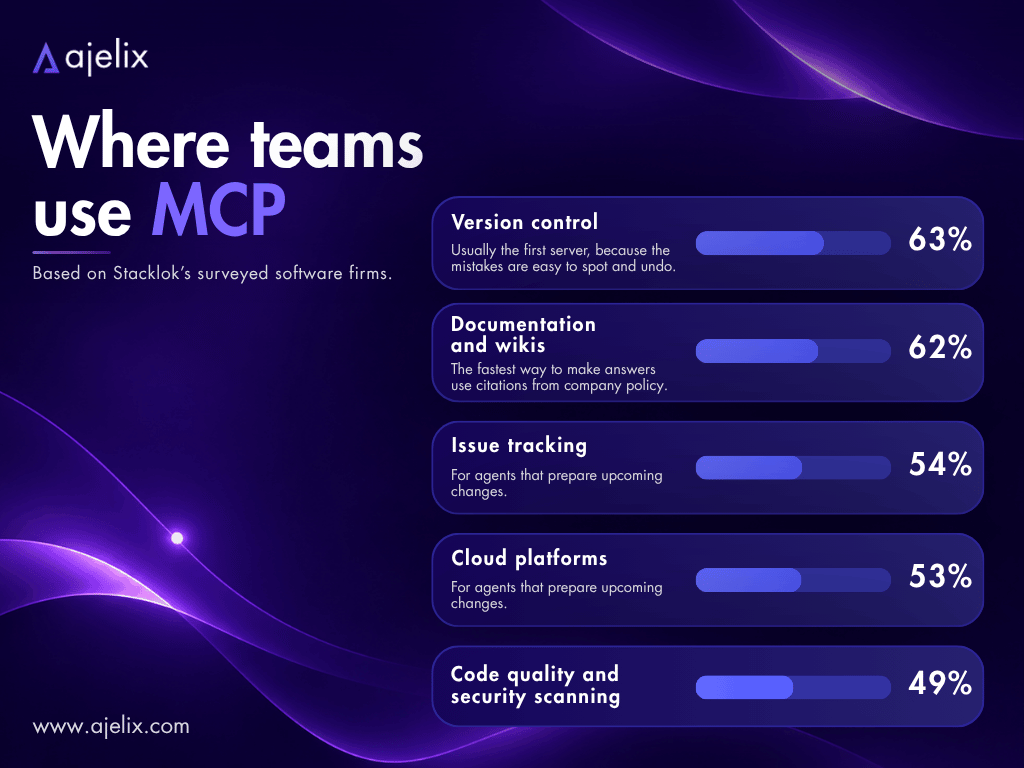
- Version control (63%), usually the first server, because the mistakes are easy to spot and undo.
- Documentation and wikis (62%), the fastest way to make answers use citations from company policy.
- Issue tracking (54%) and cloud platforms (53%), for agents that prepare upcoming changes.
- Code quality and security scanning (49%).
Deployments that succeed start with read-only, add one write action behind an approval step, then let the agent run unattended.
MCP vs API
An API is a contract written for a developer who reads the docs and hard-codes the call. MCP is a contract written for a model that decides at runtime which tool to use. An MCP server is usually wrapped around your existing API; it does not replace it.
| Typical REST API | MCP server | |
|---|---|---|
| Who calls it | Code a developer wrote | An AI host, on a user’s behalf |
| Discovery | Docs a human reads | tools/list returns names and schemas |
| Who picks the action | Developer, in advance | The model, at runtime |
| Message format | HTTP verbs, many endpoints | JSON-RPC 2.0, a few standard methods |
| Transport | HTTPS | stdio or Streamable HTTP |
| Reuse | Custom code per app | One server, any compatible client |
| Human approval | Not defined | Built into the spec’s flow |
When only one system you control will ever call the integration, a typical API uses less machinery for the same result.
Server Examples
Good MCP server examples include:
- GitHub’s MCP server. Official and open source, and the most widely adopted developer server. It is how an agent reads issues, opens pull requests and inspects workflows, and it ships a “–read-only” flag that removes every write tool.
- Playwright’s MCP server. Microsoft’s browser automation server, which serves as the reason an agent can click through a web app without a custom scraper.
- Google’s managed servers. More than 50 first-party servers for Google Cloud services became generally available or in preview earlier in 2026, covering Maps, BigQuery, Compute Engine and Kubernetes.
- Reference servers. Filesystem, Git, Postgres and memory, maintained by the protocol project.
- Ajelix connectors. Any application with an MCP server becomes a tool inside the platform.

Limitations
An MCP server is a connector with a narrow job. We compiled three things it can’t do for you, however well it is built:
- It can’t limit what the agent inherits. Whatever access you grant a server, the agent gets too. A CRM server that has an admin token hands admin reach over to every agent connected to it.
- It can’t tell you when it changes. A server you approve now can behave differently in a few months’ time. A census of the official registry found that 40.6% of servers with more than one published version changed what they declare between versions without notice, and 9.57% of scanned servers had unauthenticated network exposure.
- It can’t keep the toolset small. Every server you connect adds its tool definitions to the context window, increasing the amount of tokens used. Connect only what the process needs, not everything the registry offers.
None of this is a reason to skip the implementation, but rather a reason to decide who owns each connection before the first server goes live.
How To Govern It
Pinterest’s internal setup is the clearest example of MCP at scale: every MCP server is behind a central registry, and a server outside the registry can’t be called by any agent. The reported payoff was around 66,000 monthly tool calls across 844 active users, and around 7,000 engineering hours saved.
Four things to introduce before an agent reaches production:
- One approved catalog, with an owner, a version, a review date and a hash of each tool definition, so that a review is triggered if something changes.
- Scoped credentials per agent, not per company. The agent should hold the narrowest token that finishes the task.
- Approval gates. Refunds, contract changes, record deletions are only prepared by the agent, but a person signs them.
- An audit trail that tells you about agent actions, tools used, performed by which user, and at what time.
MCP itself lists agent identity and enterprise security as priorities. Ajelix Enterprise is built around this governance list.
MCP In Ajelix Enterprise
It’s crucial to know who decides which agent may reach which server, and what happens after it does. Ajelix Enterprise answers that with security, privacy and governance features.
- Connections are governed. Any application with an MCP server becomes a tool your agents can use, and API connections cover the systems that don’t expose MCP yet. Your IT team decides which connections should exist, which teams can reach them, and what an agent may do once connected. Credentials are stored as Secrets.
- Every action is written down. Granular role-based access keeps each employee inside their permissions, while an exportable audit trail and reasoning logs record what an agent did and why. Usage reporting is run per employee, agent, model and function, with spend limits at organisation, team and user level.
- Agents run inside a defined process. Custom agents carry their own instructions, tools and data access, and playbooks encode the order of steps, human approval points included. High-value decisions escalate to a person.
- Deployment follows your data rules. Inference runs on GPU servers Ajelix owns inside the EU, with no training on client content. The platform is also available to run on your own AWS, Azure or Google Cloud account, or fully on premises.
Ajelix Enterprise is a platform where connections, permissions and evidence are all joined together. If you want to know which of your systems already has an MCP server worth connecting, book a demo.
Choose The Setup For Your Team
The right MCP server AI setup depends on what your agents need to access and who signs off on their actions. We’ve compiled a list based on possible situations:
| Your situation | What you should be implementing |
|---|---|
| One assistant, one internal system, stable toolset | Plain API integration. Skip MCP until a second client appears. |
| Several AI clients need the same tools | Build one MCP server over your existing API, and keep the API for everyone else. |
| Piloting agents with developer tooling | Official reference servers, local stdio, read-only scopes, one team. |
| Agents touching CRM, ERP or finance data | MCP behind a gateway, allowlisted servers, scoped tokens, approval gates. |
| Regulated industry, auditors involved | Ajelix Enterprise: governed MCP and API connections, RBAC, exportable audit trail, EU or on-prem deployment. |
If keeping every MCP server inside your own permissions, logs and data boundary is your priority, contact the Ajelix team.
FAQ
An open standard that lets an AI agent discover and call tools and data on external systems through one interface, so one server works with any compatible AI application.
A small program that makes one system’s actions and data available to an agent in a standard format, so any compatible AI app can use it. One server covers one system: your CRM, your warehouse, your code repository. The agent sees which actions it can take, then picks one.
Three things, mostly: reading data an agent would otherwise guess at, preparing work a person then approves, and running the same task across several systems without a new integration for each one.
No. MCP servers usually wrap around existing APIs. You keep the API for applications, partners and back-end services, and add an MCP layer so agents can use the same capabilities.
MCP is a connection layer. Agentic AI is the decision layer: a system that takes a goal, plans steps, calls tools, checks results, and keeps going. Autonomous agents in AI need both.
Yes, with local servers and read-only access. The moment an agent can write to a system other people depend on, you need the approval step and the log, whether you build them or buy them. The protocol and SDKs are open source; you pay for models, servers and governance.
Agentic AI chat that helps you complete projects
AI for work that ingests, transforms, and delivers the exact deliverables your team needs, while you stay focused on strategy. No more chatting, agents can get the job done.


