Agentic AI vs AI Agents: What’s the Difference and Why It Matters

In recent years, work meant getting familiar with AI chatbots like ChatGPT. Right now, we’re stepping into a world led by agentic AI. While change may feel scary, I assure you that this time, it’s not.
Agentic AI and AI agents are separate terms often mistakenly used as synonyms. Understanding the distinction matters. One describes a product and the other – a capability.
Table of Contents
- Overview of Key Differences Between Agentic AI and AI agents
- Agentic AI vs Autonomous Agents: Are They the Same?
- How Is Generative AI Different from Agentic AI?
- Levels of Autonomous AI Agents: From Assisted to Fully Autonomous
- Agentic AI Use Cases: What Can It Do for Your Business?
- How to Start Using Agentic AI in Your Workflow Today
- FAQ
Key Differences Between Agentic AI and AI agents
Agentic AI is the quality that makes an AI system autonomous – the ability to plan, decide, and act independently. An AI agent is the actual system that carries out tasks. Think of agentic AI as the capability, and the AI agent as the product built on it.
Agentic AI acts with autonomy, initiative, and proactivity. Instead of requiring micromanagement at every step, it works independently and delivers a finished result. (Think: your manager’s dream employee.)
Meanwhile, an AI agent is a system designed to take actions toward a goal – the level of autonomy varies.
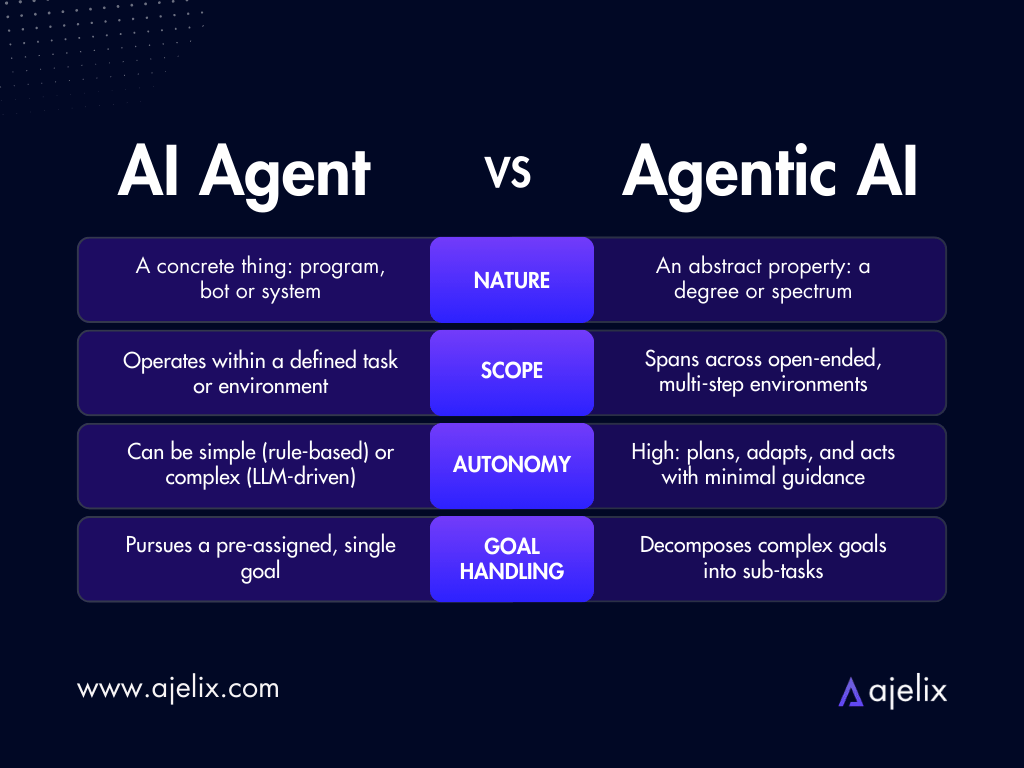
Ajelix automates your business workflows end-to-end using autonomous AI agents. Our platform is at the intersection of agentic AI and real business execution. Built on agentic principles, AI agents work independently toward your goals. They handle entire workflows without waiting to be guided through each step.
Agentic AI vs Autonomous Agents: Are They the Same?
You can look at Autonomous AI Agents as a drone completing a delivery route. The drone doesn’t need you to hold its metaphorical hand. Its purpose is to deliver the task, and it will do so until completion.
Meanwhile, think of agentic AI as the entire automated drone system. It is what gives each drone its autonomous qualities. You can consider ‘agentic’ an adjective, describing the quality that enables AI agents to complete tasks with autonomy. This means that Agentic AI is not the product.
An AI Agent can be various degrees of autonomous (See Section 4) and the stronger their agentic qualities, the more independently they can act.

How Is Generative AI Different from Agentic AI?
Generative AI produces new content – text, images, audio, or code – in response to user prompts. Agentic AI is AI that plans, decides, and acts on its own to complete a goal.
To showcase the difference, I will be using ChatGPT and Ajelix as examples.
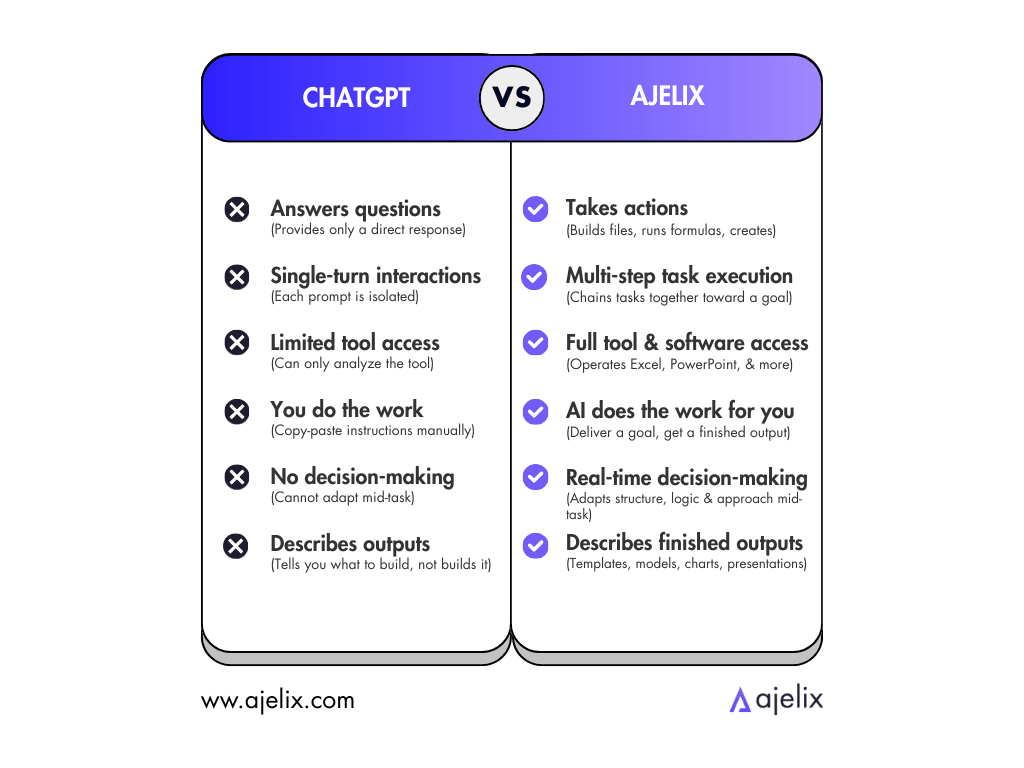
Based on the comparison, agentic AI is more powerful than generative AI. ChatGPT has a low autonomy level, while Ajelix’s is high. With Ajelix, you receive a finished output from a single prompt. With ChatGPT, you receive instructions on how to build it yourself.
Author’s note. ChatGPT is the most widely used standalone AI assistant. Popularity often makes working on it feel safer – after all, if everyone uses it, it must be good. However, the quality of what ChatGPT can give you is less impactful than agentic AI, especially for business related tasks.
Levels of Autonomous AI Agents: From Assisted to Fully Autonomous
Autonomous agents are AI systems that independently plan, decide, and execute multi-step tasks toward a goal. They don’t need human input at every stage.
These levels are currently a spectrum – no universally agreed-upon standard exists yet. However, I will explain the basic principles.
- Level 1: Assisted. You’re fully in control – the AI only gives you suggestions. Example: GitHub Copilot suggests the next line of code as you type.
- Level 2: Partial Automation. You manage the overall workflow – the AI handles well-defined tasks upon prompting. Example: ChatGPT writes a summary of your data.
- Level 3: Conditional Automation. The AI handles multi-step tasks, but checks in at key decisions. Example: Intercom Fin (AI Customer Support Agent) handles the majority of your tasks, but can decide to ask for human input.
- Level 4: High Automation. You give the agent a goal and it executes the full workflow on its own. Example: Ajelix analyzes the sales file and builds you a dashboard.
- Level 5: Full Autonomy (Currently Theoretical). The AI agent sets its own goals, plans long-horizon tasks, manages other tools or agents. It operates with no humans in the loop. No reliable commercial system exists yet.
Most AI agents today operate at Level 3 to 4. The gap between Level 4 and 5 is where most of the current AI research and debate are focused.
Author’s Note: This 2026 research mentions that using autonomous AI-driven systems in high-stakes situations raises serious concerns. Many argue that before these systems can be responsibly deployed, humans must remain meaningfully in control of what they do and how they do it.
Agentic AI Use Cases: What Can It Do for Your Business?
In this video, we showcase the Top 5 AI Agent Use Cases that turn your prompts into finished, presentable material.
These use cases include:
- Excel Templates. Describe what you need, and the agent builds it to your exact specifications.
- Financial Models. Revenue projections, cash flow analysis, scenario planning, fully built by the agent.
- Charts & Data Visualizations. Upload your data and get a complete chart suite.
- Dashboards from existing Excel files. The agent analyzes your data, cleans it up, and builds an executive dashboard.
- PowerPoint Presentation. From raw spreadsheet to a complete, structured, investor-ready pitch deck in one prompt.
Example prompt to create a PowerPoint Presentation:
Research my SaaS product: [your product url] and market, then create a modern, professional PowerPoint pitch deck for an investor meeting. The deck should clearly communicate the problem, solution, product value, target market, business model, traction, competitive landscape, go-to-market strategy, and financial outlook, using concise messaging, strong storytelling, and clean, modern visuals. Design it to feel polished, credible, and compelling, with clear takeaways on each slide that resonate with investors.
Try this prompt, or any variation of it, on chat.ajelix.com to see what agentic AI can build for your business.
How to Start Using Agentic AI in Your Workflow Today
The jump from using a generative AI chatbot to an AI agent can feel huge, but it is inevitable. The good thing is, you don’t have to be a tech expert or acquire new skills. All you need to do is write a prompt, just like you would with a generative AI chatbot.
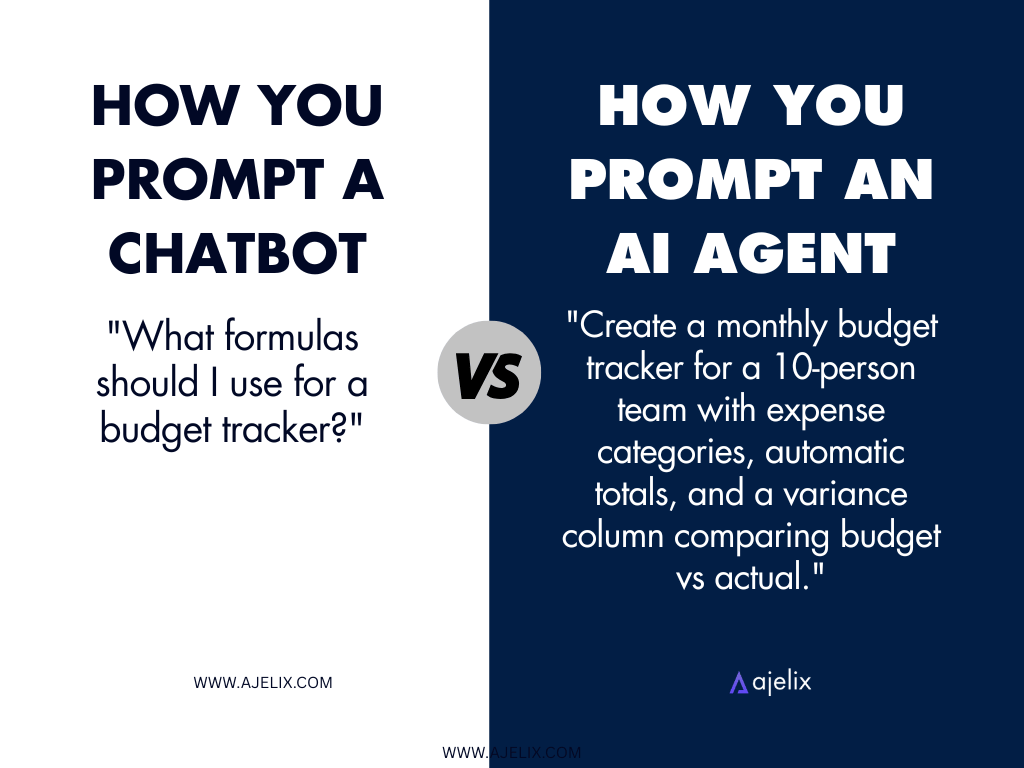
Think about the tasks in your week that feel repetitive and time-consuming. These are the best examples to hand off to your AI agent. Put what you would usually do into words, making sure your expectations for the final output are clear.
Generally, you should follow these steps:
- Be specific about the output, not the process: Instead of “help me with my sales data,” try “analyze this sales file and build a dashboard showing monthly trends, top regions, and yearly growth.”
- Include context about your business: The agent performs better when it knows the industry, the output audience, and specific requirements. Example: “this is for an investor meeting” or “this is for internal use by a non-technical team.”
- Specify the outcome aspects: Mention if you prefer a Word, Google Doc or PDF file, or if you want agentic AI to perform research.
Remember to set realistic expectations. An agentic AI delivers a finished or near-finished output, but it still benefits from a human review pass. Think of it this way – instead of spending hours building something from scratch, you are spending a few minutes reviewing something that is already 90% done. That is the real time saving.
The best way to understand what agentic AI can do for your workflow is to try it on a real task. You can test all the use cases covered in this article directly on chat.ajelix.com
FAQ
An AI agent is a concrete system – a program, bot, or software – designed to take actions toward a goal. Agentic AI is the property that makes an agent autonomous. Think of agentic AI as an adjective: it describes the quality of an AI agent that can plan, adapt, and act with minimal human guidance.
The concept of autonomous agents dates back to 1990s AI research. But agentic AI as a working, commercially available technology only became mainstream in late 2024 to early 2025. We at Ajelix started working with agentic AI at the start of 2024.
No, an autonomous agent is a type of AI agent that operates independently to complete a task. Agentic AI is the broader quality that enables that autonomy. All autonomous agents have agentic qualities, but not all AI agents are fully autonomous.
Currently, in 2026, no. But it’s possible this may change in the future.
ChatGPT is a generative AI – it responds to your prompts with text, suggestions, or basic file outputs. Agentic AI, like Ajelix, takes actions on your behalf. It builds files, runs tasks, and delivers a finished output from a single prompt – instead of telling you how to do it yourself.
No, you don’t need to know how to code, write formulas, or understand AI systems. All you need is a clear prompt describing what you want. The agent handles the rest – structure, logic, formatting, and output.
Agentic AI performs best on tasks that are multi-step, time-consuming, or follow a predictable structure. Common use cases include building Excel templates, financial models, dashboards, charts, and PowerPoint presentations.
In most cases, yes. Agentic AI delivers a finished or near-finished output. A quick human review is still recommended – but you’re refining something that’s already 90% done, not building from scratch.
Ajelix operates at Level 4 – High Automation. You give the agent a goal, and it executes the full workflow on its own, making decisions about structure, logic, and formatting along the way. It only flags situations where your input is genuinely needed.
You can test all of the use cases covered in the video in this article directly at chat.ajelix.com. A free tier is available, and no technical setup is required to get started.
Agentic AI chat that helps you complete projects
AI for work that ingests, transforms, and delivers the exact deliverables your team needs, while you stay focused on strategy. No more chatting, agents can get the job done.