Top European AI Companies Worth Switching To In 2026

When your employee uploads a sensitive contract into a consumer ChatGPT plan, the document leaves the EU borders, lands on US infrastructure, and thus becomes subject to American law. But European AI companies are capable of protecting your data privacy if your company is based in a European country.
Nowadays, keeping your data where you’re based is a procurement requirement. Despite this, many European companies still depend on non-EU AI providers.
Our team of AI experts put together a list of European AI alternatives worth switching to, starting with the platform we know best, then the tools we evaluated against it. We also looked at recommendations from users in AI communities.
Why You Should Switch To European AI Companies Now
Switching to a Europe-based AI provider is all about funding, jurisdiction, and regulation.
European AI is getting funding. In September 2026, Euronews reported that Mistral AI has “raised €3 billion in a round led by Samsung Electronics, nearly doubling its valuation to more than €21 billion in what the company says is the largest equity fundraising ever completed by a European technology firm.”
A year earlier, Reuters reported: “Dutch chip equipment maker ASML has invested 1.3 billion euros to become the biggest investor in French artificial intelligence startup Mistral AI in a significant boost to Europe’s AI ambitions.”
Depending on European technology is now an official policy. When the European Commission revealed its Technological Sovereignty Package in June 2026, Executive Vice-President Henna Virkkunen stated: “Today, we simply rely on non-EU providers for over 80% of our digital products, services and infrastructure. This is a huge problem for Europe’s security of supply.”
Commission President Ursula von der Leyen put it in the official press release: “We cannot afford to depend on others for the technologies that keep our hospitals running, our energy grids stable and our services secure.”
Regulation rewards European-native design. According to the European Commission’s AI Act Service Desk, in August 2026 “the majority of rules of the AI Act come into force and enforcement starts for applicable rules.” Jurisdiction matters more than server location: as BeyondScale notes, “The US CLOUD Act applies to all US-headquartered cloud providers globally, including AWS EU Sovereign Cloud, Azure EU, and Google Cloud EU regions.”
This means, an “EU data center” from a US vendor does not remove US jurisdiction.
The technology is already available. Germany and France account for over 59% of the total value held by Europe’s top 25 AI startups, and “19 of the top 25 startups are B2B-focused.”
If you’re compiling a list of the biggest AI companies in Europe right now, it reads something like this:
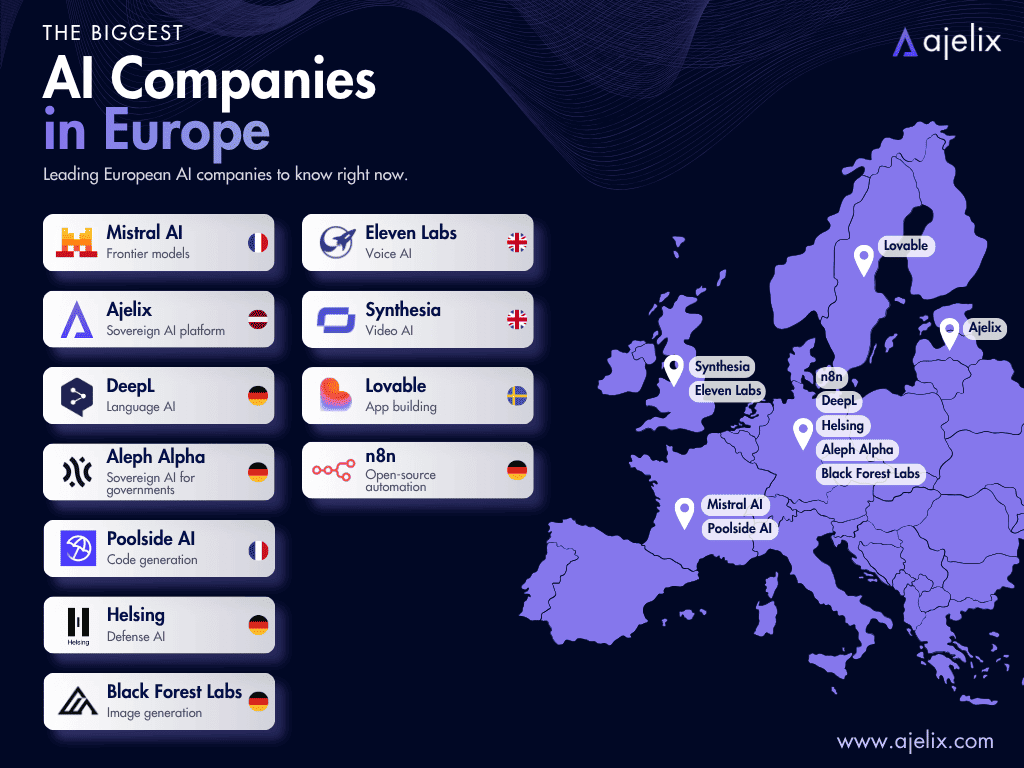
- Mistral AI (France, frontier models);
- Ajelix (Latvia, sovereign AI platform);
- DeepL (Germany, language AI);
- Aleph Alpha (Germany, sovereign AI for governments);
- Poolside AI (France, code generation);
- Helsing (Germany, defense AI);
- Black Forest Labs (Germany, image generation);
- ElevenLabs (UK, voice AI);
- Synthesia (UK, video);
- Lovable (Sweden, app building);
- n8n (Germany, open-source automation).
Several European companies claim EU AI sovereignty, but not all of them stay independent. Per Unite.AI, “Cohere announced the signing of a definitive business combination agreement with Aleph Alpha in September 2026, formalizing a partnership the two artificial intelligence developers first disclosed in April.” This deal is valued at roughly $20 billion, with Schwarz Group committing €500 million as lead investor. It’s a transatlantic company, not a purely European one.
European vendors now offer comparable capability, stronger funding, and one thing no US provider can promise: your data staying under European law.
Top European AI Companies At A Glance
We have compiled a comparison list for the best European AI companies, most of which feature a chat interface:
| Tool | Best For | Key Differentiator |
|---|---|---|
| Ajelix Enterprise | Enterprise AI agents, visual workflow and agent building, and reporting automation | Own GPU infrastructure in Riga, Latvia, meaning all AI inference stays in the EU/EEA |
| Mistral Vibe | A European AI chatbot alternative to ChatGPT for everyday and enterprise work | GDPR-native agent platform from Europe’s leading frontier lab: chat, work automation and coding in one licence, with on-premises deployment options |
| Proton Lumo | Privacy-critical conversations and documents | Zero-access encryption; not even Proton can read your chats |
| DeepL | Translation, writing and language workflows | Specialized language AI that outperforms general-purpose models on translation quality |
Below, we cover what each platform does well, what not so much, and who it’s built for.
The 4 AI Alternatives We Recommend
The following tools don’t compete against each other. Each handles a different aspect of who can read your data, and under which law.
They are, in order: a governed agent platform for company workflows; a daily assistant for the team; an encrypted chat for confidential material; and specialized language AI for translations.
1. Ajelix Enterprise
Who is it built for? Business teams and enterprises that want custom AI agents and workflows running entirely on European infrastructure, with all the needed governance built in.
- Pros: Owns its GPU infrastructure in Riga, Latvia; all AI inference runs on servers owned by Ajelix in the EU/EEA, with no customer prompts, files or outputs sent to any external AI model provider; supports self-hosted deployment of the platform and models; granular RBAC, hash-chained audit trails, reasoning logs, usage monitoring and quota management; visual no-code agent and workflow builder; RAG system grounded in company documentation with source citations.
- Cons: Run by a smaller, more focused team than the AI giants.
Ajelix started in Latvia in 2022 as an Excel formula tool and grew to 350,000+ users across 150+ countries as an agentic AI workspace. In September 2026, the company announced it had acquired its own GPU compute infrastructure and launched the Ajelix Enterprise Platform, which works as an operational layer for running AI in organizations.
The AI inference runs on Ajelix-owned servers in Riga, within the EU/EEA. The platform uses open-source models that can operate on Ajelix’s EU infrastructure or inside a company’s own environment, which matters for public sector, legal, finance, and healthcare teams that can’t route sensitive data through a US provider at all.
Among the best European AI companies for enterprises, Ajelix controls all the necessities: models, infrastructure, agents, and governance.

2. Mistral Vibe
Who is it built for? Teams and individuals who want a European AI chatbot alternative to ChatGPT with multilingual quality and flexible deployment.
- Pros: Data hosted in the EU, running on ISO 27001-certified European data centers; Enterprise tier offers on-premises, private-cloud or Mistral Cloud deployment with full data residency; 100+ connectors including Google Workspace, Outlook, SharePoint, Slack, GitHub and Jira, plus any MCP server; SAML SSO and audit logs for enterprises.
- Cons: Not the top model on independent reasoning benchmarks against US frontier systems; the free tier is heavily restricted and the Canvas editor requires a paid plan.
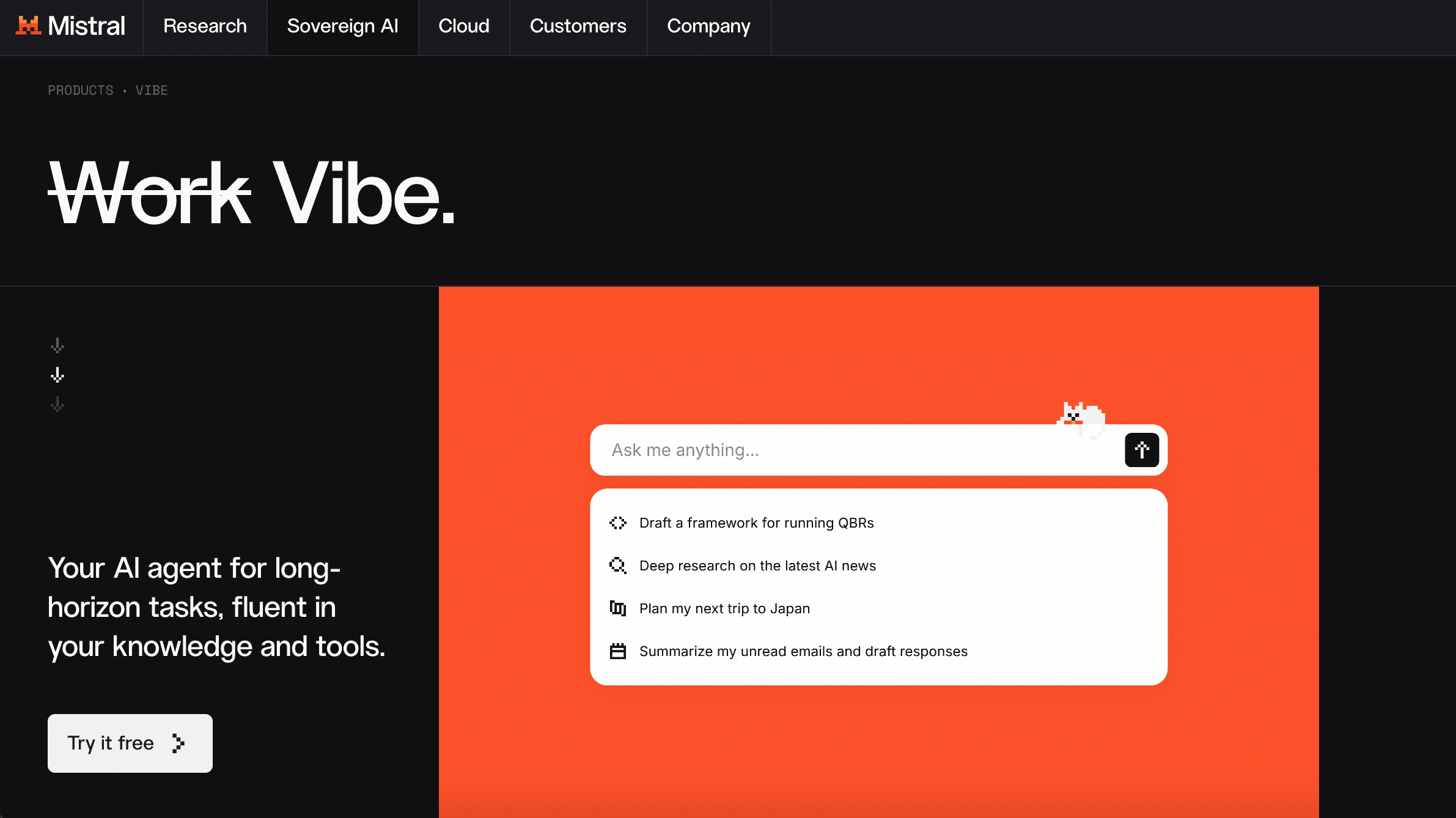
Mistral AI is the closest thing Europe has to OpenAI, and Vibe is its agent platform, covering chat, work automation and cloud-based coding. It runs three modes on one licence: Chat, Work, and Code. The company reports over 100 large enterprise customers, including French, German and Greek government institutions.
Vibe’s Enterprise tier runs on Mistral Cloud, in a private cloud, or fully on-premises, with up to 100% data residency for regulated buyers, plus zero data retention. The company also releases frontier-class models under the Apache 2.0 license.
If you’re searching for European alternatives to ChatGPT, Mistral is usually the first name on the list.
3. Proton Lumo
Who is it built for? Individuals and teams handling confidential material, who want an assistant built so that not even Proton can read what you type.
- Pros: Zero-access encryption on saved chats, files, memories and projects (even Proton itself cannot read them); no training on user data; runs open-source models on Proton’s European infrastructure under Swiss privacy law; Ghost Mode for conversations that leave no trace; open-source apps allow independent verification.
- Cons: Context must be resent each time and messages are decrypted for processing inside Proton’s environment; not as feature-rich as mainstream assistants; smaller model capability than frontier US ones.
Lumo is an AI assistant from Proton, the Swiss company behind Proton Mail. It launched in 2025 and got a major upgrade with Lumo 2.0 in June 2026, adding advanced reasoning, image recognition and generation, cited web search, user-controlled memory, and encrypted Projects.
Lumo is built to prevent journalists, lawyers, and company employees from feeding confidential documents into consumer chatbots. Of the European AI alternatives to ChatGPT on our list, Lumo is the one built for people whose main concern is data privacy.
4. DeepL
Who is it built for? Companies who regularly need to execute language workflows: translation, cross-border communication, and multilingual documents.
- Pros: Translation in more than 100 languages; DeepL Write Pro for AI-powered writing improvement, built on DeepL’s own LLMs; DeepL Voice for real-time spoken translation, including voice-to-voice output in 40+ languages; DeepL Agent, an autonomous AI assistant for administrative workflows in areas like finance, legal ops and people ops; strong data privacy controls, including options for texts not to be stored or used for training.
- Cons: It’s a language AI, not a general assistant, meaning it won’t replace a chatbot for research, coding, or document summarization.
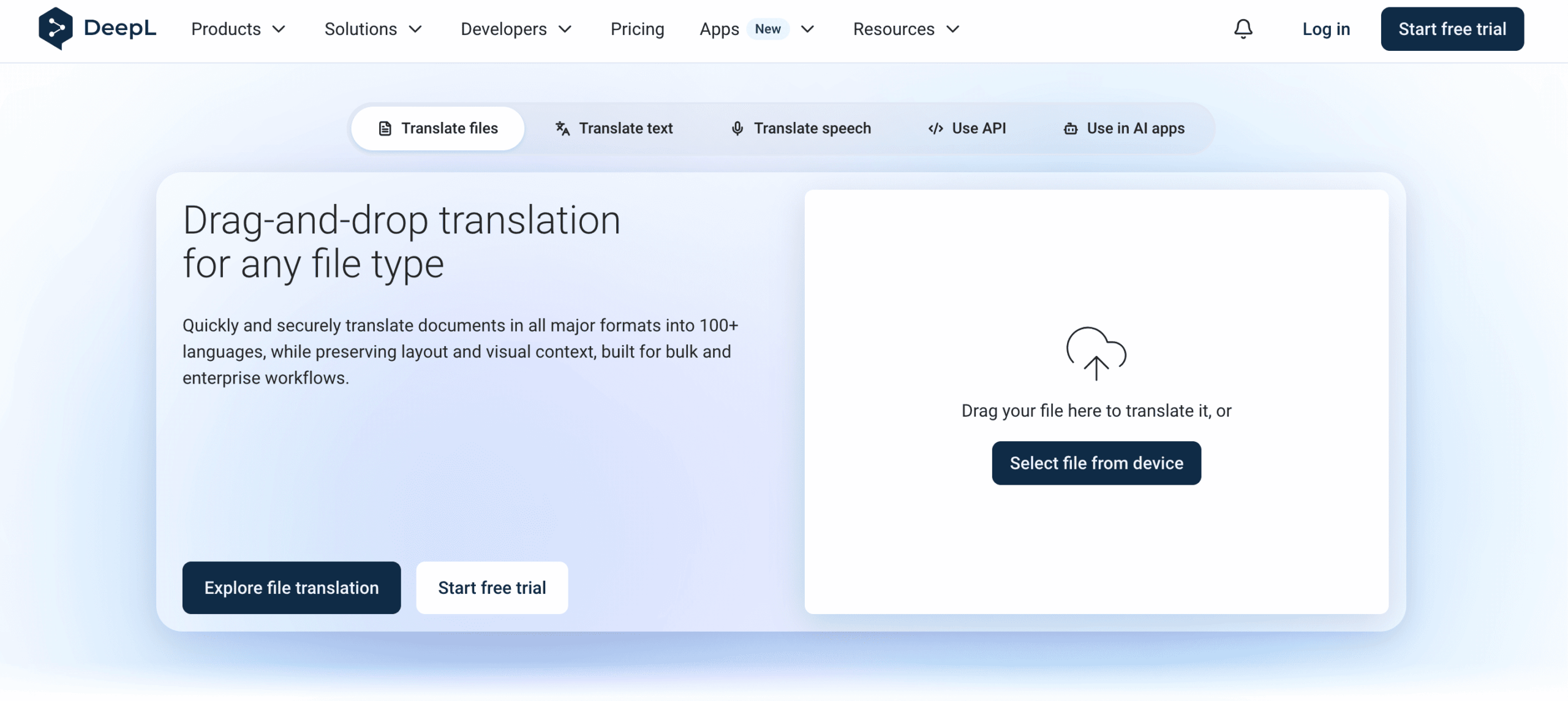
DeepL is one of Europe’s most commercially successful language AI companies. It grew out of a translation project in Cologne, built its reputation on translation quality, and spent years with a “fewer languages, better ones” pitch, until expanding between 2024 and 2026. Alongside translation, the platform covers Write for writing improvement, Voice for live meetings and face-to-face conversation, and DeepL Agent for autonomous workflows.
If your team translates contracts, localizes support replies, or runs meetings across languages, a general-purpose assistant is not the right tool for you.
DeepL Write Pro runs on the company’s own LLMs trained on its Mercury supercomputer, and its enterprise plans include data privacy guarantees needed for legal and regulated content.
What The Community Recommends
Beyond the four platforms above, Reddit communities consistently suggest a few more European options worth knowing:
- n8n (Germany): an open-source automation platform that is one of the most recommended tools in r/selfhosted and r/automation for building AI agent workflows without writing code.
- Black Forest Labs (Germany): the default recommendation in AI art communities for open-weight image generation.
- ElevenLabs (European founders): repeatedly mentioned in creator and developer communities as the leading choice for realistic voice synthesis and dubbing.
- Synthesia (UK): the go-to recommendation for AI video avatars in corporate training and L&D materials.
- Lovable (Sweden): frequently cited by non-technical founders in startup communities as the fastest way to build working web apps from prompts.
Choose The Right Tool For Your Needs
To decide which of the mentioned European AI alternatives fits your situation, here’s a comparison by use case:
| You need… | Best pick |
|---|---|
| A governed enterprise AI platform running entirely on EU-owned infrastructure, with custom agents, self-hosting, and full audit trails | Ajelix Enterprise |
| An agent with EU data residency, multilingual strength, and open-weight models you can self-host | Mistral Vibe |
| Absolute conversation privacy; an assistant that cannot read your chats even if it wanted to | Proton Lumo |
| High-quality translation, writing, and voice across 100+ languages for enterprise language workflows | DeepL |
| Other tools recommended by the community: | |
| Open-source workflow automation with a strong self-hosted community | n8n |
| Open-weight image generation models | Black Forest Labs |
| Realistic voice synthesis and dubbing for content and products | ElevenLabs |
| AI video avatars for corporate training and L&D content | Synthesia |
| Building working web apps from prompts without code | Lovable |
If governed and private AI is your priority, contact the Ajelix team.
FAQ
The current conversation centers around Mistral AI (France), DeepL (Germany), Aleph Alpha (Germany), Poolside AI (France), Helsing (Germany), Black Forest Labs (Germany), ElevenLabs (European founders), and Synthesia (UK). For enterprise AI platforms specifically, Ajelix (Latvia) and Mistral are the strongest European alternatives.
Mistral Vibe (EU data residency, on-premises deployment options, work and coding agent modes), Proton Lumo (zero-access encryption, no training on your data), and Ajelix (custom enterprise agents running on EU-owned infrastructure). The right choice depends on whether you need an everyday assistant, privacy architecture, or a governed enterprise platform.
On benchmark scores, US frontier models still lead most independent evaluations. But for everyday work tasks, document analysis, translation, and writing, European tools are competitive, and they win decisively on the questions that matter to European buyers: data residency, GDPR-native design, and legal jurisdiction.
Yes. Mistral is Europe’s leading frontier lab, releasing open-weight frontier-class models like Mistral Large 3 alongside commercial products.
It can be, depending on the architecture. EU jurisdiction avoids direct CLOUD Act exposure, but true privacy depends on what the vendor does with your data. Ajelix runs all inference on its own EU servers and sends nothing to external model providers. Proton encrypts chats so even it can’t read them. Make sure that you check each vendor’s privacy policy, not just their marketing page.
Agentic AI chat that helps you complete projects
AI for work that ingests, transforms, and delivers the exact deliverables your team needs, while you stay focused on strategy. No more chatting, agents can get the job done.