AI Agent for Marketing: Use Cases & Best Platforms
Marketing teams are being asked to do more with less – more campaigns, more channels, more personalization, and somehow faster than last quarter. The only way that math works in 2026 is if something else is doing the heavy lifting. That something is an AI agent for marketing – and this guide is your breakdown of what it actually is, which platforms are worth using, and and how to get real results from one.
Table of contents:
- What Is an AI Agent for Marketing?
- AI Agent vs. Traditional Marketing Automation
- Why AI Agents Are Reshaping Marketing in 2026
- Key AI Agent Use Cases in Marketing
4.1 Marketing Campaigns
4.2 Marketing Automation
4.3 Digital Marketing
4.4 Research for Marketing
4.5 Sales and Marketing - 8 Best AI Agent Platforms for Marketing (Reviewed)
- How to Use an AI Agent for Marketing: Step-by-Step
- Risks and Limitations to Know
- Final thoughts
- FAQ
What Is an AI Agent for Marketing?
An AI agent for marketing is an autonomous software system that can plan, execute, monitor, and optimize marketing tasks without needing step-by-step instructions from a human. Unlike a chatbot or a writing assistant, a marketing AI agent is given a goal, for example, “improve lead conversion from this landing page,” and it figures out how to get there on its own.
What does an AI Agent do?
It pulls data from multiple sources, figures out what to do with it, takes action – launching campaigns, adjusting budgets, generating content, building reports, and then uses the results to improve over time. That last part, the learning and adapting, is what makes it “agentic.”
In practical terms, an AI agent for marketing might:
- Analyze your campaign performance data and surface the three biggest drop-off points
- Generate a landing page variant based on your existing URL and brief
- Build an embeddable lead-gen calculator your team can ship today, with no code
- Compile a competitor research report with a SWOT analysis, ready for your Monday meeting
- Shift ad budget away from underperforming ad sets in real time
Author’s note: The first thing I noticed when teams start using AI agents for the first time is that they default to using them like a fancy search bar. They ask for information, get an answer, and stop there. “Research our top five competitors” gets you a pile of links. “Research our top five competitors and build a structured SWOT ready for our Monday meeting” gets you something you can actually use.
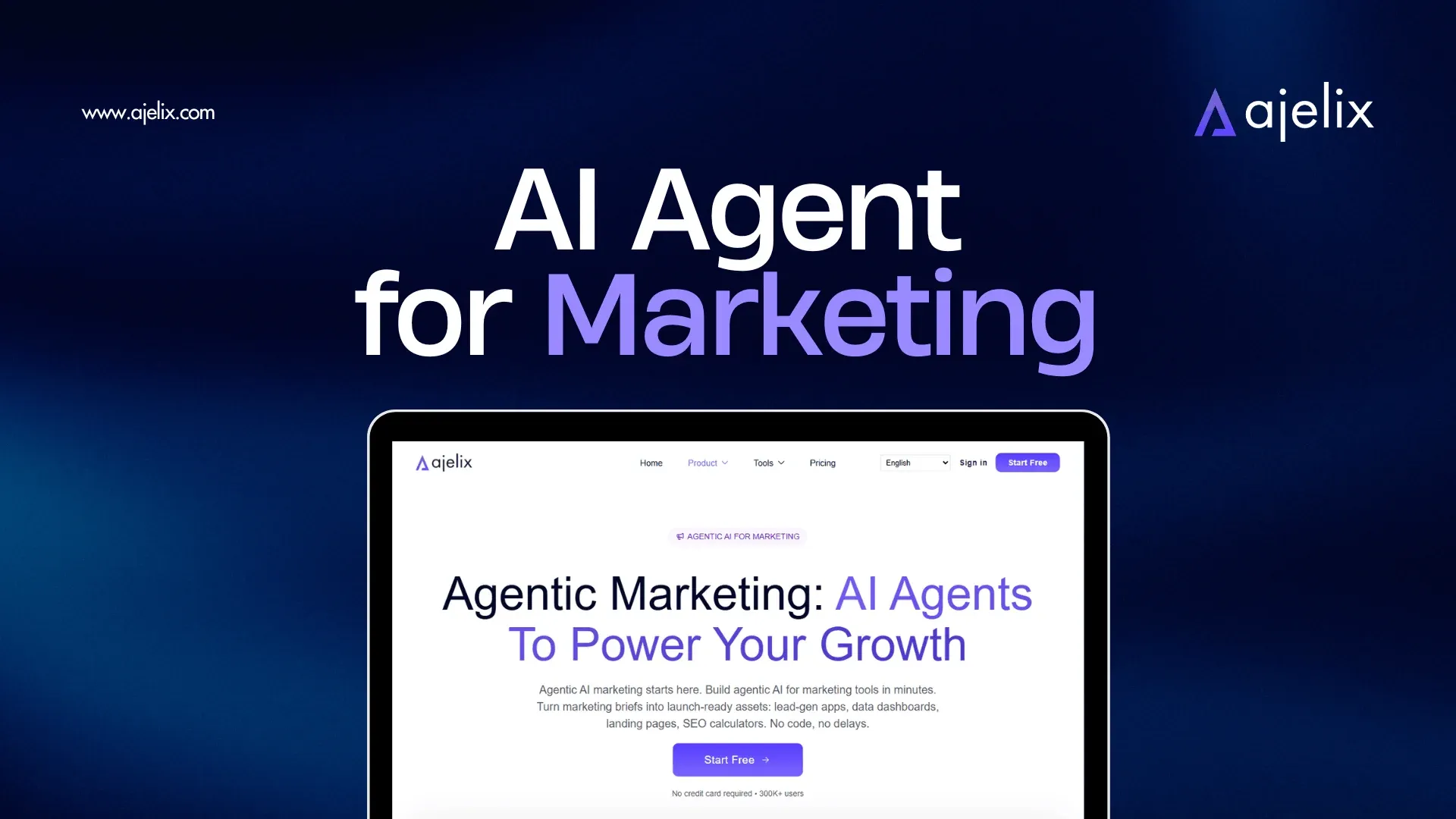
Want to see what that looks like in practice? Check out Ajelix Agentic Marketing – no developer, no designer, no lengthy onboarding required.
AI Agent vs. Traditional Marketing Automation
Before going further, it’s worth understanding what actually makes an AI agent different from the tools most marketing teams already use.
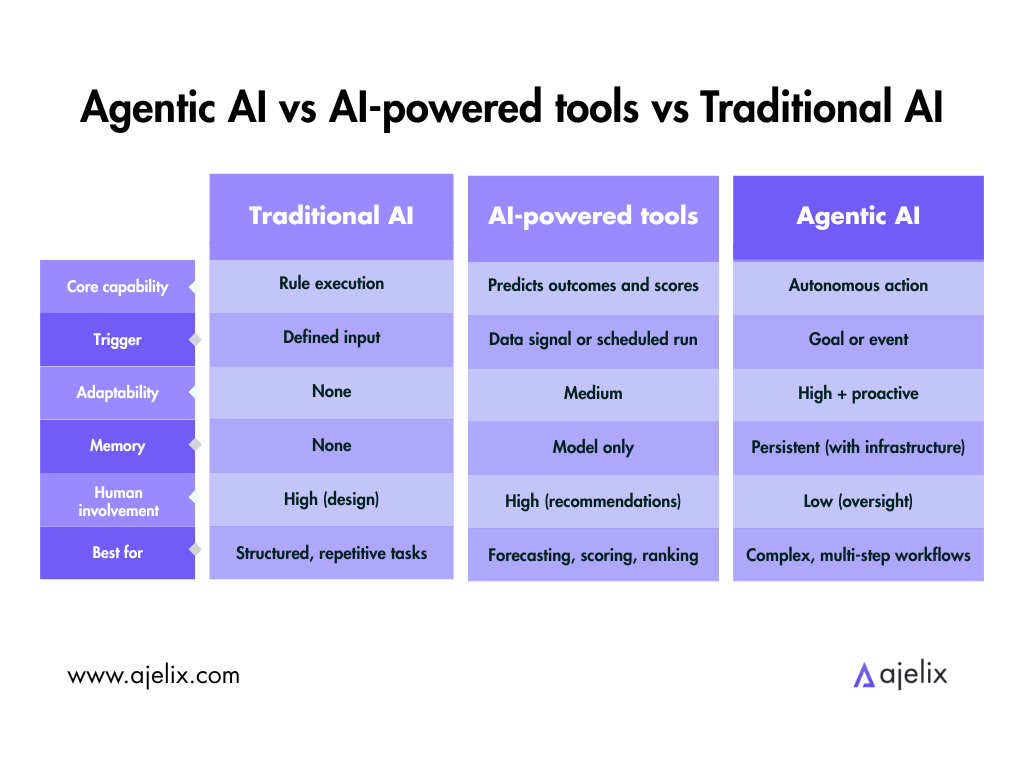
Most platforms that call themselves “AI marketing tools” today still operate in the middle column. They added a subject line optimizer or a send-time predictor on top of a rule-based workflow engine. That is better than nothing, but it is not agentic.
A true AI agent for marketing operates in the third column. You define the “destination”. It “plans the route, drives the car, and reroutes when traffic appears”, without you touching the “wheel”.
Ajelix is built on exactly this principle – you give it a brief, a URL, or a data file, and it handles everything from generation to deployment without you managing the steps in between.
Why AI Agents Are Reshaping Marketing in 2026?
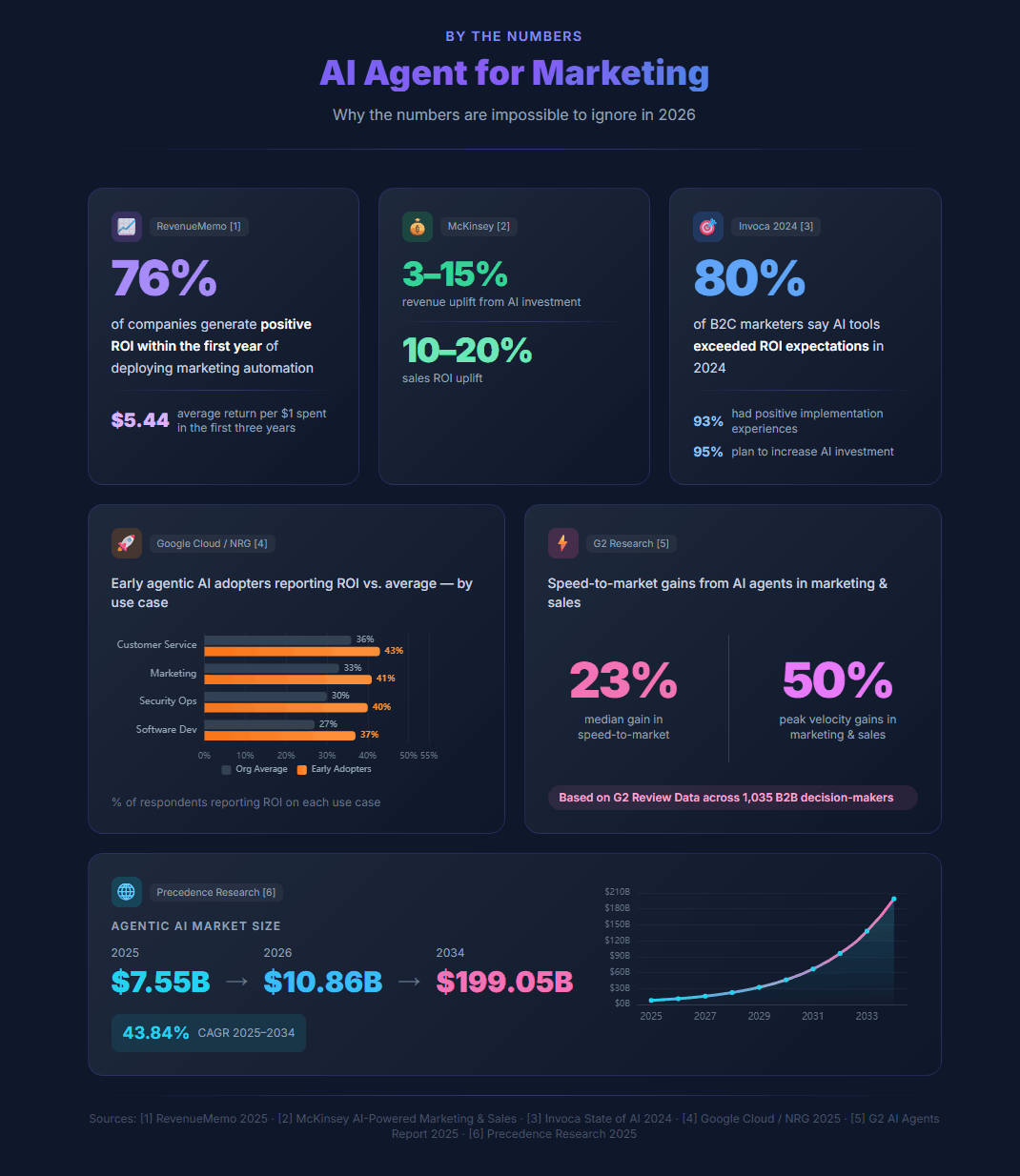
If this were just hype, we wouldn’t be talking about it. But the results coming out of marketing teams right now are hard to argue with.
These aren’t gains from carefully controlled pilots or vendor case studies written to make the numbers look good. They’re outcomes from teams that made a decision: stop treating AI as a helper and start treating it as an executor.
And honestly, the shift makes total sense when you think about what modern marketing actually demands. Customers want real-time responses. Content has to go out across five channels at once. Campaign strategy needs to react to live performance data, not last Tuesday’s report. No team, no matter how talented or how many people you hire, can operate at that speed manually. However, an AI agent for digital marketing can.
And that’s exactly the gap Ajelix was built to close – giving marketing teams of any size the output capacity of a team three times larger, without the headcount or the wait.
Key AI Agent Use Cases in Marketing
Marketing teams are finding that AI agents perform best when given well-defined tasks with clear outputs. The use cases below are where that approach is paying off most consistently right now.
Marketing Campaigns
If there’s one area where agentic AI makes the most immediate, obvious difference, it’s campaign management. Think about how much time your team currently spends building workflows, pulling dashboards, adjusting budgets, and writing yet another status update. A good AI agent for marketing campaigns takes all of that off the plate and manages the full campaign lifecycle from planning through post-campaign analysis.
What a campaign AI agent does:
- Plans multi-channel campaign structures across email, paid ads, social, and web
- Generates campaign assets including copy, subject lines, ad creatives, and landing pages from a brief
- Launches campaigns and monitors performance in real time
- Runs A/B tests autonomously and routes traffic toward winning variants
- Reallocates budget away from underperforming channels without waiting for a weekly review
- Forecasts performance and flags anomalies before they become expensive problems
McKinsey analysis found that some Fortune 250 companies have estimated campaign creation and execution is speeding up 15-fold, driven by faster innovation cycles and process optimization.
Most campaign teams aren’t slow because of bad strategy. They’re slow because getting assets built takes forever. Brief to design to revisions to “can you just move the logo a bit” eats days. Ajelix cuts all of that out. You put a brief in, you get a live, conversion-optimized landing page back in minutes.
Marketing Automation
Marketing automation is the most common starting point for teams getting into agentic AI, and honestly, it makes a lot of sense. The wins are fast, visible, and easy to measure.
Here’s the thing though. Traditional automation has always had a fundamental flaw: it’s only as smart as the rules you write for it. Lead fills out a form? They get sequence A. Visit pricing page? Sales gets pinged. It works right up until the moment conditions change, an edge case shows up, or your strategy evolves and the rules become obsolete. Then you’re back to manually patching workflows at 11pm.
An AI agent for marketing automation works differently:
- Dynamic audience segmentation continuously updates segments based on real-time behavioral signals, not static lists
- Lifecycle campaign orchestration decides which message, channel, and timing is right for each contact based on context, not pre-written logic
- Lead scoring that adapts re-scores leads as new signals come in, not just on the day they filled a form
- Email sequence personalization adjusts messaging mid-sequence based on engagement data
- Anomaly detection flags when open rates drop, conversion rates shift, or a campaign goes off-track, with a recommended action already attached
For teams that want to build custom automation agents without writing a single line of code, platforms like Ajelix give you an agentic workspace where you connect data sources, generate interactive reports, and build marketing tools that actually execute tasks from one place.
Digital Marketing
Digital marketing spans so many channels and data sources that realistically, no human team is watching everything at once. Something is always slipping through the cracks. An AI agent for digital marketing sits across your entire digital presence and fills those gaps.
SEO and Content Strategy
AI agents continuously analyze keyword performance, identify content gaps, adapt to algorithm changes, and generate optimized content at scale. They do not wait for your monthly SEO review. They flag opportunities and risks as they emerge, and in some workflows they generate the content brief, draft, and meta data in the same session.
Paid Media Optimization
Platforms like Markopolo AI’s Nucleus agent and Metadata.io autonomously allocate ad budgets across Meta, Google, TikTok, LinkedIn, and other platforms. They pause underperforming ad sets, increase spend on high-performers, and test creative variants without waiting for a human to pull a report.
Social Media Management
AI agents monitor engagement, schedule content at optimal times, identify trending topics relevant to your brand, and surface early signals of brand sentiment shifts before they escalate.
Conversion Rate Optimization
Agents analyze user behavior on your website, including heatmaps, scroll depth, and click paths, and generate variant hypotheses for testing. Some agents then implement and monitor those tests autonomously, closing the loop from insight to action without a developer in the middle.
Personalization at Scale
This is arguably the most impactful capability of an AI agent for digital marketing. McKinsey research shows that 71% of consumers expect companies to deliver personalized interactions, and 76% get frustrated when this does not happen. AI agents make this level of hyper-personalization accessible to teams of any size, by delivering the right content, offer, and channel experience to each individual without requiring a dedicated personalization team. Ajelix takes this further by letting you build personalized, interactive lead-gen tools and landing pages tailored to specific audience segments – generated from a brief, live in minutes, no development resources required.
Research for Marketing
This might be the most underrated use case on the entire list.
Think about how much time disappears every week just gathering information. Competitor research, audience insights, industry trend reports, content briefs, campaign performance summaries. Most marketing teams do all of this manually, inconsistently, and at a pace that means the insights are already half-stale by the time they land on someone’s desk.
Author’s note: Research is where I see the most dramatic before-and-after in practice. Before using an AI research agent, a competitive landscape document might take a team member two full days: pulling sources, reading, synthesizing, formatting. With the right agent setup, that same document is a 25-minute job. And the quality is often better, because the agent pulls from more sources than any one person would realistically read in a sitting.
An AI research agent for marketing fixes this completely.
Competitive Intelligence
Tools like AlphaSense, Crayon, and Relevance AI’s Market Research Agent continuously monitor competitor websites, press releases, product launches, and pricing changes. They deliver structured, source-linked briefings rather than raw data, so your team gets actionable intelligence, not a pile of links to read over the weekend.
Audience and Trend Analysis
AI research agents scan social media, news feeds, industry reports, and search trend data around the clock to identify emerging patterns before competitors act on them. According to Salesforce’s State of Sales report, 83% of sales teams using AI saw revenue growth compared to 66% of teams without AI – a gap that points, in part, to faster and better-informed decision-making.
Content Research
Rather than having a content team spend days researching a topic, an AI research agent can pull relevant data, synthesize it into a structured brief, identify semantic keyword opportunities, and produce a first draft, all in a single session. What used to take three days takes thirty minutes. Ajelix’s research capability is built for exactly this workflow – give it a topic, a competitor URL, or a campaign brief, and it returns a structured, complete output rather than a wall of raw information for someone else to process.
Campaign Performance Analysis
Upload your campaign data, whether that is a CSV, a spreadsheet, or a PDF, and an AI research agent surfaces trends, identifies anomalies, and generates a performance summary ready for stakeholder review. Ajelix’s agentic research capability is built exactly for this: upload a document or a URL and the agent builds deliverables, not just answers.
Sales and Marketing
The boundary between sales and marketing has always been where revenue is either won or lost. AI agents are increasingly being deployed across the full go-to-market workflow, not just inside one team’s silo.
Lead Generation and Qualification
An AI agent for sales and marketing can score and qualify inbound leads the moment they arrive, based on behavioral signals, firmographic data, and intent indicators, rather than waiting for a human SDR to work through a CRM queue on Monday morning.
Outreach Personalization
Agents analyze each prospect’s digital footprint and craft personalized outreach sequences that reference their specific context. According to Landbase’s 2025 GTM research Recent research shows that sales teams using AI-powered follow-ups see up to 83% higher revenue, driven by better timing and personalization.
Before AI agents can personalize outbound sequences at scale, teams need reliable prospect data, which is why choosing the best email scraping tools is often a key first step in building accurate lead lists.
Pipeline and Forecast Accuracy
AI agents applied to pipeline monitoring replace the static weekly review cycle with continuous deal intelligence, flagging at-risk opportunities as signals emerge rather than after the damage is done. McKinsey research links AI investment in sales workflows to a 10 to 20% sales ROI uplift, with forecast accuracy improvements cited as a primary driver.
Marketing-to-Sales Handoff
AI agents monitor when a lead’s behavior signals purchase intent and automatically trigger a sales notification, enroll the lead in a targeted sequence, or update the CRM record, ensuring hot leads are never sitting cold in a queue.
Revenue Attribution
Agents analyze the full customer journey across marketing touchpoints and sales interactions to surface which activities are genuinely driving revenue. This gives both teams a shared, accurate view of what is working, which makes budget allocation conversations much less political and much more data-driven.
8 Best AI Agent Platforms for Marketing (Reviewed)
There is no single best answer when it comes to top AI agent platforms for marketing. The right platform depends on your team size, primary use case, and existing tech stack. Here is an honest overview of the leading options in 2026.
1. Ajelix
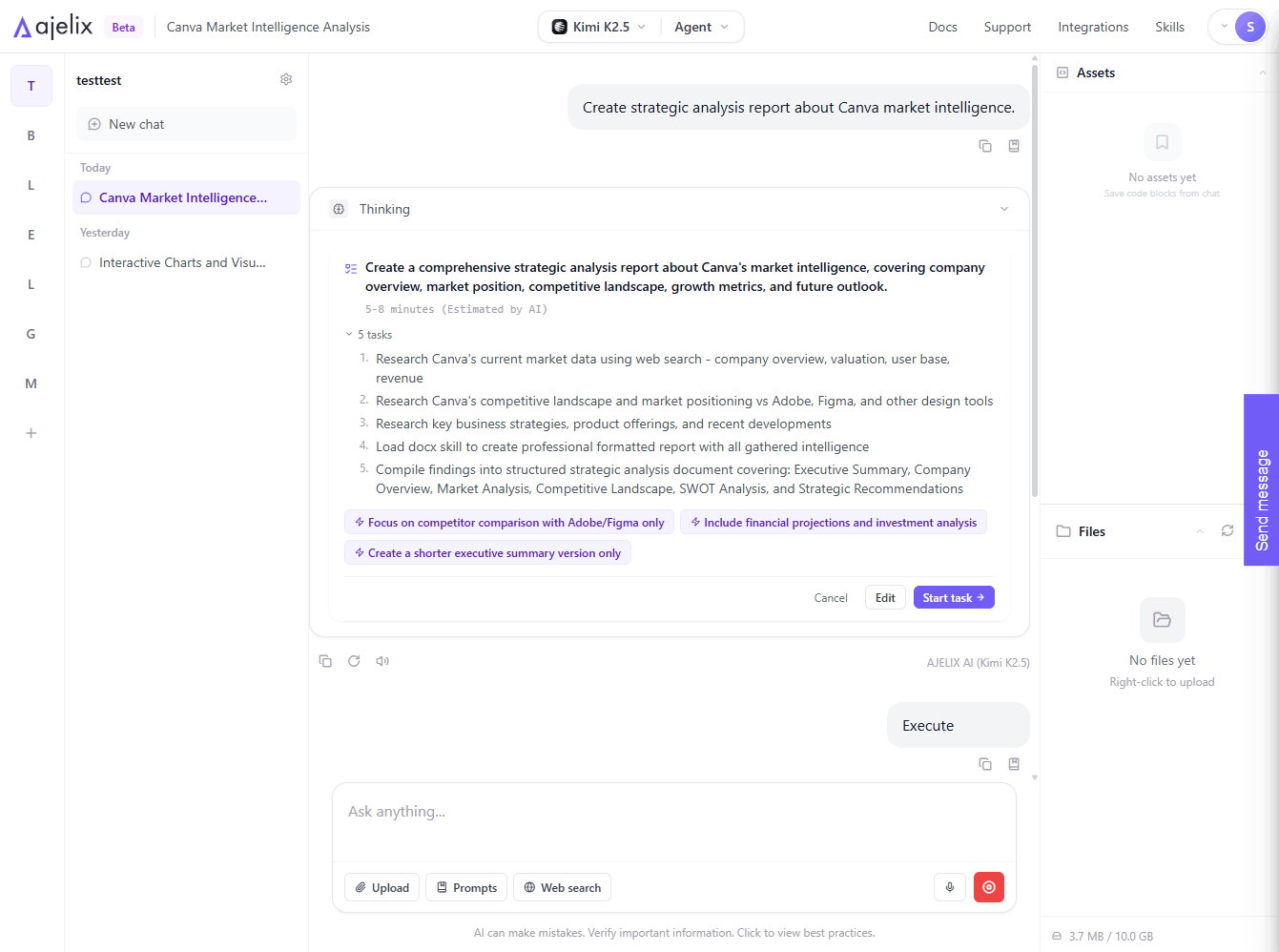
Best for: Marketing teams that need to ship production-ready assets fast, including landing pages, lead-gen apps, dashboards, reports, and presentations, without code or a design queue.
What makes it different: Ajelix is an agentic AI workspace, not just a content tool. Its Agentic Marketing capability lets you turn a brief, a URL, or a data file into a complete, deployable marketing asset. Generate a conversion-optimized landing page from a single prompt. Upload campaign performance data and get an interactive dashboard ready for stakeholder review. Build an embeddable lead-gen calculator your team can ship today.
If you are looking for the best AI agent for marketing in terms of speed from brief to live asset, this is where Ajelix stands out. Most teams see their first production-ready output within minutes of starting a session.
Key capabilities:
- Generate landing pages from briefs or existing URLs
- Build interactive lead-gen apps and calculators with no code
- Create marketing reports and dashboards from uploaded data files (CSV, PDF, spreadsheets)
- Perform end-to-end market research and competitor analysis
- Generate campaign slides and presentations from a prompt
- Trusted by 300,000+ professionals worldwide
2. HubSpot Breeze AI
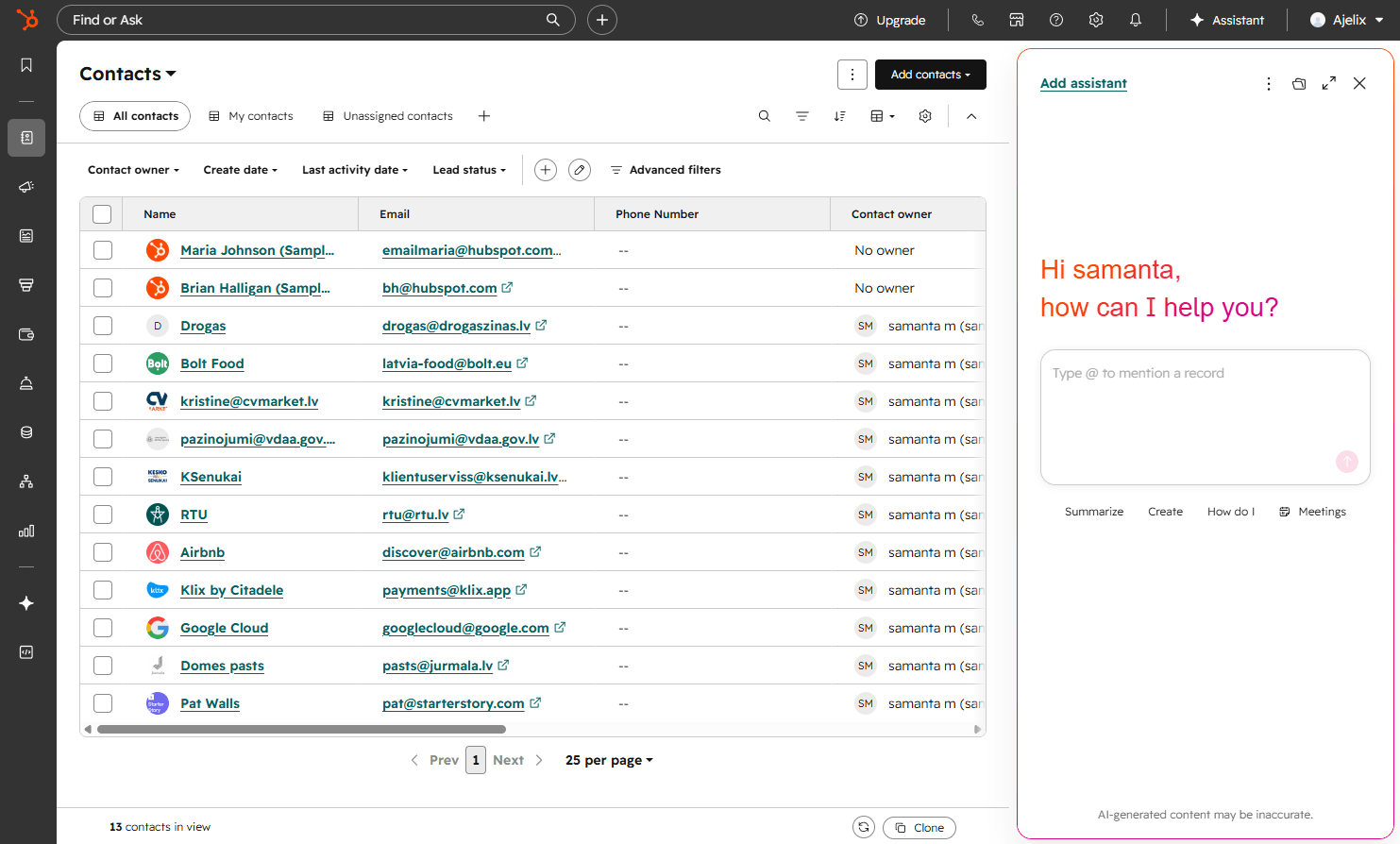
Best for: Mid-market companies that want agentic AI embedded inside their existing CRM and marketing platform.
What makes it different: HubSpot unified all its AI capabilities under the Breeze brand in September 2024, consisting of Breeze Copilot, Breeze Agents, and Breeze Intelligence. Every agent has access to the full CRM contact and company history, which means personalization is grounded in real customer data.
Key capabilities:
- Specialized agents for content, prospecting, and customer intelligence
- Predictive lead scoring and send-time optimization
- AI content assistant for emails, blog posts, and social updates
- Deep CRM integration so agents have full customer context
Limitation: Breeze AI’s most capable features are gated behind HubSpot’s Professional and Enterprise tiers, which carry significant licensing cost. Teams not already on HubSpot face both a migration project and a learning curve before capturing any agentic value.
3. Salesforce Agentforce
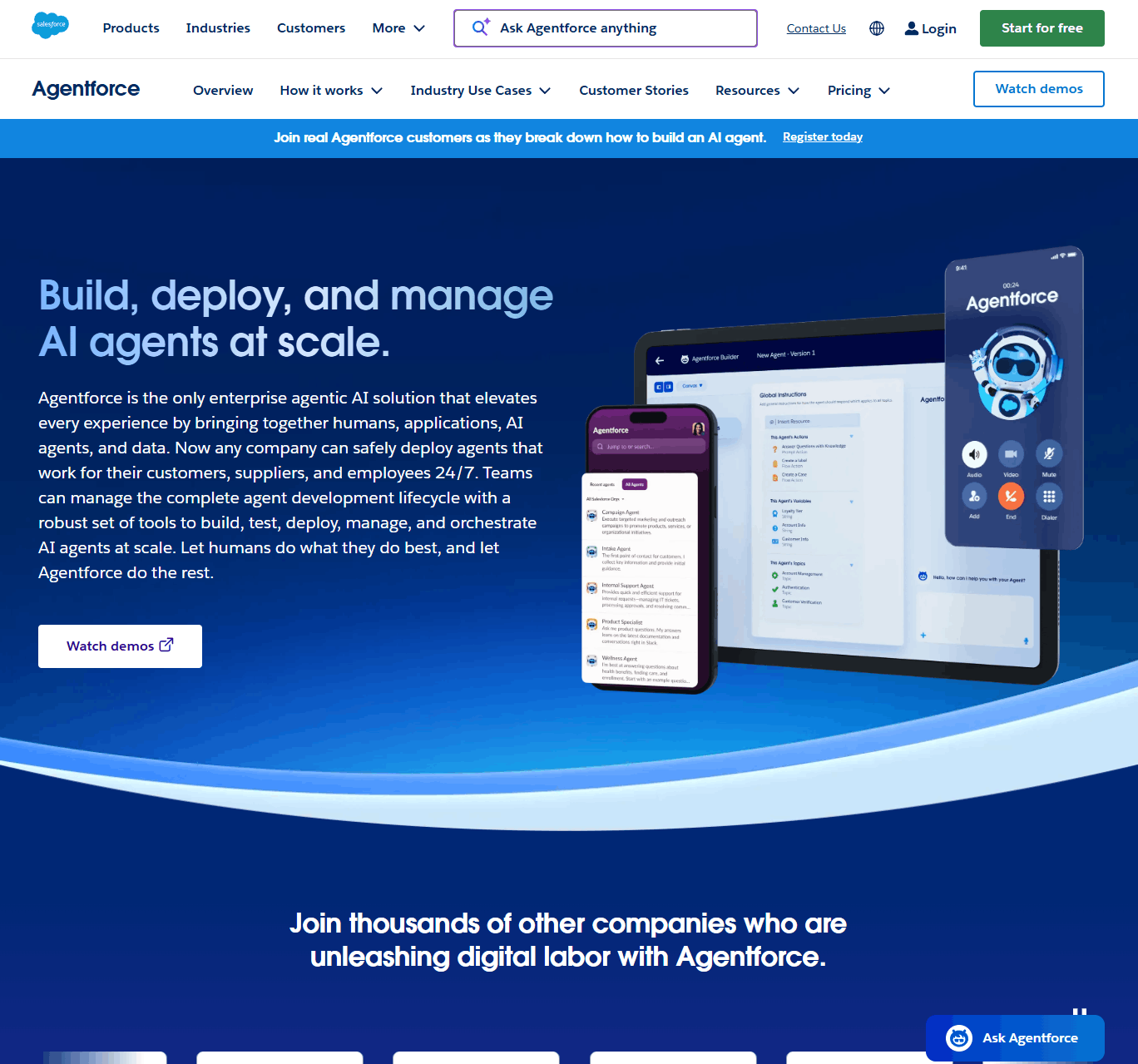
Best for: Large enterprises with complex, multi-channel campaign operations and a Salesforce-centric stack.
What makes it different: Agentforce, launched in late 2024, allows businesses to build and deploy AI agents across sales, service, and marketing using a no-code Agent Builder. Agents operate within defined roles, data access levels, and guardrails. For marketing teams on Salesforce Marketing Cloud, Agentforce integrates with Einstein AI for predictive scoring, journey optimization, and personalized content delivery at scale, all drawing on unified customer profiles from Salesforce Data Cloud.
Key capabilities:
- Predictive scoring via Einstein AI
- Autonomous campaign planning and personalization
- Cross-channel execution with deep CRM integration
- Strong governance and compliance controls
Limitation: Implementation complexity is high and cost is significant. Most organizations need Salesforce consulting partners to deploy Agentforce effectively, adding both budget and timeline. Agentforce is also priced partly per conversation at scale, making total cost of ownership difficult to predict.
4. ActiveCampaign with Active Intelligence
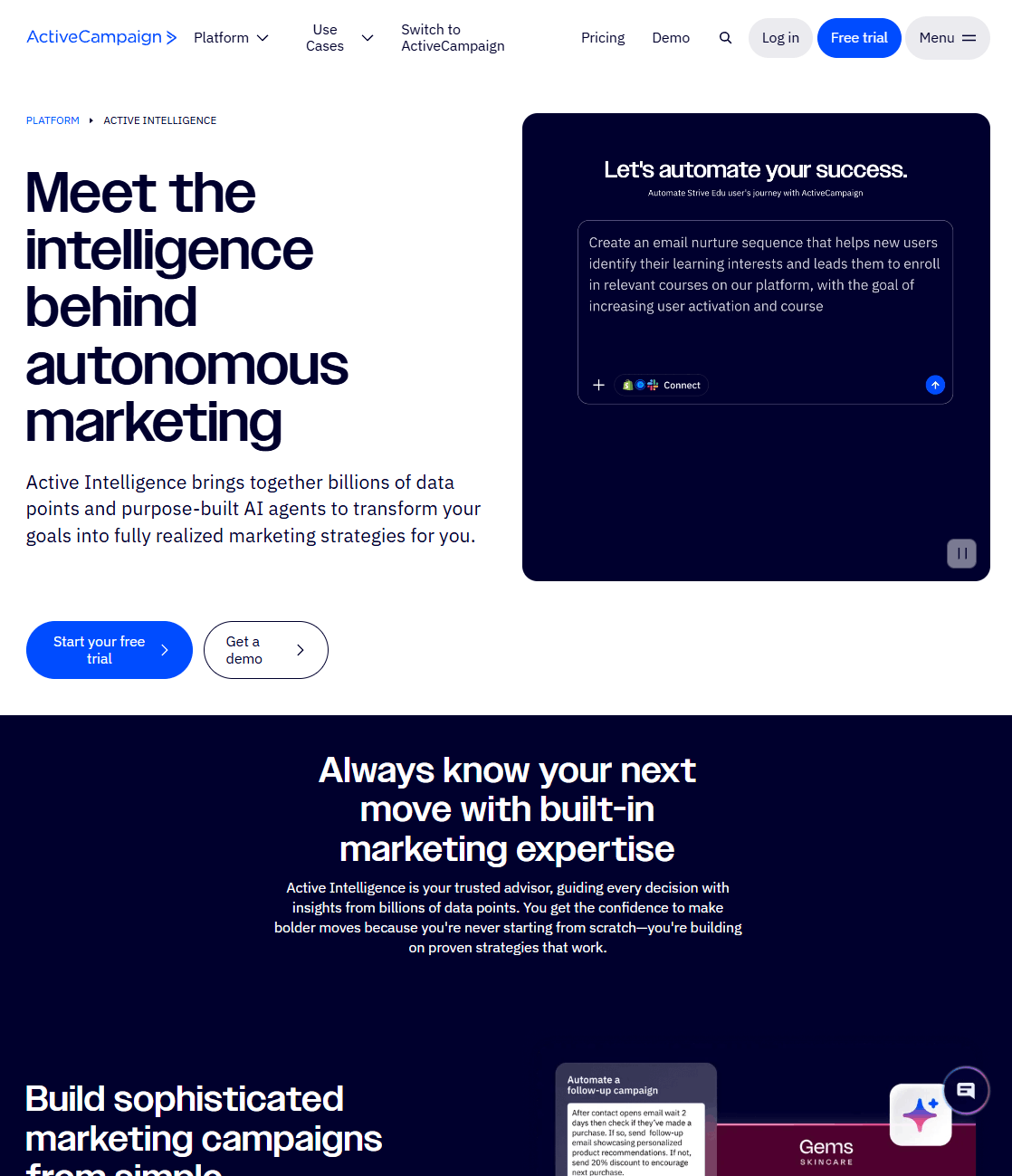
Best for: SMBs and mid-market teams focused on email and lifecycle automation with agentic AI layered on top.
What makes it different: ActiveCampaign has invested in AI across its automation platform for several years, with Active Intelligence representing its current generation. The platform manages the customer journey from first contact through retention, providing AI-generated automation suggestions based on your existing data, predictive content that selects the best email variant per contact, and segmentation that continuously updates based on behavioral signals.
Key capabilities:
- Multiple specialized AI agents handling different marketing tasks simultaneously
- Behavioral segmentation and personalized messaging
- Autonomous email optimization including subject lines and send timing
- Multi-step workflow orchestration
Limitation: Outside of email and SMS, multichannel capabilities are limited compared to enterprise-tier platforms. Reporting is functional but not deep.
5. Markopolo AI
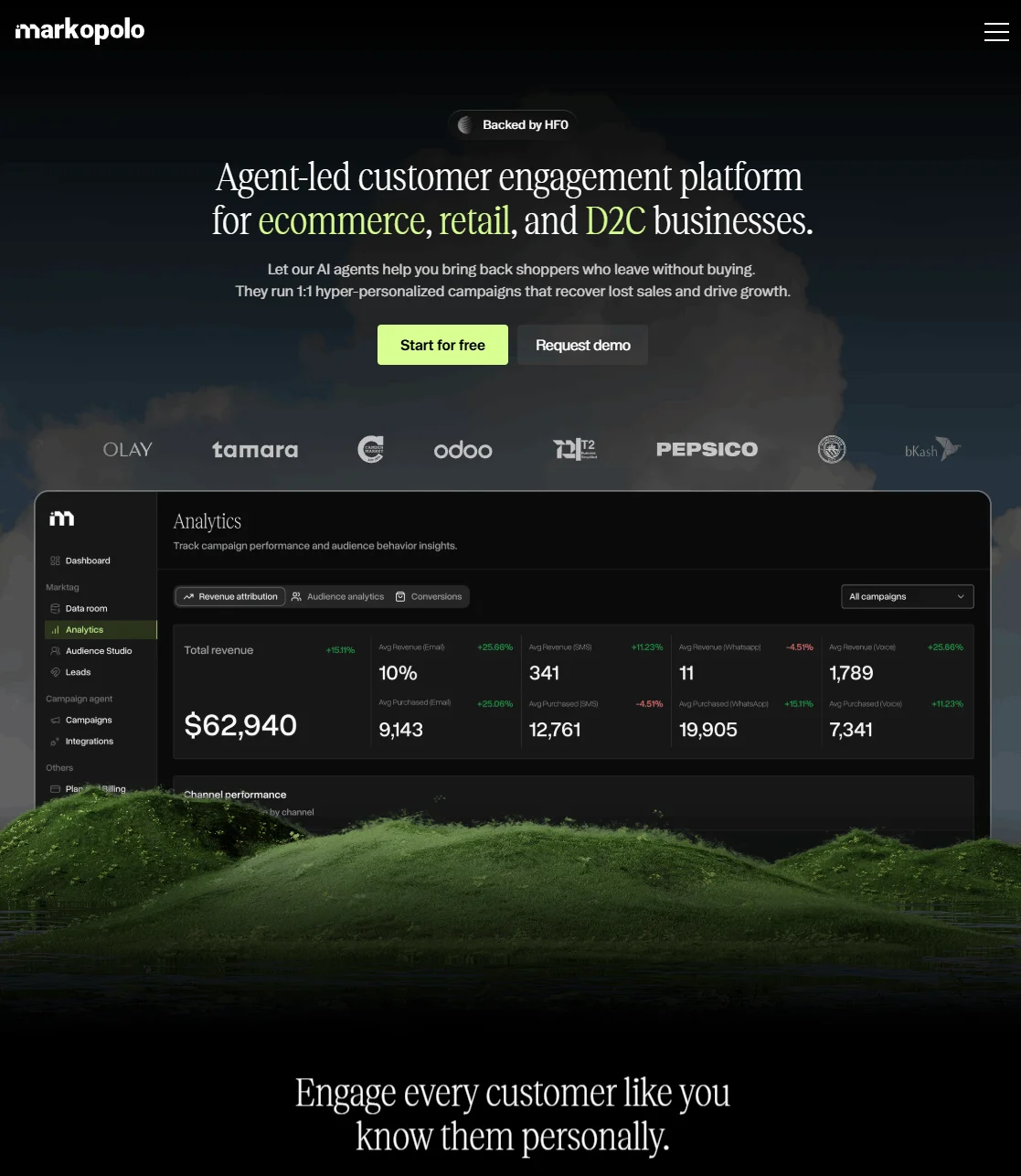
Best for: Teams running significant paid ad budgets across Meta, Google, and TikTok who want autonomous budget optimization. For those specifically searching for the best AI agent for marketing campaigns in paid media, Markopolo is worth a close look.
What makes it different: Markopolo’s Nucleus AI agent is its core product – an autonomous system that monitors paid campaign performance in real time and reallocates budget to best-performing ad sets without manual intervention. It handles creative rotation, audience testing, and cross-platform reporting from a unified dashboard.
Key capabilities:
- Nucleus AI agent autonomously allocates budget to best-performing ads
- Cross-platform campaign management from a single interface
- Autonomous A/B testing and creative rotation
Limitation: Markopolo is a single-purpose paid media tool. It does not handle content creation, landing pages, email automation, or research workflows. Smaller budgets may not generate enough data signal for the Nucleus agent to optimize meaningfully
6. Metadata.io
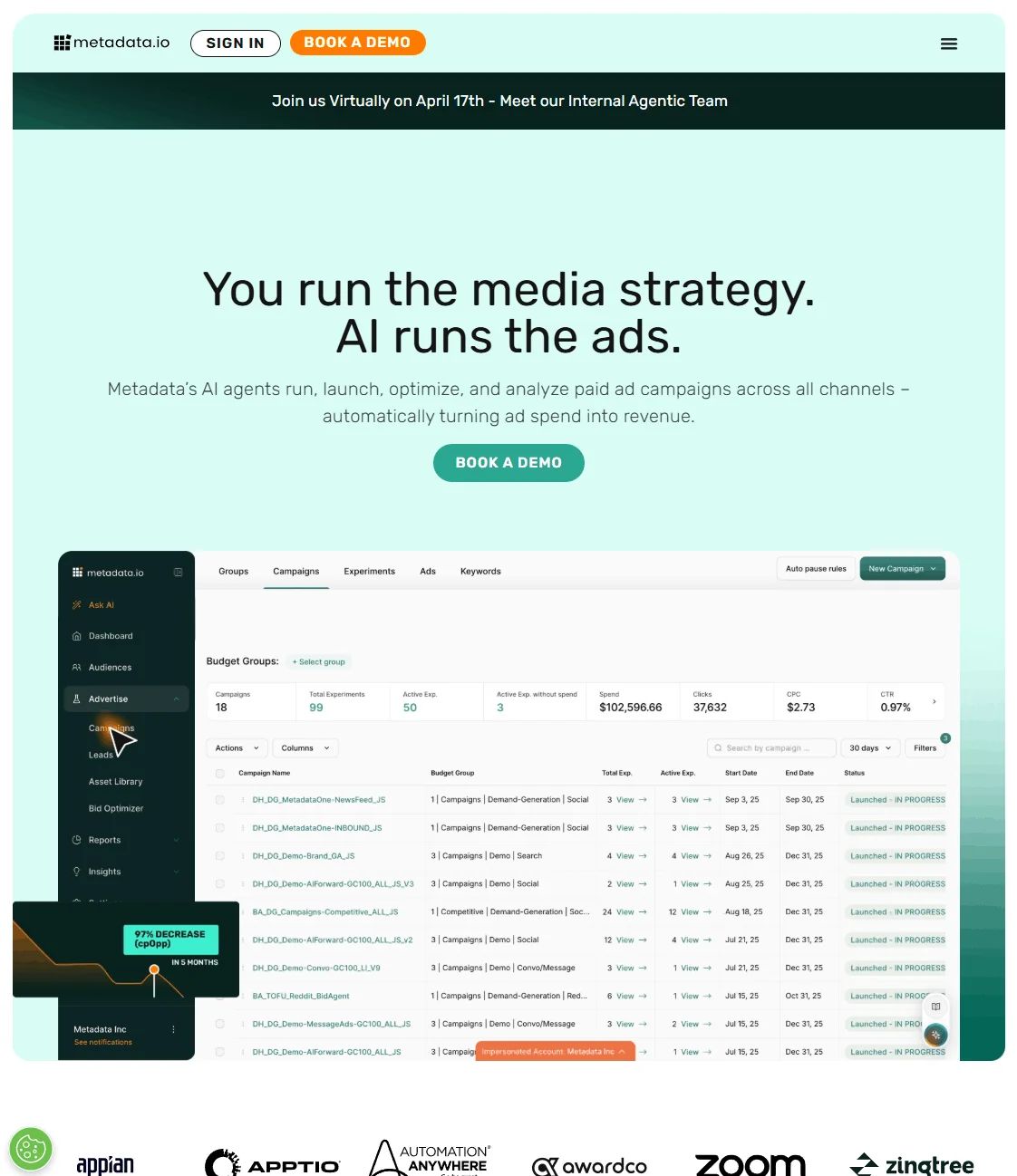
Best for: B2B marketing teams with a high emphasis on paid media, LinkedIn advertising, and pipeline generation.
What makes it different: Metadata focuses specifically on B2B demand generation, with particular depth in LinkedIn advertising and paid social. Its Bid Agent and Analyst Agent optimize targeting, bidding, and creative in real time, while the audience intelligence layer builds and tests audiences autonomously using intent data and firmographic signals.
Key capabilities:
- Bid Agent and Analyst Agent for real-time optimization
- Cross-channel paid campaign execution and unified reporting
- Audience targeting and experimentation tools
Limitation: Metadata is built for B2B teams with significant paid budgets and is largely irrelevant for B2C or organic-first strategies. Initial setup requires technical expertise and clean CRM data to connect correctly. Pricing reflects its enterprise positioning and is not accessible for smaller teams.
7. Relevance AI
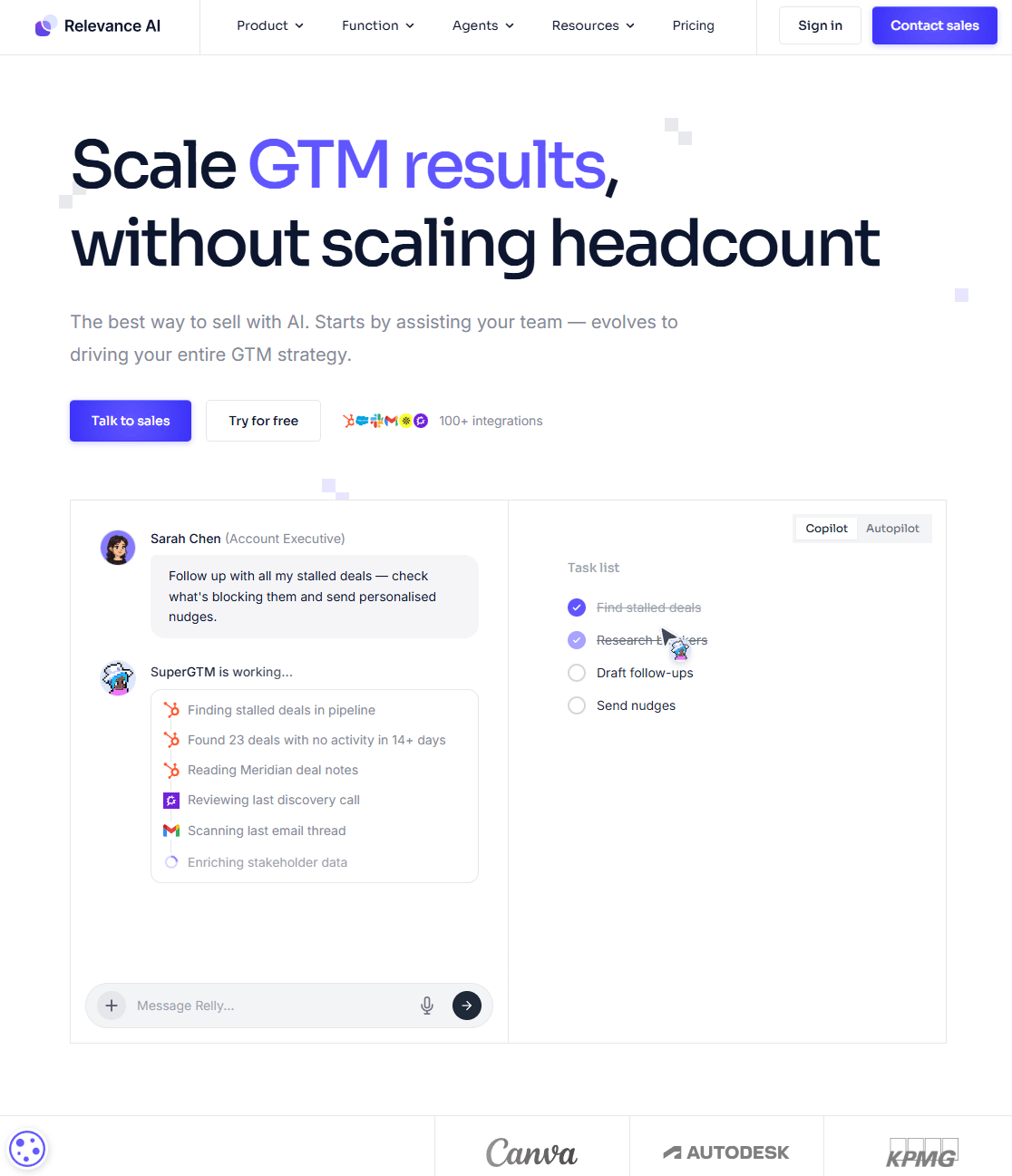
Best for: Marketing operations teams that want to build their own AI agents for specific workflows without writing code.
What makes it different: Relevance AI rather than offering pre-built marketing agents, provides a no-code environment for building your own. Teams can create custom agents tailored to their specific workflows.
Key capabilities:
- No-code agent builder with drag-and-drop interface
- Pre-built templates for market research, competitor analysis, and content workflows
- Multi-agent orchestration for complex marketing workflows
Limitation: Building effective agents requires significant upfront thinking about workflow design, data inputs, and output formats. There is a real configuration investment before seeing any value. Teams without a dedicated marketing ops function will find the setup time-consuming and the learning curve steep.
8. Creatio
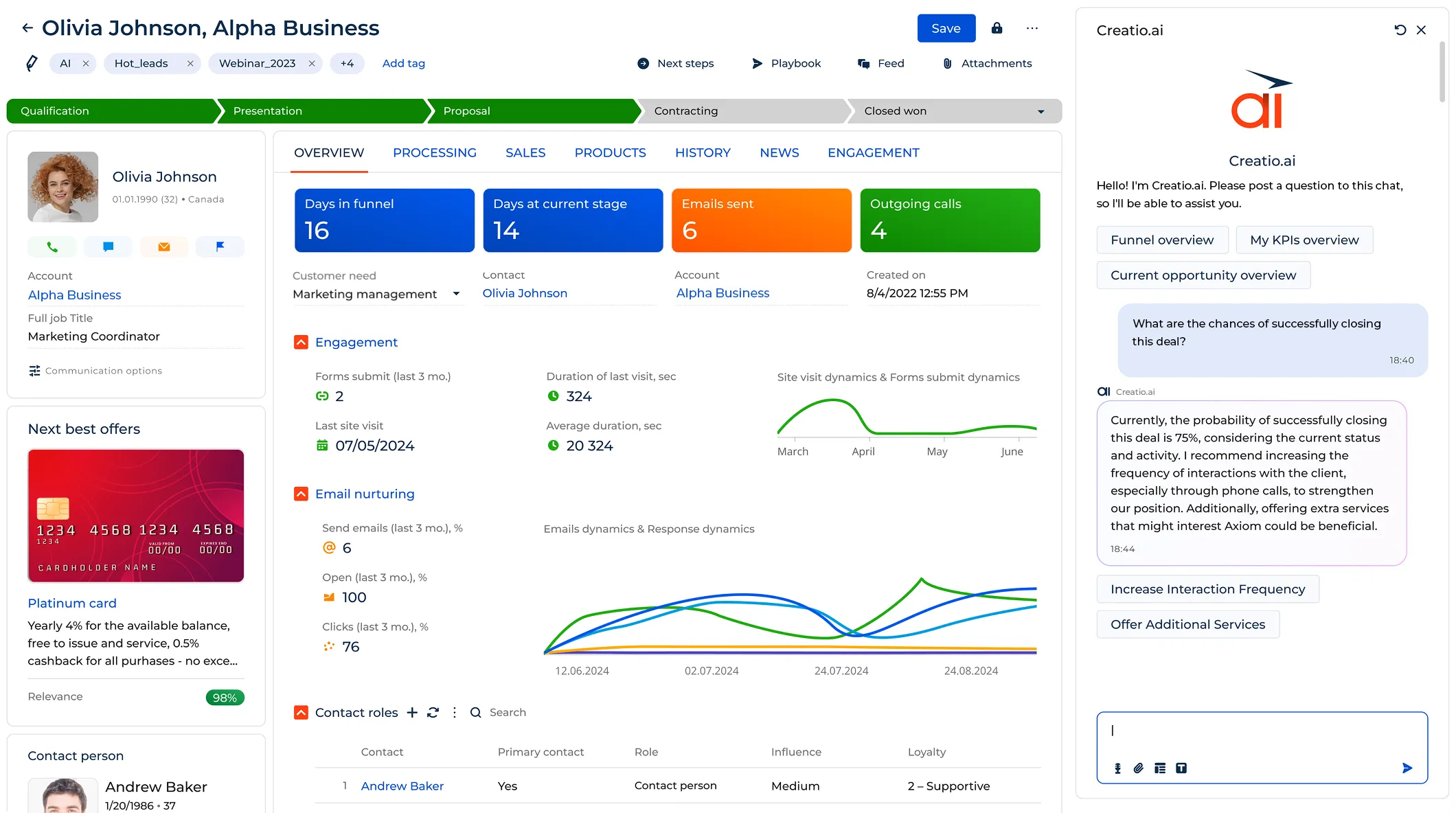
Best for: Mid-market and enterprise teams that want AI agents executing marketing work inside the same system as their CRM data and workflows, rather than bolted on beside it.
What makes it different: Unlike most tools here, Creatio isn’t a standalone marketing agent – it’s a CRM and workflow platform where marketing, sales, and service run on one data model. Agents act with full context on the customer record – campaign history, engagement signals, lifecycle stage – rather than on data synced in from another tool. Its marketing agents handle content, email, campaign orchestration, lead scoring, and lead distribution, and are model-agnostic: they can run on OpenAI, Anthropic, or Google models, or your own.
Key capabilities:
- Marketing agents for content, email, campaign orchestration, lead scoring, and lead distribution
- Continuous 360° profile enrichment and behavioral segmentation, plus no-code builders for landing pages, workflows, and custom agents
- Multi-channel execution across email, SMS, and digital ads with real-time performance measurement
- Governance layer with per-workflow autonomy limits, approval checkpoints, and audit logging
Limitation: Creatio is a full platform rather than a single-purpose tool, and the marketing product runs on top of the core platform instead of being bought standalone – teams that only want paid media optimization or a lightweight email tool will find it heavier than they need. Advanced customization also assumes someone on the team is comfortable working in a no-code environment.
How to Use an AI Agent for Marketing
Knowing the platforms is the easy part. Actually deploying an AI agent for marketing in a way that delivers results is where most teams struggle. Here’s the framework that consistently works.
Step 1: Define a Specific Goal, Not a Broad Task
The most common mistake teams make when getting started with AI agents is being too vague. “Improve our marketing” is not a goal an AI agent can act on. “Reduce our landing page bounce rate by 15% over the next 30 days” is.
Start with one high-impact, measurable objective. Good starting points include:
- Lower cost per lead on a specific paid campaign
- Increase email open rates for a nurture sequence
- Reduce time to produce a monthly campaign performance report
- Generate a qualified lead-capture tool for a new campaign
Pick one. Nail it. Then expand. If you are not sure where to start, Ajelix is a low-risk, high-speed first deployment – define a single campaign asset, hand it to Ajelix, and you will have a production-ready output before the end of the day.
Step 2: Connect and Unify Your Data
An AI agent is only as good as the data it has access to. Before deploying any agent, audit your data landscape:
- Where does your customer data live? (CRM, CDP, email platform, ad platform)
- Is it structured and consistently labeled?
- Are there silos between marketing, sales, and customer success data?
The agent needs a complete view of the customer journey to make good decisions. Half the data means half the value. Connect your CRM, analytics tools, ad platforms, and any other relevant data sources before you expect the agent to produce meaningful results.
Step 3: Set Guardrails and Define Success
AI agents operate within constraints you define. Be explicit about:
- Brand voice and messaging standards: what tone is acceptable, what language is off-limits
- Budget limits: maximum daily or campaign spend the agent can allocate
- Channel preferences: which platforms are in scope
- Compliance rules: GDPR, CAN-SPAM, and any industry-specific regulations
- Approval checkpoints: which decisions require human sign-off before execution
This is not about limiting the agent. It is about making sure it operates safely within your strategy, which is what allows you to trust it with increasingly autonomous decisions over time. G2’s 2025 AI Agents Insights Report found that human-in-the-loop strategies are twice as likely to yield 75% or higher cost savings compared to fully autonomous deployments.
Step 4: Start with One Workflow and Execute It Fully
Choose your target workflow and run it end-to-end with the agent. If you are starting with campaign asset creation using Ajelix as an example:
- Upload your campaign brief or an existing landing page URL
- Let the agent generate a conversion-optimized landing page variant
- Review the output, make strategic adjustments, and deploy
- Connect performance data back to the agent for ongoing optimization
Do not try to automate ten workflows simultaneously in week one. A single workflow executed well builds the confidence and process knowledge you need to scale effectively.
Step 5: Close the Feedback Loop
This is the step most teams miss, and it is what separates agentic AI from simple automation. Campaign results must flow back to the AI agent in real time, not in a weekly export.
When the feedback loop is closed, the agent learns from every interaction. Open rates, click-through rates, conversion events, and revenue attribution all become training signal that makes the agent smarter with each campaign cycle.
If your data is locked in a warehouse and takes 48 hours to surface, the agent is optimizing on yesterday’s reality. Real-time data flow is not optional for agentic marketing to work.
Step 6: Monitor, Evaluate, and Expand
Once your first workflow is running, establish a regular review rhythm. Not to micromanage the agent, but to evaluate whether its decisions align with your strategy and to course-correct when they do not.
G2‘s research shows the median time to first meaningful outcome for AI agents is six months or less. As confidence builds, expand to additional workflows:
- Add an AI research agent for competitive intelligence
- Add an analytics agent for automated campaign reporting
- Build a lead-gen app that the agent iterates on based on live conversion data
The goal is progressive automation. Each workflow you hand off to an agent frees human bandwidth for the creative and strategic work that still requires human judgment.
Risks and Limitations to Know
AI agents for marketing are powerful, but they are not perfect. Honest evaluation requires acknowledging the real risks.
Brand consistency risk
An AI agent generating content at scale can drift from your brand voice if guardrails are not tightly defined. Review outputs regularly, especially early in deployment.
Data quality dependency
Garbage in, garbage out. If your customer data is fragmented, mislabeled, or incomplete, the agent’s decisions will reflect that. Data quality work is a prerequisite, not an afterthought.
Over-automation
Not every marketing decision should be automated. Creative strategy, emotional storytelling, and high-stakes campaign positioning still require human judgment. The best results come from human-AI collaboration, not full delegation – and the data backs this up. G2 found that agent programs with a human in the loop were twice as likely to deliver cost savings of 75% or more compared to fully autonomous approaches.
Compliance exposure
AI agents sending emails, running ads, or personalizing content at scale must operate within GDPR, CAN-SPAM, and any sector-specific regulations. Ensure your platform has built-in compliance controls.
Hallucination risk
Generative AI components within agents can produce inaccurate information. According to Fullview’s AI statistics roundup, 77% of businesses express concern about AI hallucinations, and 47% of enterprise AI users admitted to making at least one major business decision based on hallucinated content in 2024. Human review checkpoints for agent-generated outputs in customer-facing content are essential.
Unrealistic timelines
For mid-market companies, 18 to 24 months is a realistic window to reach strongly positive ROI at scale across complex, enterprise-wide deployments. Vendors citing immediate 500% ROI are typically referring to specific, isolated use cases. Set realistic expectations internally.
Final Thoughts
The shift from marketing automation to agentic AI is not a software upgrade. It is a change in how marketing teams operate.
Traditional marketing tools automated the easy part, the send, the post, the report. The hard part, the thinking, the deciding, the adapting, was always left to you. An AI agent for marketing is now capable of handling that hard part, within guardrails you set, while freeing your team to focus on strategy, creativity, and the decisions that genuinely require human judgment.
The evidence is clear. Companies deploying the best AI agent for marketing are seeing faster campaigns, lower costs, higher conversion rates, and measurable revenue growth. The market is moving at 43.84% CAGR, and the gap between early adopters and everyone else is widening every quarter.
Whether your need is an AI agent for marketing campaigns, an AI research agent for marketing intelligence, an AI agent for sales and marketing alignment, or a more reliable AI agent for digital marketing in general, the practical starting point is the same: pick your single biggest bottleneck and deploy an agent to solve it.
If that bottleneck is the time it takes to go from brief to live marketing asset, Ajelix Agentic Marketing is the fastest path from zero to results. No code, no design queue, no waiting. Just production-ready marketing output in minutes.

FAQ
There is no single best AI agent for marketing because it depends on your primary need. Ajelix is the best choice for marketing asset creation including landing pages, lead-gen tools, dashboards, and reports. Mid-market teams focused on CRM-integrated lifecycle marketing will find HubSpot Breeze AI the strongest fit. Salesforce Agentforce is the go-to for enterprise campaign management, while Markopolo AI and Metadata.io lead on paid media optimization. Creatio fits mid-market and enterprise teams that want agents executing marketing work inside the same platform as their CRM data and workflows, with no-code customization.
For end-to-end campaign execution including asset creation, Ajelix’s agentic marketing capability delivers the fastest time-to-asset. For autonomous paid campaign optimization, Markopolo AI’s Nucleus agent is purpose-built for that specific use case. The best AI agent for marketing campaigns ultimately depends on whether your bottleneck is on the creation side or the optimization side.
The top AI agent platforms for marketing in 2026 include Ajelix for asset creation, HubSpot Breeze AI for lifecycle marketing, Salesforce Agentforce for enterprise, ActiveCampaign for SMB automation, Markopolo AI for paid media, Metadata.io for B2B demand generation, Relevance AI for building custom agents and Creatio for teams that want marketing agents running on the same platform as their CRM data and workflows.
A chatbot responds to prompts. An AI assistant helps you complete a task. An AI agent executes the full workflow autonomously. It plans, acts, monitors results, adapts, and reports back. The key difference is autonomous, multi-step execution rather than single-turn assistance.
Yes. Most modern platforms, including Ajelix, are no-code or low-code and designed for marketing teams rather than developers. The most reliable AI agent for digital marketing is one your team can actually use without writing a line of code. You describe what you want, and the agent builds it.
For specific, well-defined use cases such as campaign asset creation, report automation, or lead-gen tool development, results are immediate, often within the first session. G2’s 2025 research shows the median time to first meaningful outcome is six months or less across broader deployment lifecycles.
Partially. A good AI agent for marketing automation will include compliance guardrails like unsubscribe handling, frequency caps, and consent flags. But your team still needs to define the rules that govern what the agent can do, especially in regulated industries. Compliance is a shared responsibility between the platform and the team.
Absolutely. Platforms like Ajelix are specifically designed to deliver enterprise-level marketing output for teams of any size, with no code required and pricing accessible to small and mid-sized businesses.
Agentic AI chat that helps you complete projects
AI for work that ingests, transforms, and delivers the exact deliverables your team needs, while you stay focused on strategy. No more chatting, agents can get the job done.